• Hey Guest!
    British Car Forum has been supporting enthusiasts for over 25 years by providing a great place to share our love for British cars. You can support our efforts by upgrading your membership for less than the dues of most car clubs. There are some perks with a member upgrade!

    **Upgrade Now**
    (PS: Upgraded members don't see this banner, nor will you see the Google ads that appear on the site.)
Tips
Tips

TR4/4A I Removed My Overdrive--TR4A

TR3driver said:
Once the head is twisted off, you have to drill through the pin inside the shaft to get it to release.

Exactly. That's where my shop is at present: Staring at the smooth portion of the setscrew jammed into the shaft, with that hole they drilled through it, jammed so tight it's as if "welded" into the shaft.

The shop fully expects they'll get it out, but there is some head shaking that this will be necessary for all three setscrews, carefully drilling each time and hoping not to damage either the threads or the shaft.

Furthermore, when they drilled through the setscrew (or pin, but it's really not tapered) the fork still couldn't come loose until the upper part of the setscrew broke in half from a sharp blow applied to the shaft. Prior to then, the setscrew just sat nicely in place with a hole drilled through the middle. Neither an "easy out" nor any similar tool was able to extract the setscrew.
 
Trust me, it is tapered, the taper angle is just very small. Tapers under a certain angle are known as "locking tapers" for just that reason : they lock very tightly. The difference over such a short distance may only be .001" or even .0005", but it is there. This is a much different technique than a setscrew.

Trying to use an easy-out is both a waste of time and foolish. There is no way it is going to remove the pin; and the risk of breaking it off is high. (Having to drill through an easy-out is much worse than having to drill through the pin.) As I said, you have to keep enlarging the new hole in small steps, until it breaks through the side of the pin. But with it set up in the drill press, that isn't hard or particularly time consuming. It should take only a few seconds to change the bit for the next size larger.

Banging on things is somewhat counter-productive as well. Even if you get the shaft out, you'll still have to finish drilling the pin. Might as well leave it already setup in the press until you finish.
 
That's right, I should correct the record on that. The shop would not even try using an easy out, and said that would be a waste. So they apparently appreciate that part of it.

Also, even though it is referred to as a setscrew by Moss, there is in fact a taper (but only on two of my four setscrews--see post below). It's actually more like .0058, which I think will surprise the shop. I'll let them know in the morning.

I suppose they'll be trying what you said, Randall, but to move the fork off the first drilled out pin, they did say they had to hit the shaft horizontally and cause the pin to shatter and break off. Drilling so close that it just breaks through the side of the pin sounds proper, but it would seem you risk enlarging the machined hole in the shaft unless you have an extremely good eye and a perfect aim with a bit that won't jump.

Hopefully, they did what you said and were very close. Too much brute force wouldn't seem wise.

Thanks
 
Well, I have to reverse part of that.

I just put a mic to all four setscrews I ordered from Moss. Both pouches that arrived have the same numbers stamped on them. 848-060. One pouch came from the UK and the other gives no origin on the pouch. The setscrews in the UK marked pouch came from Moss in Virginia, and are of regular steel finish, whereas the others, from Goleta, are of a shiny steel finish.

The setscrews in the pouch marked "Made in the UK," have a taper as mentioned in my prior post--about .0058. Total width at bottom: .2447 Total width at top: .2505.

The two from Goleta do not say where they were made, and they have absolutely no taper. Both are .2473 total width. Almost right in half measured against the UK setscrews.

I may call Moss to see why the difference.
 
KVH said:
Drilling so close that it just breaks through the side of the pin sounds proper, but it would seem you risk enlarging the machined hole in the shaft unless you have an extremely good eye and a perfect aim with a bit that won't jump.

There is a risk that you will nick the side of the hole in the shaft, but hopefully that won't ruin the shaft (and you won't have to drill next time). But the point is that, as long as you are reasonably close to center, it doesn't have to be perfect. By going up in small (like 1/64") increments, you hopefully find the point where the pin will collapse before the bit actually touches the shaft.

It will be interesting to see what Moss has to say. Sounds like a defect to me. Those pins take a fair amount of back-and forth force (remember when you push on the shift knob, you've got something like a 4:1 mechanical advantage) and obviously you don't want them coming loose.
 
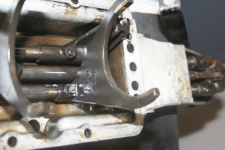
A very interesting discovery. Contrary to better advice, I did take apart my transmission cover, and I did snap off the first of the three tapered setscrews in the shafts. Old subject by now.

See pic below (before the break).

My machine shop was ready to try the next two tapered setscrews when a Jaguar guy stopped in with another issue and saw my cover sitting on the bench with the snapped setscrew.

He said that he'd been told that those tapered setscrews should be removed with an impact driver connected to a socket--not air controlled, but one you hit.

The shop tried it on the other two, and each tapered setscrew was easily removed with no damage. Basically, I'm done and ready now to reassemble.

Just wanted to pass that info along and record that experience here for the next person tackling a transmission and learning as they go. Maybe a coincidence, but my guess is that the hitting/vibration/shock of an impact driver enabled the setscrews to be removed.

Thanks all.
 

Attachments

  • 27781.gif
    27781.gif
    100.4 KB · Views: 232
Well, it was many months. Ordering parts, reading and re-reading the manuals, running off to machine shops, assembling and disassembling, buying new tools, learning some new tricks, and taking all the good advice from this Forum.

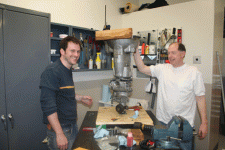
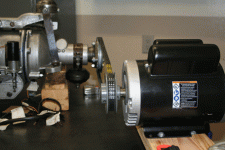
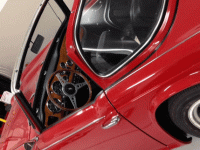
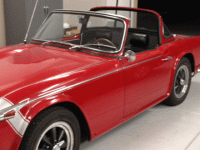
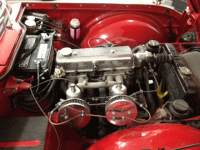
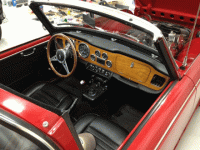
Finally, it's all back together. Runs terrific. I'm posting some pics, not just 'cause I'm so darn proud I could hug myself, but because I haven't shared much in the way of photos, and I think there's a member out there who owns my car's twin sister.

Thanks again, and here are some pics.
 

Attachments

  • 28366.gif
    28366.gif
    84.7 KB · Views: 187
  • 28367.gif
    28367.gif
    86.3 KB · Views: 189
  • 28368.gif
    28368.gif
    91.6 KB · Views: 189
Oh my my, that looks great! You've been holding out on us, more pics please!
 
It's great when something goes back together and it works. ODs are not that easy to work on and get it right. I also see that you got one of those high teck gadgets on the back end of the trans.

Very nice looking car, why is it I've never seen your car around at one of the events, or drives?
 
I'll get to those drives and functions soon. Just been buried trying to attend to all responsibilities. Work on the car is usually between 9:00 PM and 1:00 AM. Can take a toll.

I'll take more (and better)pics. Thanks again for all the help around this place!! I've needed it.

Now I'm tracking down a fuel gauge issue.
 

Attachments

  • 28379.gif
    28379.gif
    102.9 KB · Views: 150
  • 28380.gif
    28380.gif
    94.6 KB · Views: 146
Very nice looking! Are those American Racing Mags and TR6 seats?

That's very similar to what I want to do with my second one. Surrey top with knock-off alloy wheels and a seat of Lucas fog lights in front.

Scott
 
Back
Top