• Hey Guest!
    British Car Forum has been supporting enthusiasts for over 25 years by providing a great place to share our love for British cars. You can support our efforts by upgrading your membership for less than the dues of most car clubs. There are some perks with a member upgrade!

    **Upgrade Now**
    (PS: Upgraded members don't see this banner, nor will you see the Google ads that appear on the site.)
Tips
Tips

TR4/4A I Removed My Overdrive--TR4A

I'm really getting close, but the machine shop has an issue.

The heat trick worked great to remove the speedometer bushing from the OD case in my TR4A. However, there is a small threaded insert that screws into the bushing, and that insert holds the fitting for the speedometer cable.

To prevent this threaded insert part from loosening, and maybe to set some mandatory end float, that threaded part was "pinned" just a bit shy of being tight into the bushing.

Can anyone tell me why it has to be pinned, because my pin broke and I'm wondering (as is the shop) if we really need to have it re-pinned.

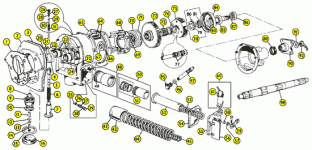
This pin is not shown in the drawing below, but it is a component of part 95.

Thanks for the help.
 

Attachments

  • 27269.gif
    27269.gif
    19.2 KB · Views: 434
I don't have one handy but my thought is that if it was pinned originally then it should be pinned again. It was done for a reason then, that same reason still applies.
Glad the heat worked. I'll bet it didn't take much.
 
Are you sure you mean item 95 (which is the angle drive), rather than item 97 (which is the gear and bearing assembly).

Assuming you mean 97, as I recall the "bearing" is actually made of several separate pieces. The threaded section where the angle drive (or speedo cable on earlier TRs) screws on also has threads that engage with an outer sleeve around the actual bearing. The pins are just to keep the threaded piece from unscrewing from the sleeve, when you remove the angle drive/cable.

But I agree with Jerry, you should probably replace the pins (or drill holes for new ones). Should be an easy thing for a machine shop.

It is possible that the pins helped set the overall length of the bearing assembly, which is moderately important. As I recall, the factory had problems with early assemblies being too short, with the result that the square "shaft" from the angle drive would bottom in the hole, putting pressure on the angle drive and shortening it's life. Item 96 in the above diagram is a spacer that they added, to ensure this didn't happen.

I don't know how likely you are to have that problem, but it wouldn't hurt to double-check that the shaft doesn't bottom in the hole when assembled. I would remove the gear from the bearing, slide it onto the shaft until it bottoms, and measure the overall length. Then reassemble with the bearing in place and check the length again.
 
Call Scott Harper in Warren, OH. I bet he has dozens of good used speedo drives. He's there from around 11:00AM to 5:00PM weekdays only. One of the good guys. And I've always found him to be reasonably priced.
330-3927176
 
Yes, thx, it's 97 not 95. I'll have it re-pinned. Tedious, since it pins right into the threads. The depth of the bushing is set by the set screw. That pin apparently also has some role in controlling the height of the gasket.

I may post some pics for more advice and insight. I'll bet folks can hardly wait!
 
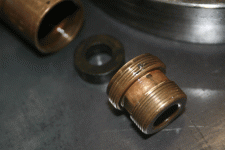
Attached below are some pics of my TR4A Speedo Drive, and showing the sheared pin. We'll put in a new one. Also shown is a rock hard seal we'll replace with a new softer one.

The drive was leaking rather slowly, but over time it was quite noticeable. It's still not clear why the tiny pin was where it was, but my sense is that it was set to be snug with the seal, and for no other purpose. The end of the speedo shaft sits in a slot in the housing and appears to have nominal end play with no effort to be exact. Tightening the top insert does not impact end float, and end float appears to be controlled entirely by the set screw that fits the hole in the bushing. Am I wrong?

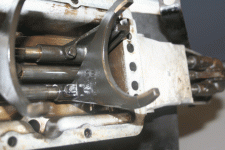
Also shown is my top cover. I'm replacing the seals just as "Twigworker" is doing. Based on what you see, do I need to drill and pull those plugs out, just like Randall and others described? What a hassle that will be. Screws wouldn't have worked when Coventry put all this together? Something doesn't seem right. I believe I may be misreading the posts.

Thanks for the help all!
 

Attachments

  • 27285.gif
    27285.gif
    86.4 KB · Views: 344
  • 27286.gif
    27286.gif
    100.4 KB · Views: 341
I suppose it might be possible to change the shift rail seals without pulling the three plugs; by making up a set of dummy shafts to insert and hold the balls & plungers up in their bores. But that seems like more hassle to me, while pulling the plugs wasn't hard at all. And you'll still have to pull the plugs if you discover that the detents aren't strong enough.

Earlier boxes did use threaded plugs; the change appears to have been a cost-cutting measure. Those threads look expensive, I'll bet they saved a whole 50p per car!

For the threaded adapter, let me pose a thought experiment: with the adapter removed from the bearing assembly, thread the angle drive onto the adapter. Note how the angle drive does not engage the shaft at all. Now thread the adapter into the bearing assembly, with the angle drive still attached. The square piece sticking out from the angle drive goes farther into the shaft the more you turn the adapter into the bearing. If it hits bottom, you have a problem that may not get detected until the (expensive) angle drive is ruined.
Otherwise, I agree, it has nothing to do with the end float of the shaft that carries the gear.

Removing those square headed taper pins can be tricky, too. I suggest finding an 8-point socket that will fit over them, and then using some sort of T-handle or tommy bar, so that you can turn them without applying any kind of side load. They break easily (due to the largish nylon insert in the side), and new ones are nearly $20 each. If you can find them, the early ones were stronger (but need to be safety-wired in place as they don't have the locking insert).

PS, the other option of course is to just leave the whole thing alone. Those old rock-hard seals won't leak TOO much, and if the detents were right 45 years ago, no doubt they are still fine today.
 
Patience, please while I toss out some more questions.

First, I better take those pins out. Otherwise, I will have failed to take the road less traveled.

And it won't violate the "if it ain't broke" rule, since I do have some significant leaking. If leaking on a TR ever equates with "broke."

I've gone this far, I might as well jump all the way in.

You're right about those taper bolts. Moss lists them for about $18.00 (in an old catalog). Mine have no holes for wiring.

That brings up my OD adapter plate. Whoever last worked on my overdrive not only left the planet gear thrust washer out, but also left the four inner bolt heads on the adapter plate with no lock-wiring. I assume I should install some wire? Is that critical? Those bolt head do have holes.

Any specific type of wire? I would not want to learn that regular steel wire will deteriorate and that I should have used stainless steel. Also, I assume any reasonable method of wrapping and twisting will do, and that there is no method of mastery to the job.

Finally, I'm trying now to determine why there was no end float at the annulus shaft, and I assume in that regard that I must re-assemble, press in the new bearings, check, and disassemble, and maybe do it all again, and that there is no other way.

Thanks for all help folks.
 
Were your bolts set up for lock wires on the adapter plate? I think that was an early setup, for a TR3 for example so that is what they show in the manual. But a 4A wouldn't have the wire - my TR4 doesn't.
 
I don't know when the factory quit using safety wire on the bolts holding the adapter to the main gearbox; the factory documentation is curiously silent on that point (I couldn't even find a listing for the bolts). But TRF claims the non-wired bolts were special "wedglok" bolts; probably with a nylon insert in the threads like the later taper pins.

Loctite would probably work, but mine have safety wire.

Unfortunately there is a special wire (soft 304 stainless), and special pliers, and something of a skill in combining the two. Ordinary steel wire might be OK, but it can sometimes vibrate enough to eventually break, and I won't risk it. The good news is that the pliers are only about $10 @ Harbor Freight; and Aircraft Spruce sells safety wire in small 25' spools for just $1.25. Or you can get a whole pound (likely a lifetime supply) for $8.
 
I'm not sure how the bolts were intended to be used, but they are the kind with wiring holes in the bolt head. I can't see that it would hurt to wire them, but if there's a trick to it, I'd sure like to see a Link. Like Randall indicates, there could be issues or problems, like vibration.

thx
 
Keeping this thread alive just a bit longer:

What about that accumulator piston? I'm a bit afraid to remove it to check it. I think mine is the old type with a steel ring.

Will I be able to get it back in? I note that the ring apparently is no longer available.

thx
 
I think it is actually 2 or 3 rings, can't remember exactly. And I'd pull it if I were you. It will go back, just takes a gentle touch, you don't need anything like a piston spring compressor. And best of all, they are still available - I bought mine from Overdrive Repair Services in the UK (but they aren't that cheap unfortunately).
 
Let me try to restate what I've learned about the theory of the OD from all of the comments and assistance in the posts above:

The turning of the output shaft of the transmission turns the eccentric bearing which operates the OD pump. That pump produces oil pressure in the accumulator piston cavity, reaching about 450 PSI, and maintains it at the level, but with a relief valve which is the non-return valve.

When the OD switch is activated, the Operating Valve is raised slightly, allowing pressure to escape through the hole in the side of the valve, and that pressure translates to the two operating pistons which push the thrust ring assembly to the rear, causing the sun gear to engage with the annulus and produce the increased rotations per RPM.

I would imagine that the pistons are held in that position by the oil pressure being maintained, which would mean that the OD pump is at the heart of the entire process.

If I have all this straight, that little hole in the operating valve is also critical, and there must be some finely designed galley or channel in the aluminum OD casting that accommodates the pressure from the pump and accumulator piston.

Do I have this generally correct?
 
KVH said:
The turning of the output shaft of the transmission turns the eccentric bearing which operates the OD pump. That pump produces oil pressure in the accumulator piston cavity, reaching about 450 PSI, and maintains it at the level, but with a relief valve
Check
<div class="ubbcode-block"><div class="ubbcode-header">Quote:] which is the non-return valve.[/QUOTE]
No, the relief valve is formed by a series of holes in the side of the accumulator bore. When the pressure starts to rise too high, the accumulator piston compresses the big spring further, and uncovers the holes, which lets some of the oil out.
The "non-return" valve is what keeps the oil from flowing back into the pump when the piston is moving downward.
<div class="ubbcode-block"><div class="ubbcode-header">Quote:]
When the OD switch is activated, the Operating Valve is raised slightly, allowing pressure to escape through the hole in the side of the valve, and that pressure translates to the two operating pistons
[/QUOTE]
Check
<div class="ubbcode-block"><div class="ubbcode-header">Quote:] which push the thrust ring assembly to the rear, causing the sun gear to engage with the annulus and produce the increased rotations per RPM.[/QUOTE]
Not quite. The operating pistons actually move the ring forward, and it is the tapered clutch surfaces that engage. The gears remain engaged at all times. For overdrive, the clutch comes up against the brake ring, which stops the sun gear from turning, and forces the annulus to turn faster than the planetary gear carrier.
<div class="ubbcode-block"><div class="ubbcode-header">Quote:]I would imagine that the pistons are held in that position by the oil pressure being maintained, which would mean that the OD pump is at the heart of the entire process.

If I have all this straight, that little hole in the operating valve is also critical, and there must be some finely designed galley or channel in the aluminum OD casting that accommodates the pressure from the pump and accumulator piston.

Do I have this generally correct?

[/QUOTE]
That part is all correct. This is also why checking the pressure under various conditions is important.

Is it just me, or is the BCF server unusually cranky tonight? It's never all that smooth for me, but I am having to retry dozens of times to get a screen update.
 
KVH said:
What about that accumulator piston? I'm a bit afraid to remove it to check it. I think mine is the old type with a steel ring.
They were all steel (actually cast iron I believe). If you have IRS, then you should have the later type, where the smaller accumulator piston runs in a separate housing (which in turn seals to the bore in the main casting with an O-ring).

IMO removing it is required, since you've had a failure and you need to clean up any bits of ground-up metal. Most likely the rings are fine, but I note TRF has both types listed as available.

For the early type, the bore has a tapered section, which works very nicely as a ring compressor. Just use the same chunk of all-thread that you used to pull the piston out, and gently tap it back into place.
I forget the details for the later type offhand, but the piston goes into the housing and then the housing goes into the bore.
 
I pulled the OD pump. It was so tight in the casting that I actually bent a 1/4 inch strap iron piece I was using with an all-thread bar as a makeshift puller. Hopefully the threads in the pump housing are OK.

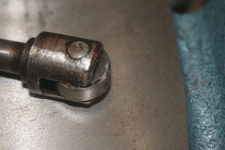
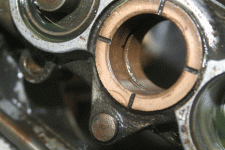
I need some advice on two things I found. The pictures are below. First, that roller is chipped, and it appears the PO must not have put the OD back together very skillfully, because the roller also looks like it rubbed against the brass pressed bushing.


I'm inclined to ignore both issues because the roller is fairly smooth, and the chipped part is to the outer edge, though it may contact the eccentric cam somewhat. The second picture does make it look bad, but part of that is due to the glare of the flash.

A new plunger which hopefully comes with the roller is $104.00 which is OK, but I'm not sure I need one.

As for the pressed brass bushing, I don't even see that as being available from Moss or the others, and with a magnifying glass I'm certain the marring on the bushing is just a bit more than skin deep.

Any opinions welcome.

Thanks
 

Attachments

  • 27329.gif
    27329.gif
    94.8 KB · Views: 287
  • 27330.gif
    27330.gif
    94 KB · Views: 289
  • 27331.gif
    27331.gif
    84 KB · Views: 287
Other than checking that the plunger isn't bent I'd ignore both.
 
Wow. I am amazed at what some people do when assembling overdrives. That damage ranks right up with the gorilla that beat on my J-type until he broke the rear housing!
There is normally a fair amount of clearance between the roller & the bushing; instead the flat part of the plunger rides on that metal button visible below the bushing. Obviously, someone put it together without holding the plunger down and it got caught on the cam. So they kept cranking down until it first forced the roller up against the bushing, and then broke the roller.

This OD was working, at least for awhile, correct? What does the cam look like? If it has been up to pressure and the cam isn't showing any damage from the chip, then I agree with Randy. Check that the plunger still moves freely in the pump and try it.

The bushing is supposedly not field-replaceable. New ones have to be bored concentric to the shaft, which requires either a special tool or a big milling machine. But that definitely is not enough damage on it to worry about. That face doesn't really take any force at all, just the pump cam wandering about a bit.
 
Back
Top