• Hey Guest!
    British Car Forum has been supporting enthusiasts for over 25 years by providing a great place to share our love for British cars. You can support our efforts by upgrading your membership for less than the dues of most car clubs. There are some perks with a member upgrade!

    **Upgrade Now**
    (PS: Upgraded members don't see this banner, nor will you see the Google ads that appear on the site.)

TR4/4A Vapor lock????

The most insidious thing is a fuel hose that has swelled internally.Always use fuel injection grade
hoses.Todays gas is crap ,and destroys the made in china regular hoses. The hose at the tank
will give you just a dribble at the pump if this is the case.
Even worse is a leaf from a big tree(sycamore ) that floats about randomly stopping fuel.
This causes multiple changes of fuel pumps for the next 10 years.........
Mad dog
 
Possible clog in the fuel system. My TR 3 did just that. The line from the tank to the pump had a partially collapsed section and fine grit from a rusting tank would collect and prevent fuel from passing. After sitting and the relief of suctioning the fuel in the line cleared and the car ran until the grit gathered again. New fuel line, no problem. Now the grit is getting collected by the filter in the pump and an in-line filter.
 
Possible clog in the fuel system. My TR 3 did just that. The line from the tank to the pump had a partially collapsed section and fine grit from a rusting tank would collect and prevent fuel from passing. After sitting and the relief of suctioning the fuel in the line cleared and the car ran until the grit gathered again. New fuel line, no problem. Now the grit is getting collected by the filter in the pump and an in-line filter.
Thanks
 
IMG_4802.jpeg
I had weird fuel delivery issues and I put an airline on the fuel pipe from the pump to the tank. The pressure rose then just gave as if a blockage had cleared.
Drove ok for a bit then returned.

I checked the pipe work and some PO had put a rubber pipe to join the metal pipes from the tank the join was about the position of the front of the rear wheel.
See the attached plan.
Swapped it out and cured all my fuelling issues as the pipe had degraded inside. In just the shorted gap between the 2 metal pipe ends.
 
3-4 miles is not enough heat to cause cavitation. It is enough to heat a dodgy capacitor to failure. Re-starting after a cool-down is classic capacitor failure. See if you can find one that is not made of Chinesium.
 
Have you fixed the problem? If not, I know we all have our stories. But if you chug, miss, then stall, and you’ve tried all the standard, obvious things, like plugs, points, fuel, timing, and capacitor, you might give some thought to the elusive problem I had and discovered months and months after I first started hunting for it.

It was this—a fuel pump (a new one in my case) putting out nearly twice the factory recommended pressure of 1.5 to 2.5 psi. Seriously, I was at 3.9 psi and suffered constant stalling due to flooding. Everyone kept saying “vapor lock,” but no way. The problem was that pump. I installed a pressure regulator/reducer and my TR runs better than ever, and stalling is a distant memory. Makes me want to ask if you installed a new pump that could be the culprit, though an older pump could pose the same problem.

A cheap gauge from Harbor Freight can help you check. You can disconnect the fuel line at Carb No. 1 and clamp that gauge into place in less than five minutes. But while using it, don’t let it hang or dangle anywhere near the fan or fan belt. Just warning. . .
 
Last edited:
Check your low tension lead on the coil. Vibration from engine can compromise the wire connection right at the female connector. When issue first manifest's itself, it is fine on cold engine. Heat exacerbates the problem. When hot, the motor will begin to mis-fire under load. Then mis-fire regularly. Then completely die. It's as if someone turns the ignition key off. I experienced this a few years ago. The issue progressed over several months before I could diagnose it.

Just a thought. If that is the issue, it's a $0.10 fix

Bob
 
Thanks Bob, I am going to check fuel pressure and see if maybe it is to high and finally flooding out. There is no misfire, it just kind of sounds like you are running out of gas and dies.
 
Have you fixed the problem? If not, I know we all have our stories. But if you chug, miss, then stall, and you’ve tried all the standard, obvious things, like plugs, points, fuel, timing, and capacitor, you might give some thought to the elusive problem I had and discovered months and months after I first started hunting for it.

It was this—a fuel pump (a new one in my case) putting out nearly twice the factory recommended pressure of 1.5 to 2.5 psi. Seriously, I was at 3.9 psi and suffered constant stalling due to flooding. Everyone kept saying “vapor lock,” but no way. The problem was that pump. I installed a pressure regulator/reducer and my TR runs better than ever, and stalling is a distant memory. Makes me want to ask if you installed a new pump that could be the culprit, though an older pump could pose the same problem.

A cheap gauge from Harbor Freight can help you check. You can disconnect the fuel line at Carb No. 1 and clamp that gauge into place in less than five minutes. But while using it, don’t let it hang or dangle anywhere near the fan or fan belt. Just warning. . .
Thanks KVH I bought a pressure gauge and I am going to check. I hope that is it, should be easy fix if it is.
 
Usually when my Land Cruiser fuel filter was plugged (rust in the tank) and it was starving for fuel, it would loose power, and buck, and spit and backfire as the mixture got leaner & leaner.

Yours sounds different to me.

Is there a rubber line before the carbs? Clamp it off, and demonstrate what “running out of gas” sounds like in your neighborhood (close to home) so you can be sure the symptoms are the same…
 
Thanks KVH I bought a pressure gauge and I am going to check. I hope that is it, should be easy fix if it is.
Couple of things. It’s best to run the engine with the gauge set up, but if your pump has the manual primer lever, you’ll get a preview by trying that, though your fuel bowls, of course, will need to fill up first. The spare rubber hoses that come with the Harbor Freight gauge work fine but you might need some extra 1/4” rubber hose depending on where your steel line ends. Mine was easy, because my steel line was only about 6 inches from carb No. 1. You won’t need any of those other silly looking fittings. Just go with hose and small clamps. You may need a little lithium grease to avoid the hoses binding.

I totally ignored the instructions that say to attach the gauge down near the fuel pump. What a nightmare that would’ve been. They only say that because they’re assuming, like for most cars, your line from there is rubber fuel line that will distort the reading, but on a TR4, as you know, it’s all steel to the carb, except for the short run at the end, so the gauge can go right there and it will work fine. Just keep it away from the fan belt, fan and generator. It’s easy to set up out of the way. The entire testing, hose clamps and all, might take ten minutes. It’s simple. But read the gauge properly. Look only at the fuel pressure read-out scale.

If you’re above 2.5 I’d be concerned. Mine was 3.9. A disaster on the road.

If yours is high, you might do what I did. I did not want to buy and test new pumps, nor did I want to play with the internal pump spring to find a balance. Instead, I installed a pressure regulator and it has worked like a dream. If it comes to that, I can give you the run-down and exactly how and where to install it.

Good luck.

 
Couple of things. It’s best to run the engine with the gauge set up, but if your pump has the manual primer lever, you’ll get a preview by trying that, though your fuel bowls, of course, will need to fill up first. The spare rubber hoses that come with the Harbor Freight gauge work fine but you might need some extra 1/4” rubber hose depending on where your steel lie ends. Mine was easy, because my steel line was only about 6 inches from carb No. 1. You won’t need any of those other silly looking fittings. Just go with hose and small clamps. You may need a little lithium grease to avoid the hoses binding.

I totally ignored the instructions that say to attach the gauge down near the fuel pump. What a nightmare that would’ve been. They only say that because they’re assuming, like for most cars, your line from there is rubber fuel line that will distort the reading, but on a TR4, as you know, it’s all steel to the carb, except for the short run at the end, so the gauge can go right there and it will work fine. Just keep it away from the fan belt, fan and generator. It’s easy to set up out of the way. The entire testing, hose clamps and all, might take ten minutes. It’s simple. But read the gauge properly. Look only at the fuel pressure read-out scale.

If you’re above 2.5 I’d be concerned. Mine was 3.9. A disaster on the road.

If yours is high, you might do what I did. I did not want to buy and test new pumps, nor did I want to play with the internal pump spring to find a balance. Instead, I installed a pressure regulator and it has worked like a dream. If it comes to that, I can give you the run-down and exactly how and where to install it.

Good luck.
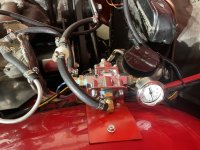
Thanks KVH for the info. My TR4 already has a regulator so I will be hooking gauge to it. Sounds like you have a lot of knowledge on TR4s, so this probably won't be the last time I need your help.
Thanks,
Jim
 
Back
Top