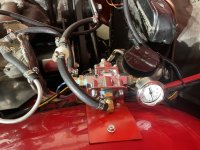
Couple of things. It’s best to run the engine with the gauge set up, but if your pump has the manual primer lever, you’ll get a preview by trying that, though your fuel bowls, of course, will need to fill up first. The spare rubber hoses that come with the Harbor Freight gauge work fine but you might need some extra 1/4” rubber hose depending on where your steel lie ends. Mine was easy, because my steel line was only about 6 inches from carb No. 1. You won’t need any of those other silly looking fittings. Just go with hose and small clamps. You may need a little lithium grease to avoid the hoses binding.
I totally ignored the instructions that say to attach the gauge down near the fuel pump. What a nightmare that would’ve been. They only say that because they’re assuming, like for most cars, your line from there is rubber fuel line that will distort the reading, but on a TR4, as you know, it’s all steel to the carb, except for the short run at the end, so the gauge can go right there and it will work fine. Just keep it away from the fan belt, fan and generator. It’s easy to set up out of the way. The entire testing, hose clamps and all, might take ten minutes. It’s simple. But read the gauge properly. Look only at the fuel pressure read-out scale.
If you’re above 2.5 I’d be concerned. Mine was 3.9. A disaster on the road.
If yours is high, you might do what I did. I did not want to buy and test new pumps, nor did I want to play with the internal pump spring to find a balance. Instead, I installed a pressure regulator and it has worked like a dream. If it comes to that, I can give you the run-down and exactly how and where to install it.
Good luck.


 Hey Guest!