• Hey Guest!
    British Car Forum has been supporting enthusiasts for over 25 years by providing a great place to share our love for British cars. You can support our efforts by upgrading your membership for less than the dues of most car clubs. There are some perks with a member upgrade!

    **Upgrade Now**
    (PS: Upgraded members don't see this banner, nor will you see the Google ads that appear on the site.)
Tips
Tips

Ultra-rich Fuel Mixture and Flooding Inlet Manifold Drains

Walter--

In your initial post you said you "recently revised" the engine. Were any of those revisions related to the fuel system?
Have you actually fitted the fuel pressure regulator and if so what did it read when you decided "it did not solve the issue"?
Did you try to adjust the pressure down and if so what was the result?
Have you followed Red's suggestion of checking the fuel level at the jet bridge?
Have you considered fitting an SU pump?
 
All the suggestions sound good, but if you think there might be any debris in the carbs at all, you could try flushing them out. disconnect the fuel lines and run the engine until you burn all the fuel in the carbs and the engine dies. Then squirt a can of carb cleaner into the carbs and lightly tap a wrench on the bottom of the float bowls. The vibrations should free up anything sticking. You can also try blowing a little compressed air into the carbs (20lbs pressure or so). Reconnect everything, start it up and see if it improves. I had to do it twice before everything on my strombergs loosened up.
 
Walter--

In your initial post you said you "recently revised" the engine. Were any of those revisions related to the fuel system?
Have you actually fitted the fuel pressure regulator and if so what did it read when you decided "it did not solve the issue"?
Did you try to adjust the pressure down and if so what was the result?
Have you followed Red's suggestion of checking the fuel level at the jet bridge?
Have you considered fitting an SU pump?
i installed a revision kit on the carbs and changed the old fuel filter with a new one. Also all fuel hoses have been replaced.
I fitted the pressure regulator and regulated back to 2 psi there was still dripping fuel from the inlet manifold drain and the mixture was ultra rich. Fuel level at bridge was not visible in jet.
 
All the suggestions sound good, but if you think there might be any debris in the carbs at all, you could try flushing them out. disconnect the fuel lines and run the engine until you burn all the fuel in the carbs and the engine dies. Then squirt a can of carb cleaner into the carbs and lightly tap a wrench on the bottom of the float bowls. The vibrations should free up anything sticking. You can also try blowing a little compressed air into the carbs (20lbs pressure or so). Reconnect everything, start it up and see if it improves. I had to do it twice before everything on my strombergs loosened
I disaasembled both carbs and cleaned every single part, but i will try this method just to see if it helps.
 
i installed a revision kit on the carbs and changed the old fuel filter with a new one. Also all fuel hoses have been replaced.
I fitted the pressure regulator and regulated back to 2 psi there was still dripping fuel from the inlet manifold drain and the mixture was ultra rich. Fuel level at bridge was not visible in jet.
Hi Walter--

Thank you for you reply. Mixture and fuel level are separate issues but putting mixture aside for the moment I am at a loss to understand how, if you are making this observation with the ignition on and the pump is energized, fuel can be escaping from the manifold drains and yet not be visible at the bridge.
 
Since nothing else seems to have an effect I'll throw a couple SWAGs out. Since the problem appears to be with both carbs, I'd want to take a close look at the float valve installations. With needle valves, I've always been concerned that if the float lever isn't 'just so;' i.e. perfectly flat between the hinge and the spoons on the end the needles could get cocked sideways in the valve body and not close completely (if the hinge isn't set correctly the floats could drop far enough to cause this). Also, since needle valves are spring loaded there's some possible difference in setting; i.e. did you set the correct angle of the levers (516" on some cars; 7/16" on others IIRC)? The flat part of the levers generally end up parallel to the lips of the float bowls. Was the depth set with the damper spring compressed, or not? I've never seen an official explanation of why there are springs in the needles, but eventually came to the conclusion that they are used to damp the bouncing of the float bowls to smooth fuel flow. Therefore, I've always set the depth with the springs compressed, since fuel flow won't stop until the springs are compressed and the needle seats are seated.

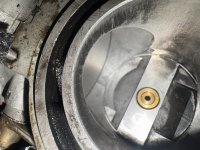
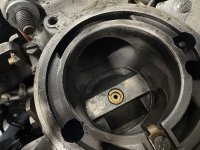
Other than that, we really need to see photos of the jets in the bridge--dashpots removed, of course--with pump running so we can see the depth of the jets in the bridge and the fuel level. With a stuck 'choke'--jets stuck in the lowered position--the fuel level could be above the top of the jets, and you would get flooding.
 
Jets are approx 1.5mm below bridge. Fuel is not visible with pump running.
 

Attachments

  • IMG_2054.jpeg
    IMG_2054.jpeg
    2.4 MB · Views: 36
  • IMG_2053.jpeg
    IMG_2053.jpeg
    2.8 MB · Views: 35
Walter--

I keep wondering if this is partly a matter of terminology. When you say "drain pipes" are you referring to the two pipes that lead from the inlet manifold (parts nos. 32 on page 17 of the Moss catalogue) or are you describing the overflow pipes coming from the top of each float bowl lid (parts nos. 39 on page 30)?
 
Hard to tell with resolution, parallax, etc. but first pic shows a jet that appears to be a bit oblonged. Second pic shows an irregular-shaped jet orifice. Neither appears to be properly centered in their sleeve; however, I don't think that's the cause of your issues (but could cause fine-tuning issues). Jet in second pic appears to be somewhat lower than other. How did you center the jets?
 
I mean the drains leading from the inlet manifold and not from the top of the float bowls. The drains at the top of the float bowl are dry. The drains from the inlet manifold only leak when engine is running.
Walter--

I keep wondering if this is partly a matter of terminology. When you say "drain pipes" are you referring to the two pipes that lead from the inlet manifold (parts nos. 32 on page 17 of the Moss catalogue) or are you describing the overflow pipes coming from the top of each float bowl lid (parts nos. 39 on page
 
Hard to tell with resolution, parallax, etc. but first pic shows a jet that appears to be a bit oblonged. Second pic shows an irregular-shaped jet orifice. Neither appears to be properly centered in their sleeve; however, I don't think that's the cause of your issues (but could cause fine-tuning issues). Jet in second pic appears to be somewhat lower than other. How did you center the jets?
The centering was done as described in the manual. Both pistons fall on the bridge with a clear click.
 
Need to ask: Are there drain pipes connected to the inlet manifold and if so, do their lengths reach about 7 centimeters (3 inches) past the lip of the oil pan? Also, if installed, are the drain pipes shaped into a slow "Z" configuration. Without drain pipes, a massive vacuum leak will result or similarly if lengths are too short.
 
Is It Bigger Than A Breadbox?
 
Need to ask: Are there drain pipes connected to the inlet manifold and if so, do their lengths reach about 7 centimeters (3 inches) past the lip of the oil pan? Also, if installed, are the drain pipes shaped into a slow "Z" configuration. Without drain pipes, a massive vacuum leak will result or similarly if lengths are too short.
Yes, drain pipes are installed just as you describe
 
As I am really desperate, I ordered new jets, jet bearings, floats and float needles. I cannot figure out anything other than these components.
 
Hi again, at the start of this thread you said that the drains were pouring fuel when running at idle. With the ignition on and the engine stopped, are the drains still pouring fuel or does the pump stop? If the pump stops your problem is not in the float bowls.
 
Back
Top