

-
 Hey Guest!
British Car Forum has been supporting enthusiasts for over 25 years by providing a great place to share our love for British cars. You can support our efforts by upgrading your membership for less than the dues of most car clubs. There are some perks with a member upgrade!**Upgrade Now**
(PS: Upgraded members don't see this banner, nor will you see the Google ads that appear on the site.)
You are using an out of date browser. It may not display this or other websites correctly.
You should upgrade or use an alternative browser.
You should upgrade or use an alternative browser.
Very happy to see these inner fenders
- Thread starter Brosky
- Start date

Silverghost
Yoda
Offline
That's interesting - two different cars with identical finishes behind the fenders. Does anyone know how the factory was set up? Is there any chance the chassis were dipped up to that level in some rust proofing solution perhaps?


OP

Brosky
Great Pumpkin
Offline
<div class="ubbcode-block"><div class="ubbcode-header">Quote:]Were the BL engineers going out of their way to find ways to make the cars rust?[/QUOTE]
Rich,
I believe that the unspoken automotive corporate terminology of the 60-70's was "Planned Obsolescence".
i.e., the oxymoron created by the term "rustproofing" as being representative of most of the poor, or poorly applied products of that era.
Rich,
I believe that the unspoken automotive corporate terminology of the 60-70's was "Planned Obsolescence".
i.e., the oxymoron created by the term "rustproofing" as being representative of most of the poor, or poorly applied products of that era.
G
Guest
Guest
Guest
Offline
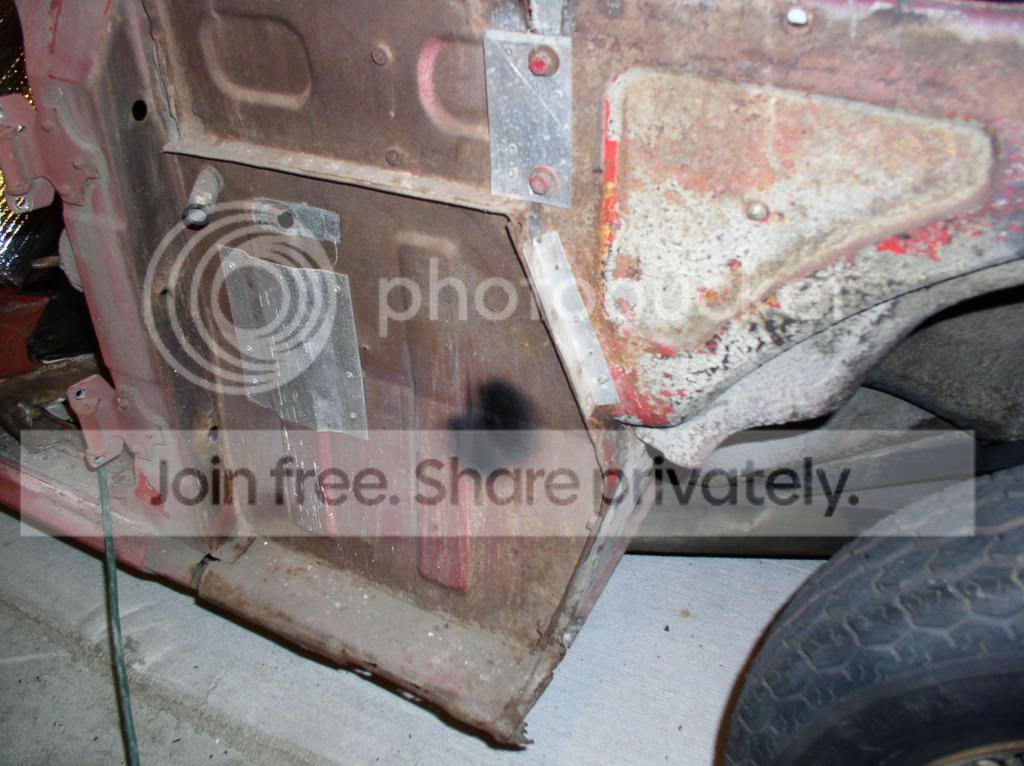
tdskip said:Design flaw!
And this is on a California car.
Also notice the two tone 'water mark' here as well.

tdskip, do you have a picture of the passenger side too?
.
G
Guest
Guest
Guest
Offline
Looks like someone cut for speakers that they put in the kick panels. Thanks for the picture.


G
Guest
Guest
Guest
Offline
Everybody's car seems to have the same "high water marks" on the inner fenders, so I'll speculate that they did indeed coat the bottom halves of the inner fender primer with a rust prohibitive coating. I also am going to agree with what TR6oldtimer says, you aren't going to jury rig anything to keep the water from the channel between your hood and your wiper box sill out. Water will still run down those inner fenders. At the factory they knew water was going to drain in there anyway so the fresh air vent also drains in there with those hoses as short as possible. The longer the drain hoses from your fresh air vent, the more apt for some leaves or debris to accumulate and clog them up. I would keep longer hoses as straight down as possible and back flow them with compressed air once in a while if you plan on driving your car in any foul or Autumn (leave falling) weather.
I still can't believe that a California car rusted through with 2 large round holes on both inner fenders half the way down a somewhat straight panel, but a Buffalo, NY car driven all year round didn't.
.
I still can't believe that a California car rusted through with 2 large round holes on both inner fenders half the way down a somewhat straight panel, but a Buffalo, NY car driven all year round didn't.
.
Hmmm, all the joints at various spots of the fender to inner and body were sealed with a sealant compound. This stuff was quite hard and I speculate original my fenders had never been off. With these seal this was there would not be a point of entry for water except the hoses and around the splashshield seal.
I used a more flexible seam sealant to close these back up again.
I used a more flexible seam sealant to close these back up again.
swift6 said:I wouldn't call it a design flaw. These cars have lived long past the initially intended and designed purposes. If they caused a problem while still "young" you could call it a desin flaw. But not after 32 plus years.
Fair point...
OP
Brosky
Great Pumpkin
Offline
Shawn,
I feel that any design engineer or manufacturer who would intentionally drain water (possibly with a caustic salt mixture) from one sealed area into another sealed area without having a proper second drain to clear that area, has a created a definite design flaw. Just because the cars have been lucky enough to make it this long, in spite of that is another story.
No matter how you cut it, it was just plain dumb to do this type of thing.
I feel that any design engineer or manufacturer who would intentionally drain water (possibly with a caustic salt mixture) from one sealed area into another sealed area without having a proper second drain to clear that area, has a created a definite design flaw. Just because the cars have been lucky enough to make it this long, in spite of that is another story.
No matter how you cut it, it was just plain dumb to do this type of thing.

swift6
Yoda
Offline
Paul,
There is a secondary drain system in the design. At the bottom of the inner fender, where the outer and inner meet, there should be slots that allow for drainage out of that cavity. The slots are small, can be easily overlooked and can be overwhelmed in downpours or car washes, making it take time to drain. Your doors should have similar slots in the bottom of them. It is common however for these slots to plug up with debris and either slow the drainage or stop it completely. That is when they rust out. Especially when the seal on the inner fender panel wears out and allows the debris from tires thrown back onto the inner fender to get into that area and plug it all up.
Many auto manufacturers used a similar drainage system for the scuttle area. You can find similar applications on many Fords, Jaguars, Volvo's etc...
I guess you need to specify what you mean by a "proper" second drain. Designers would not want it obvious as it would most likely be an eyesore. There had to be some method to the madness as it was used by several manufacturers.
There is a secondary drain system in the design. At the bottom of the inner fender, where the outer and inner meet, there should be slots that allow for drainage out of that cavity. The slots are small, can be easily overlooked and can be overwhelmed in downpours or car washes, making it take time to drain. Your doors should have similar slots in the bottom of them. It is common however for these slots to plug up with debris and either slow the drainage or stop it completely. That is when they rust out. Especially when the seal on the inner fender panel wears out and allows the debris from tires thrown back onto the inner fender to get into that area and plug it all up.
Many auto manufacturers used a similar drainage system for the scuttle area. You can find similar applications on many Fords, Jaguars, Volvo's etc...
I guess you need to specify what you mean by a "proper" second drain. Designers would not want it obvious as it would most likely be an eyesore. There had to be some method to the madness as it was used by several manufacturers.
OP
Brosky
Great Pumpkin
Offline
Shawn,
I agree that the doors are discreetly, but properly drained by the hidden slots.
My inner fender seals were still very pliable and live, but I'm sure that's an exception to the rule. I think that I know where you mean between the fender and the inner panel shown on Tom's picture above and if so, that is indeed very small, or close for lack of a better definition.
I'm still going to think about the draining and how to improve it, without making a major project out of it, but I'll wait until I see how the fenders will hang and what that clearance at the bottom will be.
More to follow next week.
I agree that the doors are discreetly, but properly drained by the hidden slots.
My inner fender seals were still very pliable and live, but I'm sure that's an exception to the rule. I think that I know where you mean between the fender and the inner panel shown on Tom's picture above and if so, that is indeed very small, or close for lack of a better definition.
I'm still going to think about the draining and how to improve it, without making a major project out of it, but I'll wait until I see how the fenders will hang and what that clearance at the bottom will be.
More to follow next week.
R
RonMacPherson
Guest
Guest
Offline
Honda and Acura used a drain hose, in the trunk, etc. with kind of a flapper valve which let the water out, but not in. It looks like someone(which they probably did) mold the hose ending where it becomes two sided and the two sides meet together.. Head for Honda/Acura dealer and ask the parts person to look in their parts fiche, you will find what I am talking about. I know they used this from the 70's through the early 90's..

TR6oldtimer
Darth Vader
Offline
IMO, the biggest problem with the design, which goes back to the TR4's, is the lack of protective paint in this area, as well as the extensive use of seam sealers and putty to seal holes in the body parts. If they simply had sprayed an enamel over the sealers and primer here and behind the fenders, this problem would not have been nearly as bad as it is 30-40 years later.
Thirty plus years, that is well beyond the design life for these vehicles. The amazing thing is there are still a lot of them around.
Thirty plus years, that is well beyond the design life for these vehicles. The amazing thing is there are still a lot of them around.