 but were afraid to ask:
 In my experience I have had several "new" parts which hove not performed properly in service as others have suggested. From the discussion, it seems the carb floats are not controlling the fuel level in the carburetor's fuel supply properly. I would suspect (1) float failure (2) float to needle adjustment, or (3) the needle to seat is fowling so it is not shutting off the flow when the float is full up. Carburetor floats are normally quite reliable, but they can fail in service also. All it takes is a pin hole leak. lf I experienced your situation, I would remove the problem carb(s) and go through the needle and float assemblies meticulously. Make certain everything is clean and everything operates freely. Check the float for leakage (any is unacceptable), check the vents, check the needle setting to be certain the needle is seated fully when the float is raised to the full position. I typically use a blow hose pressurized by mouth to be certain the needle is fully seated and not leaking any air. If everything inside checks out, reassemble the carb(s) on the bench, invert the carb and use the mouth blow hose again to see if there is any air leak by. If so, the float is hanging. That would mean the float is hanging on something and is not freely operating. It could be bent in the hinge, simply the wrong float for the carb, or an impingement somewhere inside the carb float bowl.


-
 Hey Guest!
British Car Forum has been supporting enthusiasts for over 25 years by providing a great place to share our love for British cars. You can support our efforts by upgrading your membership for less than the dues of most car clubs. There are some perks with a member upgrade!**Upgrade Now**
(PS: Upgraded members don't see this banner, nor will you see the Google ads that appear on the site.)

Tips
- We have a special forum called "Member Articles" where you can submit actual articles for consideration for publication. Learn More
- Don't have an Avatar? If not, your avatar will default to the 1st character in your username. Go into "Account Details" to change your Avatar.
- Some basic forum navigation info: click
 Hey - did you know if you click on the title of a thread it will take you to the first unread post since you last visited that thread?
- Hey Guest - Is your British Car Club in our Clubs database? If not, send me a PM - Basil

- Looking for a local club? Click the "Clubs" tab above and browse hundreds of clubs world-wide.
- Add Android or iPhone APP: click
- Did you know - any picture or video you add in your posts in any marque-specific forum will also get added to the Media Gallery automatically.
- A few more tips about posting and replying: click
- Hey there Guest - be sure to keep your profile page up to date with interesting info about yourself: learn more
- More tips and tricks on Posting and Replying: click
 STOP!! Never post your email address in open forums. Bots can "harvest" your email! If you must share your email use a Private Message or use the
  smilie in place of the real @
- Want to mention another member in a post & get their attention? WATCH THIS

- So, you created a "Group" here at BCF and would like to invite other members to join? Watch this!
- Hey Guest - A post a day keeps Basil from visiting you in the small hours and putting a bat up your nightdress!
- Hey Guest - do you know of an upcoming British car event?
 Pretty Please - add it to our Events forum(s) and add to the calendar! >> Here's How <<
- Hey Guest - you be stylin' Change the look and feel of the forum to fit your taste. Check it out
- If you run across an inappropriate post, for example a post that breaks our rules or looks like it might be spam, you can report the post to the moderators: Learn More
- If you would like to try some different "looks" or styles for the site, scroll to the very bottom, on the left and click the Style Selector.
You are using an out of date browser. It may not display this or other websites correctly.
You should upgrade or use an alternative browser.
You should upgrade or use an alternative browser.
Ultra-rich Fuel Mixture and Flooding Inlet Manifold Drains
- Thread starter Walter74
- Start date

Bob_Spidell
Yoda

Offline
This just came through my FB scroll from 'Dr. Carburetor Alan Vinegar' and is, perhaps, germane to the discussion:
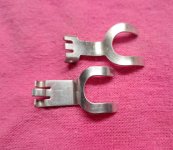
"Not all float bowl lids are the same. Most HD8s use a taller lid and the pedestals inside are taller. As a result the float forks is different as seen in the picture. The previous rebuilder did some nasty bends to the fork and using Grose jets miraculously it worked. I picked up the correct forks from Autofarm who specializes in Healey Parts."
"Not all float bowl lids are the same. Most HD8s use a taller lid and the pedestals inside are taller. As a result the float forks is different as seen in the picture. The previous rebuilder did some nasty bends to the fork and using Grose jets miraculously it worked. I picked up the correct forks from Autofarm who specializes in Healey Parts."
Attachments


Offline
If you have the HD type of carbs, you probably only need the jet diaphragms changed. They are a rubber material and crack causing gas to escape through them.

Offline
Does this happen with the choke on, off or both?

Offline
Walter--
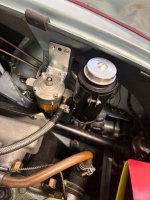
Reviewing the posts I see from #24 that you added a fuel pressure regulator which I believe you set to 2 psi and that did not help. What kind of fuel pump are you using and can you send a picture showing where/how the fuel pressure regulator is installed?
This topic/problem sure has legs!
Reviewing the posts I see from #24 that you added a fuel pressure regulator which I believe you set to 2 psi and that did not help. What kind of fuel pump are you using and can you send a picture showing where/how the fuel pressure regulator is installed?
This topic/problem sure has legs!
OP

Walter74
Senior Member

Offline
I have the choke cables completely disconnected.Does this happen with the choke on, off or both?
OP
Walter74
Senior Member
Offline
The pump is a Pierburg 06t289. Attached you can find a picture of the Filter King regulator installed and set at 2PsiWalter--
Reviewing the posts I see from #24 that you added a fuel pressure regulator which I believe you set to 2 psi and that did not help. What kind of fuel pump are you using and can you send a picture showing where/how the fuel pressure regulator is installed?
This topic/problem sure has legs!
Attachments
Offline
Walter--
At this point if this were my car I would remove the Pierburg fuel pump and install an SU.
In any case I hope you eventually get this problem solved and when you do let us know what was the issue and the fix.
At this point if this were my car I would remove the Pierburg fuel pump and install an SU.
In any case I hope you eventually get this problem solved and when you do let us know what was the issue and the fix.
Offline
Walter--
Did you ever solve your problem?
Did you ever solve your problem?
When I restored my BJ8 several years ago, we had a similar problem. It turned out that several years earlier not long after I had purchased the car, a Healey shop in southern California had put larger jets in my carbs (this was around 1970). When we rebuilt the carbs several years later (around 2005), the standard needle was installed and too much gas was getting into the manifold. Usually caused flooding and it took a while to figure it out that we needed the standard jets.
Offline
Maybe I'm old-fashioned but I feel that if one posts a query and a protracted discussion follows (in this case 50+ posts) "netiquette" dictates that one should keep fellow members apprised of progress and outcome, whether or niot the issue is successfully resolved and even if it is abandoned.
I come here to both gain and share knowledge and I feel it is frustrating to not find out how a problem such as this one was ultimately resolved. In the end it deprives me of adding to my knowledge base and all of us knowing that someone was helped.
I come here to both gain and share knowledge and I feel it is frustrating to not find out how a problem such as this one was ultimately resolved. In the end it deprives me of adding to my knowledge base and all of us knowing that someone was helped.

Excess fuel at idle and no RPM change when lifting the HS6 piston suggests the carb pistons aren’t dropping correctly or the jets are too low (over-rich). Check piston freedom, damper oil, jet centering, and choke return. Also inspect for high fuel pressure overpowering needle valves. A rolling-road SU specialist can diagnose precisely.Hello,
I have recently revised my BJ7 engine. The engine is running, but with extremely rich mixture. The drain pipes from the inlet manifold are pouring fuel when engine is running idle.
I have checked carbs, timing and valves but everything seemed to be correct. Needles and valve seats are new. Float chamber level is correct. Jet level is also ok. When lifting HS6 piston with the engine running nothing happens to the revs.
I am pretty desperate at the moment, so who can help me solve this issue?
Looking forward to your replies
Offline
Michael,Maybe I'm old-fashioned but I feel that if one posts a query and a protracted discussion follows (in this case 50+ posts) "netiquette" dictates that one should keep fellow members apprised of progress and outcome, whether or niot the issue is successfully resolved and even if it is abandoned.
I come here to both gain and share knowledge and I feel it is frustrating to not find out how a problem such as this one was ultimately resolved. In the end it deprives me of adding to my knowledge base and all of us knowing that someone was helped.
You’re not the only one who’s old fashioned
 . I guess the problem still exists or the poster gave up?
Ditto. Enquiring minds want to know…!Michael,
You’re not the only one who’s old fashioned
OP
Walter74
Senior Member
Offline
Sorry for my late response, but the problem is still alive. I have checked carbs, ignition and other usual suspects without result. I am now at the point where I suspect a retarded camshaft to cause all my problems.
After extensive diagnosis I measured inlet valve lift at overlap TDC at 1.30mm against the Denis Welch spec of 2.33mm — confirming the camshaft is retarded.
The camshaft was installed using the standard timing sprocket, aligned on timing marks only — no degree wheel was used during installation.
Current setup:
• Denis Welch DWR8 camshaft with new followers
• 123 GB6 distributor, curve 8
• Twin SU hs6 carburettors
• Compression 150-160 psi all cylinders
• Valve clearance 0.30mm cold (spec 0.38mm — will correct)
Questions:
1. Does this confirm the camshaft needs advancing?
2. Is a vernier sprocket the correct solution?
3. How many degrees correction would be expected given this lift measurement?
Any advice from those with DWR8 experience would be much appreciated.
Thanks
After extensive diagnosis I measured inlet valve lift at overlap TDC at 1.30mm against the Denis Welch spec of 2.33mm — confirming the camshaft is retarded.
The camshaft was installed using the standard timing sprocket, aligned on timing marks only — no degree wheel was used during installation.
Current setup:
• Denis Welch DWR8 camshaft with new followers
• 123 GB6 distributor, curve 8
• Twin SU hs6 carburettors
• Compression 150-160 psi all cylinders
• Valve clearance 0.30mm cold (spec 0.38mm — will correct)
Questions:
1. Does this confirm the camshaft needs advancing?
2. Is a vernier sprocket the correct solution?
3. How many degrees correction would be expected given this lift measurement?
Any advice from those with DWR8 experience would be much appreciated.
Thanks
Offline
I think your valve clearance is way too high. Mine is set to 12 thousands clearance. Compression looks great.Sorry for my late response, but the problem is still alive. I have checked carbs, ignition and other usual suspects without result. I am now at the point where I suspect a retarded camshaft to cause all my problems.
After extensive diagnosis I measured inlet valve lift at overlap TDC at 1.30mm against the Denis Welch spec of 2.33mm — confirming the camshaft is retarded.
The camshaft was installed using the standard timing sprocket, aligned on timing marks only — no degree wheel was used during installation.
Current setup:
• Denis Welch DWR8 camshaft with new followers
• 123 GB6 distributor, curve 8
• Twin SU hs6 carburettors
• Compression 150-160 psi all cylinders
• Valve clearance 0.30mm cold (spec 0.38mm — will correct)
Questions:
1. Does this confirm the camshaft needs advancing?
2. Is a vernier sprocket the correct solution?
3. How many degrees correction would be expected given this lift measurement?
Any advice from those with DWR8 experience would be much appreciated.
Thanks
Offline
How far down is the jet bridge on each carb? Give me thousands info. Take the measurements with a Dial Caliper.