• Hi Guest!
    If you appreciate British Car Forum and our 25 years of supporting British car enthusiasts with technical and anicdotal information, collected from our thousands of great members, please support us with a low-cost subscription. You can become a supporting member for less than the dues of most car clubs.

    There are some perks with a member upgrade!
    **Upgrade Now**
    (PS: Subscribers don't see this gawd-aweful banner
Tips
Tips

TR6 TR6 put put sounds, part 2

Often, especially on an engine in storage in WESTERN WASHINGTON, you get this thing called RUST.

The seats and valve faces may just be rusted is all.

That is where a valve spring compresor, bench grinder with wire wheels, and lapping set would do you in good stead.
 
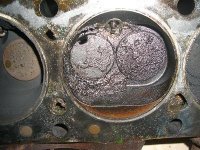
Just an update. Dale PM me and said he thought it was the intake valve. I was sure it had to be the exhaust valve, eventhough some of the tests contradicted that prediction. The second head I had taken into a British car mechanic in town took it apart for a valve job and the head turned out to be in very bad shape. Someone who didn't know what they were doing ground down the valves poorly and made them unuseable for a valve job. There were other problems too. I ended up having to take off the head of my engine today - not fun. I was going to do the liquid test, but I don't think that will be needed - look at the pick below and you will see why. Thanks all of you so much for your help. I learned a great deal.

Kevin
 

Attachments

  • 18307.jpg
    18307.jpg
    79.4 KB · Views: 275
ichthos said:
Thanks all of you so much for your help. I learned a great deal.

Kevin

No better teacher than experience! No question that having the resources from the various BCF members is a plus. Good to see the progress!

Mickey
 
Exhaust valve indeed! OUCH!

So are you now "headless" Kev?
 
Yep, I'm headless. I guess I will be bumming rides for at least a couple weeks. I will have very little time to work on my car after today. I am still ok with this as at least I have a plan and can see some light at the end of the tunnel. Besides, with my rebuilt carbs and head, it will be exciting to see how much better my car performs.

Kevin
 
Might be a good Idea to have the head hot tanked to clean the passages out, looks like some rust build up on the water passages.
 
WOW NICE HOLE! Make sure you keep that valve as a trophy!
 
DrEntropy said:
Exhaust valve indeed! OUCH!

So are you now "headless" Kev?

Hey Doc! How about an education for us?

1 We had Kevin do a compression test and he found
his cylinder No. 3 at 30 psi.

2. many suggestion of head gasket, manifold gasket,
burnt valves, bad valve guides, you name it.

3. I suggested Kevin do a simple exhast valve test.
Cut a piece of newspaper square 6" X 6" or so and
hold it against the exhaust pipe. If the paper is
continuously pushed away, the exhaust valves are
functioning properly.

If the paper gets sucked toward the pipe and then pushed
away, suck toward, push ,etc. That indicates a problematic exhaust valve.

Kevin's paper test indicated no exhaust valve problem.
No valves not working properly.

Kevins vacuum testing ruled out head gasket, bad timing,
burnt valve, bad manifold or carb gasket, loose valve guides,
worn rings, bad plug gaps or way out carb adjustment.

Kevin's vacuum testing indicated a sticking or leaky valve.

Obviously the vacuum test picked up the chunk missing from
No.3 exhaust valve. Why did the paper test on the exhaust
pipe NOT suck back with that big a hole in exhaust valve?

A compression and a vacuum gauge are excellent diagnostic tools.
The tests narrowed the problem to a valve on No.3

Why did the paper test fail with such a large chunk missing
from the valve? That's why I called the intake valve as the culprit.

Thanks for educating us beginners at engine diagnostics.

best regards,

dale (Tinster).

edit: fumble fingers

 
In ~theory~ the paper test may work, but it would have to be done cranking the engine by hand and a TIGHT exhaust system. The definitive test would have been a leak-down one. Air forced into #3 at TDC firing position would have had a hurricane coming out the blat tube.
 
ichthos said:
Yep, I'm headless. I guess I will be bumming rides for at least a couple weeks. I will have very little time to work on my car after today. I am still ok with this as at least I have a plan and can see some light at the end of the tunnel. Besides, with my rebuilt carbs and head, it will be exciting to see how much better my car performs.

Kevin

Good attitude.

A competent machinist can fly cut the seat and set an interference fit insert seat in there... not cheap but buying more old heads is kinda "iffy", IYSWIM.
 
DrEntropy said:
In ~theory~ the paper test may work, but it would have to be done cranking the engine by hand and a TIGHT exhaust system. The definitive test would have been a leak-down one. Air forced into #3 at TDC firing position would have had a hurricane coming out the blat tube.

Thanks alot Doc. Noted for future reference.
Much appreciated. Is there a special air fitting
sold with spark plug threads?

best regards,

dale (Tinster)
 
I cobble a cheap compression gauge for the fitting. :wink:
 
ichthos said:
I was sure it had to be the exhaust valve, eventhough some of the tests contradicted that prediction.
Intake valves run a whole lot cooler than exhaust valves, because they don't have to deal with hot exhaust gases. As a result, they almost never burn or stick. I've never seen an intake problem, other than perhaps building up enough gunk (from too much oil) to block the air flow.

I read that the described paper test only showed if the cylinder was running at all; but I can't say I've tried it myself.
 
That's why I told him how to use a hillbilly leakdown.
That hole woulda been obvious out the tailpipe.
 
:lol:
 
Back
Top