• Hey Guest!
    British Car Forum has been supporting enthusiasts for over 25 years by providing a great place to share our love for British cars. You can support our efforts by upgrading your membership for less than the dues of most car clubs. There are some perks with a member upgrade!

    **Upgrade Now**
    (PS: Upgraded members don't see this banner, nor will you see the Google ads that appear on the site.)
  • When posting a classified ad, you MUST select a prefix from the drop-down next to the subject line. If you don't you will get an error and your ad will not be posted!
Tips
Tips

TR2/3/3A TR3A Engine Startup Follies

PatGalvin

Jedi Warrior
Country flag
Offline
Hey Guys
I finally started up the new engine build on my TR3A. Was expecting this to be an energizing experience and not so "draining". Let me explain.

I had put restrictor plug on the recirc line from thermostat housing back to engine. First, that hose leaked so I installed a new SS radiator clamp instead of the traditional wire clamp. At end of my test run last night, it popped off entirely and dumped about a gallon of hot antifreeze on the garage floor. What a huge mess. I think I'll take the restrictor plug out for now. Am running a cheap thermostat and not the expensive bellows.

Of greater concern is the drip from my bellhousing. It is engine oil, not tranny oil (they smell differently). I ran the engine for about 20 minutes and it dripped quite a bit. I had crank turned and new rear seal installed. All per Moss directions. They turned the crank to exactly the spec per instructions. I later read that maybe this is too much and should turn less. If I have to pull this crank and renew the rear seal on the new engine, I'm going to cry some big alligator tears.

Other than that, she runs pretty solid. Static timing was only a couple degees off when I timed it at 800 rpm with a light. I got SUs fairly tuned in last night (idle and mixture). I bought UniSyn and that doesn't seem to work at all at the low air flows at idle. Maybe I'm using it wrong. Least of my problems for now.

Thoughts on the coolant hose leaks and rear oil leak?

Pat

triumph014.jpg


triumph016.jpg


triumph007.jpg
 
Rear oil leak: It could be the rear seal, or it could be all that felt packing junk around the rear main bearing cap. In either case, I don't see you getting to the bottom of it without stripping the motor. At the very least, you should pull the tranny and the flywheel and see if you can pinpoint the source. What with the body not in the way, that won't be <span style="font-style: italic">too</span> much work.

Coolant hose thing: I haven't the foggiest... How big is the hole in your restrictor? Even if it were closed off completely, a good hose clamp should be able to defeat whatever pressure your water pump can generate. I don't know...
 
Pat-

One consolation is that it looks great! On the rear leak, my hope is that Moss is putting out proper dimensions at this point - but even if you have taken a little too much off the crank I think people have salvaged things by trimming the seal and clipping off a little bit of the spring to add some closing force. I think Jack Drews wrote up something up about that technique, I can search for it if you need it. I'd hope getting the gearbox/flywheel off would be the major part and if you see the seal leaking I'd probably try to fix it first without doing a complete crankshaft pull.

Randy
 
Randy
Can seal be replaced without removing the crankshaft? Also, if you do find the previous post regarding improving the seal, I'd love to see it.

Thanks for your response.

Pat
 
PatGalvin said:
Randy
Can seal be replaced without removing the crankshaft? Also, if you do find the previous post regarding improving the seal, I'd love to see it.
Pat

Pat-

Here's the link to what Jack had to say on the rear seal:
Uncle Jack comments

Now as to doing it without pulling everything, I confess I may have that thought screwed up - if the bolts holding the seal can't be backed out without hitting the crank flange, then at a minimum I think you would need to pull the rear main. With that out, you might be able to deal with a seal swap and reinstallation of the rear main - but with that also the ugly felt stuff too.

Hunted a little on the FOT mail list - people have done a change out, but pulling the rear main appears to be needed, and it sounds like a major pain. I think its also dependent on flywheel design, apparently later flywheels have too much material on the backside to get any access. This doesn't sound promising, unfortunately.

FOT thread on rear seal

Randy
 
The only way that hose would pop off is pressure.
An air lock against the back of the t-stat will do it, but your bypass hose should have allowed for that.

I ALWAYS drill about a 1/8" hole in the t-stat....allows air trapped to escape and a full fill against the t-stat pellet....
 
New engine seems to have pretty high crankcase pressures due to seating rings. I noticed a good stream of warm air dicharged from my valve cover when I pulled the stock valve cover cap. Also, crankcase is venting from the U shaped pipe that vents the lower end. When rings seat, wouldn't we expect that the oil seepage from rear seal may diminish?

Naively Optimistically Yours,

Pat
 
TOC said:
The only way that hose would pop off is pressure.
An air lock against the back of the t-stat will do it, but your bypass hose should have allowed for that.

I ALWAYS drill about a 1/8" hole in the t-stat....allows air trapped to escape and a full fill against the t-stat pellet....

Hi Art
I did drill the thermostat, based on something Randall posted. I seem to like most of his ideas. I'm going to remove the restrictor on bypass hose for now. I can add later, if overheating is an issue.
 
Not that it's any consolation, Pat, but you wouldn't be the first to have the crank ground too small. One of our club presidents went down exactly the same road, used the Moss seal and followed the Moss directions; with the result it leaked far worse than the scroll seal ever did. She wound up having to pull the crank and find a different one.

The Morgan article that Art linked to above covers other problems, but not, AFAIK, having the crank ground too small.

Higher revs with the bypass blocked (even partially) and the thermostat closed (even with a 1/8" hole in it) are going to produce some higher pressures against the bypass hose than it normally sees. I always use SS worm-drive clamps anyway, so hadn't thought about the original wire clamps not having enough grip to hold. It does NOT help that the fitting not only has no lip to help retain the hose, but actually tapers to help it slip off.
 
You didn't do something like I did after a rebuild and lube the hose fitting so it would be easy to slip on the hose? Also makes it easy to slip off!
 
TR3driver said:
The Morgan article that Art linked to above covers other problems, but not, AFAIK, having the crank ground too small.

Hard to tell whether the crank was ground too small, but in the article it does say that "Our poor Morgan mechanic had a Moss unit ".
 
Shoot, this is just killing my Triumph buzz. My machine shop precision ground the crank to exactly 2.500. I checked it at home and it was spot on.

Does anyone have this rear seal installed with crank ground to this dimension with no (or little) leakage?
 
On the back side of the Unisyn there is a dial that adjusts the airflow through the unit. It can be opened and closed to compensate for the amount of air flowing into the carbs.
 
Pat
So sorry to here of the issues you found, but I must compliment you on your "build" quality in the pictures. These problems will be solved and when they are you are going to have an outstanding example of the marque.
I'm Jealous.......leaks and all
Gordon
 
Thanks for the sympathy and compliment Gordon. I've been dreaming about building a car like this since college. And that was nearly 30 years ago, when I sold my last TR3.... I'm livin' the dream, leaks and all!
 
The stupid thing about all of this rear main seal leakage stuff is that if you <span style="font-weight: bold">properly </span> set up the original scroll seal, it will not leak. Two problems exist when setting up the original seal. The first is that the dimensions that the factory give for the setting mandrel is wrong (too large), and to make matters worse, the tool you get from Moss is even larger then what the factory says it should be, making for a bigger leak.

Randall came up with correct dimensions several years back, and that's what I used when I made up a tool at work from a piece of delrin. I do not have any rear scroll leaks on my engine that now has about 1500 miles on it.
 
martx-5 said:
The stupid thing about all of this rear main seal leakage stuff is that if you <span style="font-weight: bold">properly </span> set up the original scroll seal, it will not leak. Two problems exist when setting up the original seal. The first is that the dimensions that the factory give for the setting mandrel is wrong (too large), and to make matters worse, the tool you get from Moss is even larger then what the factory says it should be, making for a bigger leak.

Randall came up with correct dimensions several years back, and that's what I used when I made up a tool at work from a piece of delrin. I do not have any rear scroll leaks on my engine that now has about 1500 miles on it.

I just noticed BPNorthwest is carrying a tool I think made by Joe Alexander with better specs for setting the rear seal. I used one recently to set the scroll but won't be drip testing for a while longer.
 
Well, I went to BPNorthwest's website, and they don't give any dimensions, other then saying it is to factory spec. Well, that is part of the problem, the factory spec is not right. Since they allowed for questions concerning that product, I asked them for dimensional data. We'll see what I get back.

Do you still have the setting tool??? Maybe you could measure the two OD's on it, and we'll see if it's correct or not.

In the meantime, I'll dig out the correct dimensional data.

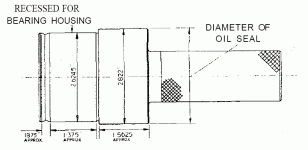
OK, here's the dimensions for the factory mandrel...

As you can see, the factory has the seal diameter as 2.822". It should be 2.818"...that is what I and several club members have used, and we don't have any scroll leaks.
 

Attachments

  • 22873.gif
    22873.gif
    19.5 KB · Views: 265
Back
Top