• Hey Guest!
    British Car Forum has been supporting enthusiasts for over 25 years by providing a great place to share our love for British cars. You can support our efforts by upgrading your membership for less than the dues of most car clubs. There are some perks with a member upgrade!

    **Upgrade Now**
    (PS: Upgraded members don't see this banner, nor will you see the Google ads that appear on the site.)
Tips
Tips

TR2/3/3A TR3 broken pushrod

You might want to read through this thread that I posted a while ago. I lost a push rod in pretty much the same way. Ended up limping it to a place where I could work on it, simply replacing it and then driving home.

https://www.britishcarforum.com/bcforum/ubbthreads.php/topics/510625/1

Never pulled the head, but I did drop the pan and replace all of the pushrods with the thicker ones. It's been running fine ever since.

Good luck!
 
TR3driver said:
...no oil to the top end whatsoever.... theory is that the rear cam bearing got installed wrong somehow

I ran it without the valve cover. No visible oil squirts or drops at all.

Of course I'm going to pull the rocker shaft and check the oil passages in the head and block - but how does one diagnose oil flow through the cam bearing? I guess I could spin the oil pump directly with a drill (distributor removed) and see what comes out the oil passage in the block (with the head off).....

Yowza. How often does this happen, no oil flow to the head?

I've seen (actually, we have one on the shelf) the auxilliary oil feed pipe used to supplement volume to the rocker shaft.... but it seems if you are solving a flow problem with one of these auxilliary pipes, that you would subsequently deprive the rear cam bearing of ANY significant oil volume? I can see it on a race car, where you would take extra steps to make sure pressure through both passages would be the same....

One other thing - after studying the oil system, I can't see how oil gets to the rocker ball / pushrod cup interface....?
 
It can take a few minutes to get there, but you should see oil oozing from the holes in all of the rocker arms. While I wouldn't call it common, it does happen that the passages get clogged up with sludge and deposits, so I try to check it every few years (or on an engine I'm not familiar with).

After finding no flow at all, even with the plug in the head removed; and no evidence of blockage, I assumed the rear cam bearing insert was the problem. Actually went as far as spinning the engine with the starter (with the liners suitably clamped in place, of course) to see if any oil would come up the hole. I got no oil before drilling, and plenty afterwards, so whatever the issue was, the drilling fixed it.

The external oil feed gets oil right from the main oil gallery on the side of the block, so it won't starve any one bearing. But it puts a huge amount of oil into the rocker shaft, which of course means all the other bearings are getting less oil. It literally painted the underside of the hood!

And I could not manage to control all the oil in the top end; the intake guides were rather badly worn from lack of oil and with the external feed they were sucking so much oil that I literally got a warning from the California Air Resources Board for excess smoke! I even drilled the rocker pedestal and installed a 1/16" restrictor, but there was still way too much oil up top.

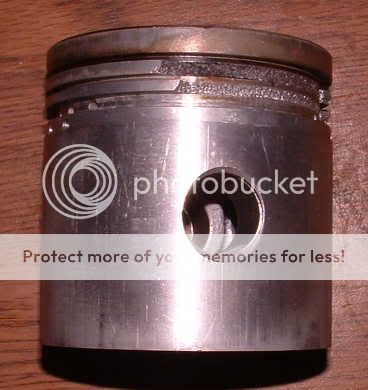
About the same time as the CARB warning, I installed oil seals on the intake guides; which worked OK until one of them got dislodged somehow and allowed just one cylinder to continue sucking oil. That led to more unpleasantness:
BrokenTR3piston.jpg


The rocker balls only get 'splash' lubrication, there is no passage leading to them. Seems to be plenty of splash, though, as long as oil is reaching the holes in the rockers. At higher rpm, the oil gets slung off the rocker tips and just goes everywhere inside the cover.

 
TR3driver said:
It can take a few minutes to get there, but you should see oil oozing from the holes in all of the rocker arms.

questions:

1) a few MINUTES for oil to flow through the rocker holes? I would think that at 50 PSI anything less than 10 seconds would indicate, at the least, severely restricted flow.....?

2) like a dummy I went and removed the rocker shaft assembly before checking the last few comments here (and re-checking oil flow from the rockers for more than 30 seconds).... so my plan now is to crank the engine and see if oil is getting to the rocker passage in the top of the head... if nothing there, then I will pull the plug in the back of the head. QUESTION - with the rocker shafts removed do I need to worry about the tappets flopping around while spinning the motor with the starter?

3) if I have a machine shop re-surface the rocker tips (where they hit the valves) do the tips then need to be re-hardened?
 
The stock oil feed to the rockers is very low pressure, nowhere near 50 psi. Basically, it gets metered (meaning only a certain amount of oil passed per revolution) by the rear cam bearing; so the pressure is nearly zero.

I haven't actually timed it, but it does take a fair amount of time for all the passages to fill, so the oil starts coming out the top. I generally use the time to start putting tools away and whatnot, since as the old saying goes, a watched pot never boils.

It seems unlikely to me that the cam could throw the lifters out of their bores with the engine only turning at starter speed; but I suppose it could happen. You were going to remove the head anyway, right? :laugh:

If you feel the rockers need to be reconditioned, I would recommend sending the entire assembly off to Rocker Arm Specialists . They know what to do, and how to do it. When I sent them mine, the cost including shipping was only about what I would have to pay for the parts themselves, and the whole thing came back looking like new. They even replaced things that I probably would not have, like the adjuster screws and locknuts. Not sure if they harden the rocker tips or not (were they hardened originally?) but I've got a bunch of miles on it, and it still looks new. (One of the things that got moved from the wrecked 3A to the project 3.)
 
Randall. I'm intrigued by the picture of that piston. Did I understand that it was oil that did that ? What's the theory ? Thanks.
 
Oil has a really low octane; so my theory is that the one cylinder was pulling enough oil past the intake guide and misplaced seal to knock only under cruise conditions and not loud enough for me to hear. With heavier throttle, there is less manifold vacuum sucking on the guide and hence less oil passed (plus more fuel/air to dilute it) and hence no knock.

The continual knock pounded the rings until they broke away the piston lands. No doubt it was a gradual process, but I didn't notice anything wrong until the second land broke, when it suddenly started blowing a huge cloud of blue smoke. Drove it maybe 10 miles to get home, pulled it apart, found the busted piston & rings on the same cylinder where the seal had come apart.

The seals I used were similar to:
Teflon_RubberSeal9147.jpg

and the inner Teflon ring pulled out of the outer rubber boot. No idea why, but I recall that one or two popped apart while I was installing the valves, so maybe I just didn't get one put back together properly, or maybe they were just a little small.
 
Sometimes "new and improved" just isn't. :shocked:
 
Just for clarity Doc, this was not an attempt to improve upon the original design.

Rather it was a band-aid, intended to temporarily solve a problem induced by another band-aid (the external oil feed line). My only intention at the time was to coax a few more months out of that motor, without getting arrested (or lynched) for excess smoke. (Living in the Los Angeles smog basin as I do, folks are kind of sensitive about billowing plumes of blue. For that matter, so am I.)
 
Back
Top