• Hey Guest!
    British Car Forum has been supporting enthusiasts for over 25 years by providing a great place to share our love for British cars. You can support our efforts by upgrading your membership for less than the dues of most car clubs. There are some perks with a member upgrade!

    **Upgrade Now**
    (PS: Upgraded members don't see this banner, nor will you see the Google ads that appear on the site.)
Tips
Tips

TR2/3/3A TR3 broken pushrod

eschneider

Jedi Warrior
Offline
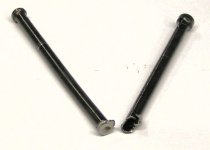
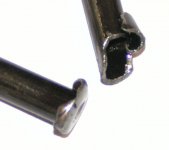
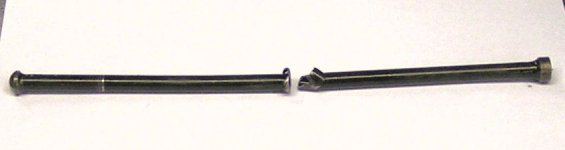
Thought I'd share some photos of this one.

Car (Morgan +4, actually - with the stock TR3 motor) was running great while putting some pre-delivery miles on the old girl - we are nearing the end of a loooong restoration process.....

On the last leg of a longer test run, it developed a miss. I found ZERO compression on #3, so I pulled the valve cover and found the damage. Valve is in the closed position.

This was a stock motor, not rebuilt - but otherwise in good shape. Compression 200 miles ago was 145 on all cylinders.

The plan is to pull the cylinder head and go through the entire valvetrain.... but I gotta admit I'm a relatively young guy in this crowd, and never have had the opportunity to deal with these kinds of failures. Frankly my generation of engines just worked, so I've never seen a broken pushrod before.

The break point seems to be fatigue. What mystifies me is that only one half of the break is mushroomed. Guess it really doesn't matter - it's gotta come apart to fix it.

Love to hear your thoughts and pearls of wisdom.
 

Attachments

  • 21404.jpg
    21404.jpg
    15.7 KB · Views: 539
Ken Gillanders at British Frame & Engine once said they ran a stock TR3 motor with the early 5/16 pushrods under a strobe light. He said "The pushrods looked like dancing spaghetti."

For some reason, BFE sells uprated pushrods ...
https://www.britishframeandengine.com/parts1.html

Just a WAG, but I suspect the mushroomed end was beating against the underside of the head once it broke away from the upper half.
 
TR3driver said:
Just a WAG, but I suspect the mushroomed end was beating against the underside of the head once it broke away from the upper half.

The mushroomed end is on the rocker half of the broken rod. That half should (theoretically) have been stationary.
 
Ah, then that would explain why it broke ... it was installed upside down!

Photo above shows that the mushroom is on the half with the convex end, which normally goes into the lifter. Note also the shiny ring, where it was hitting against the side of the lifter.
 
Which end did you say goes into the lifter ?
The mushroom end ? Doesn't the convex end
make contact with the rocker arm ?
Harry
 
Mushroom end fits into the lifter/tappet. The concave end fits under the ball/ ajuster nut on the rocker.

Cheers,
M. Pied Lourd
 
Just so. The adjusting screw on the rocker has a ball that fits into the cup on the pushrod. The lifter just has a rounded hole that the end of the pushrod fits into.
 
eschneider said:
...... it developed a miss. I found ZERO compression on #3, ... Valve is in the closed position...

Hmm.. zero compression is not good. It could mean something much more significant than a broken pushrod. To have zero compression there must be a leak - an open valve....or... something worse - like a holed piston.

First step should be to remove the rocker assembly and re-run the compression test. If it is still at zero, the head has to come off.
 
Certainly would be best, IMO; if only to clean out any swarf left in the lifter. Might want to drop the pan as well, for the same reason.

But depending on circumstances (like do you feel lucky?), I might be tempted to replace the pushrods (all of them) first, then check compression and oiling to the top end. That will give you a better idea of what needs to be done when the head comes off.
 
While I'll admit I've not tried it, I would not expect to get reasonable compression readings with the rocker shaft removed. For example, if everything is sealing perfectly and the piston started at TDC, then it will just pull a vacuum on the cylinder as the piston goes down and then come back to about atmospheric pressure (0 psi) as the piston reaches TDC again.

IMO you have to install at least one new pushrod (although I can't imagine not doing all of them), install the shaft, set the valve lash, THEN check compression.

And, as MD says, this would be a good time to check that oil is reaching the top end; which pretty much requires starting the engine and letting it idle for a minute or two.
 
luke44 said:
Hmm.. zero compression is not good. It could mean something much more significant than a broken pushrod. To have zero compression there must be a leak - an open valve....or... something worse - like a holed piston.

First step should be to remove the rocker assembly and re-run the compression test. If it is still at zero, the head has to come off.

Yes - as stated in the original post, the head is coming off. I am hopeful it's just a bent valve. If there was catastrophic piston damage, it would not have been running as well as it did.
 
TR3driver said:
Certainly would be best, IMO; if only to clean out any swarf left in the lifter. Might want to drop the pan as well, for the same reason.

Exactly my thought - I think I'd do that even if compression was 100%. At this point I want some reassurances that the valve guides and stems aren't going to be a cause for future concern.

TR3driver said:
But depending on circumstances (like do you feel lucky?), I might be tempted to replace the pushrods (all of them) first, then check compression and oiling to the top end. That will give you a better idea of what needs to be done when the head comes off.

I feel like "making my own luck" on this one. There was a valvetrain failure, so IMO anything less than disassembly and a thorough inspection is gambling with the rest of the motor. Morgan +4 engine removal SUCKS.....

Good point on checking the oiling - I didn't 'tink-o dat. Pressure is 50PSI at idle, but that doesn't mean the supply to the head is what it should be. Maybe I'll do a cylinder leakdown test for fun, as well.....
 
TR3driver said:
Ah, then that would explain why it broke ... it was installed upside down!

Ugh. OK, I deserved that. Yes, I mis-spoke.......

Thus, your postulate about the mushroom-ing being caused by the underside of the head makes sense. We will know for sure shortly.... as Chris Farley would have said (god rest his soul), "oh, that had to leave a mark....."
 
eschneider said:
Pressure is 50PSI at idle, but that doesn't mean the supply to the head is what it should be.
I once bought a 56 TR3 in Texas (mostly for it's overdrive), and drove it home to CA. Engine seemed to run good, so I swapped it along with the OD into my 59 TR3A without doing any checking. Later I realized that there was no oil to the top end whatsoever! Apparently it had been surviving totally on oil being added to the engine ... the pushrods were actually rusty!

My theory is that the rear cam bearing got installed wrong somehow; although I have no idea how. I had no money for a rebuild, nor inclination to remove the front apron again (pulling the engine on a TR3A is no walk in the park either). So instead, I used a long drill bit packed with grease to drill down through the bearing insert; cleaning and regreasing the bit frequently. Believe it or not (I don't) it worked ... that short block was still running strong when the car got wrecked. I should probably pull it apart just to see what really happened.
 
Back
Top