• Hey Guest!
    British Car Forum has been supporting enthusiasts for over 25 years by providing a great place to share our love for British cars. You can support our efforts by upgrading your membership for less than the dues of most car clubs. There are some perks with a member upgrade!

    **Upgrade Now**
    (PS: Upgraded members don't see this banner, nor will you see the Google ads that appear on the site.)
Tips
Tips

PCV?

Down grading an engine system is risky. Crankcase venting is one of the best pollution reduction designs invented. California fought Detroit for a decade to get road draft tubes replaced with engine vents that recycle the internal blowby and oil vapors. That battle is legendary.


Adding a home-made system is also risky. Chances are you won't sort out how to make it function at all RPM and road speeds. The reason the old TR2, TR3, TR4 vent tubes are such an odd shape is because they went through a lot of trials and do overs. Sorting out how much crankcase pressure is needed is tricky. If you don't want to mess up oil flows to seals.

I think if there is too much liquid (condensed oil vapor and blowby fuels) in the air cleaner look at the source. Are the rings shot? Is there too much oil in the pan? Are the oil return passages in the head blocked with carbon? Is the head gasket blown?

If you feel you have to do something creative then install the catch tank in the hose to the air cleaner.
 
Here's an interesting alternative :
https://www.summitracing.com/parts/SUM-120108/?rtype=10

Haven't tried it myself, but Joe at ARE says it works well on his racing TR4.

Advantages include holding a slight negative pressure on the crankcase even at WOT (to reduce seal leakage and maybe even make more power), and no effect on intake mixture. And it should mostly finish burning the crankcase gases, once the exhaust system warms up.

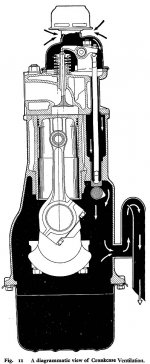
Here's a diagram of the old road draft tube design, from the TR2/3 workshop manual.
 

Attachments

  • 24047.jpg
    24047.jpg
    90.1 KB · Views: 303
The Summit package is surely well suited for the applications they say. I don't want to sound 'preachy' because that isn't me. However, random modifications to any car will have consequences. Some desirable and most not so.

Crankcase pressure in the old cars was expected to be equal to the air around the engine. The draft tube was just the passage and hopefully catcher/return of useful oil. The earliest 'breather' type closed systems were only that, a passage back into the engine. Intake air is the only available path. The Summit package looks like it includes a oneway gate and possibly a flame arrestor (to keep an explosion from blowing the valve cover off). Crankcase vapors run across the LEL and UEL levels (Google it) everytime the engine runs. A backfire at the wrong time will do serious harm.
 
AEW said:
Crankcase vapors run across the LEL and UEL levels (Google it) everytime the engine runs.
Do you have any evidence for that assertion? I find it really hard to believe that the mixture leaking past the rings will be richer than what went into the cylinder in the first place, especially if there is fresh air coming into the crankcase.
<div class="ubbcode-block"><div class="ubbcode-header">Quote:] A backfire at the wrong time will do serious harm. [/QUOTE]
I'm also finding that hard to believe. Intake backfires (basically the explosive mixture in the intake manifold gets lit somehow) aren't all that rare, but they almost never do any serious damage unless there is a something like a positive displacement blower blocking the path to free air. Worst damage I've ever had was singed eyebrows (which taught me to keep my face away from the carb throat
grin.gif
) And of course the reed valve would have to fail to even allow the flame front into the hose leading to the crankcase.

Care to quote an example? Lots of racers use crankcase evacuation and while they do occasionally have explosions, I've never heard of one being blamed on a backfire through the exhaust.

One other thing, the early PCV systems had a direct connection (no check valve or even a flame arrestor) between the rocker cover and the air cleaner. If your theory is correct, an intake backfire would "do serious harm" as well.
 
Backfire won't....unless you have a totally clapped out engine and raw gasoline instead of engine oil in the crankcase.
Back-dating ventilation is not an issue.
PCV valves were California then Federal mandates.
Road draft tubes worked just fine, and unless someone can show me siginifcant internal changes to the same freaking motors that would preclude the back-dating to a road draft tube, I would certainly like to see it.
In print.
 
I used to run a crankcase ventilation system put out by Moroso many years ago on my 71 Camaro 350. It was just like the Summit offering, using Chevy pollution one way valves bunged in to each header collector.

I used heater hose to connect it together. I guess it worked as I had no oil leaks or related problems. I saw that Joe (ARE) has the a similar/clone setup available for TRs.

Back then, I worked at a speed shop in Albany that had a full service garage and in-floor dyno so we did all kinds of experimental things to our own cars after hours. Like the kid with the 1050cfm 3-barrel on his 396bb chevelle. When the 3rd barrel opened (even just bliping it by hand), it literally exploded with a blast that sounded like a canon went off.

Anyway ...
 
BTW, a PCV system can only handle so much crankcase pressure and blowby.
One of the "compelling" issues for marques that tended to have engines that had limited longevity was the elimination of "blow-by" and the smell in the cockpit when the engines started going south.
When you get enough blow-by to be an issue, the engine needs to be rebuilt.
FoMoCo has a high-flow PCV listed for cars with high mileage.
One issue is, when you have a sealed system, and limited (by design) maximum flow through a PCV valve, guess what happens when the crankcase pressure exceeds the amount the PCV can handle?
Gaskets, seals, everything leaks.
I've had vehicles in the shop with the main seals about blown out, pan gaskets sticking out between bolts, on V-8's intake end seals blown out....all due to higher than allowed crankcase pressures.
If it was MY LBC, I would have a road-draft tube and vented cap.
 
I have a sealed cap and the original PCV valve as well as the road draft tube... seems to do just fine.any harm in this?
 
mtlman8 said:
I have a sealed cap and the original PCV valve as well as the road draft tube... seems to do just fine.any harm in this?
Only concern I can see is that under at least some conditions, it is probably sucking dirty air from the road into your crankcase. Probably not enough to worry about, though.
 
TOC said:
One issue is, when you have a sealed system, and limited (by design) maximum flow through a PCV valve, guess what happens when the crankcase pressure exceeds the amount the PCV can handle?
An additional problem with a "sealed" PCV system is that at full throttle, there is no manifold vacuum available to pull the gases through the PCV valve. Thus the crankcase pressure has to rise above zero to get any flow at all (and there will always be some flow). That is at least part of the reason that most American PCV systems have a fresh air inlet that is linked to the intake air filter; because then at WOT the blowby can flow "backwards" through the inlet and get sucked into the engine through the air box, rather than having to pressurize the crankcase.

Another advantage of a fresh air intake is that it helps purge the blowby gases from the crankcase, so they have less time to condense and form acid and varnish.

When I add PCV to my TR, I definitely plan to incorporate a big fresh air inlet, probably with it's own filter. I'm no tree hugger, but I live in a smog basin and I'm not particularly fond of the smog.
 
Randall, nice job on the cut and quote... I'm still weak on how to write comments. So I had a long answer to points that have been made with some chemistry numbers and BS about my credentials that nobody cares about anyway and I managed to lose it. I really don't feel like retyping it. Here's a summary:

YES- I have background in the topic of motor vehicle emissions.
YES- a homemade PCV is possible but probably a bad idea.
No- this does not address the first person's question. He needs advice on how to tell if his engine is worn out and what to do about that.

Again, I admire your forum skills !
 
I installed a Ford Mustang Cobra electric vacuum pump on my TR6. The pump maintains 4 inches of mercury at all times in the crankcase. The performance using the seat of the pants feel is better. Throttle response seems much better. It would be interesting to see with and without the modified PVC dynamometer results… I have read others claims of 5 to 7 HP increase.

On the plus side the TR6 no longer marks its spot when parked. I tested many PVC solutions before trying the electric pump. A word of caution is if you have too much crankcase vacuum the result is pulling oil from the cylinders resulting in a seizure. From research it seems that a crankcase vacuum of 6 inches or less is best.

The additions will be a one-way valve and a catch tank or buffer to return crankcase oil preventing the crankcase oil from contaminating the vacuum pump.

With the discharge of the pump plumbed into the intake, when completing a drive you clothes no longer smell like hydro-carbons. Especially with the top up. My wife is much more pleasant after a drive and more willing to accompany me on a drive now…
 
big6 said:
I installed a Ford Mustang Cobra electric vacuum pump on my TR6.

I'd like to hear more about this alternative. Do you have any pictures? What does the pump cost?

Thanks!
 
This discussion reminds me that I have an issue with PCV/EGR on my Spit that I need to solve. I think I started a thread on it a few months ago but I can't find it when I do a search for my name. I think this is at least in part the cause of the surging that I have experienced. I am very close to getting the car back on the road and need to get this sorted quick.

I have a '70 Spit that I switched to SU carbs, it has a Smith's PCV/EGR valve that sits in a port on top of the intake manifold with a hose that runs to the valve cover. All the parts seem to be in place in the valve (new diaphragm). This system seems to provide full manifold vacuum to the valve cover, if my oil dipstick is not seated properly I can hear air whistling around it and the engine runs lean. I think that I have read that I should drill a small hole in the oil fill cap but don't quite understand; won't this just make for a lean mixture by sucking air into the manifold after the carbs?

Thanks....Dennis
 
Agree, a lot of air can go through a small hole. It would mean you would need to compensate A/F ration to get to a good mix at idle, which in turn would make the idle speed high. Like intentionally having bad throttle shaft seals.

PCV valves in general regulate flow by an internal valve spring tension and metered oriface (depends on the car, guess that't why there are so many at the parts store). Really high vacuum, like idle, shuts a typical valve. This presumes some level of crankcase venting as well as the vapor from the combustion. If the Spit's system is designed to be a sealed unit (? in 1970) there won't be anything passing through from the valve cover to the manifold except a little waste vapor. What would happen if you tested it by temporarily blocking the PCV vacuum source? Would the engine run smooth? not overly rich? (if you have access to an analyser it would help. Presumeably your car doesn't have an O2 sensor? (they are handy)(and the little laser temp readers are fun too)

EGRs are all in all a pain. I didn't know 70 Spits had them. Earliest EGR designs are prone to over working. I mean that to get a reduction in combustion temperature to below 2000F they dump in waste gasses based on vacuum when the engine is at operating temperature under load, not based on actual presence of NOx in the exhaust. To make sure it is at least only working as designed check to see if the base of the EGR (pintle valve I think) is burned and allowing too much flow. Check to that the sensors for operating temp are/is not stuck in the full open position. You may need to wait until it's cold to do the test and note at what temp it allows vacuum to open the EGR. There is probably a nice diagnostic in the manual?
 
Sounds to me like some parts got switched around when you converted to the SU carbs. I don't believe a 70 Spit should have a PCV valve linked to the intake manifold. Instead, the port on the valve cover would have been linked directly (or possibly with a flame trap) to a port on the side of the carb, located between the venturi and throttle plate. This limits the vacuum applied to the crankcase to just a few inches of water (not much at all).

The PCV valve should perform basically the same function, limiting the applied vacuum to a fairly low value. However, there were several different models of Smiths PCV valves with very similar appearances but not always similar functions. It may be that yours is the wrong type for this application (or just doesn't work right).

But with the factory setup, it is normal for the engine idle to change when you remove the dipstick or oil fill plug.

Here's a document you might find helpful:
https://docs.google.com/leaf?id=0B2H2NJt...list&num=50

BTW, an EGR valve would not connect to the rocker cover, nor usually be found on a 1970 model Spit. I think you are looking at just a PCV valve (they aren't the same thing at all). A photo might be helpful.
 
AEW said:
I'm still weak on how to write comments.
Not hard at all, just a bit 'fiddly'. Easiest is to start by clicking on the 'Quote' button below the post you want to quote. That will open a dialog page with the original post enclosed in <div class="ubbcode-block"><div class="ubbcode-header">Code:</div><div class="ubbcode-body ubbcode-pre" ><pre>
author said:
<original text here>
</pre>[/QUOTE] tags. Just edit out the irrelevant stuff, then move to the bottom (past the [/quote]tag) and write your reply.

If you want to get fancier, you can insert your own <div class="ubbcode-block"><div class="ubbcode-header">Code:</div><div class="ubbcode-body ubbcode-pre" ><pre>
</pre>[/QUOTE]tags, copy & paste text and so on. Just make sure that the tags match up. Oh, and the "Preview Post" button is your friend
grin.gif


I don't mean to be showing off, or making anyone feel bad about their lack of skills. I just kind of got used to doing it that way on the old email BBS systems, so it seems "right" to me. (The above "Code:" boxes are because it's otherwise difficult to write about strings that get interpreted as tags by the BCF software.)
 
TOC said:
Carb MUST be designed for the inherent vacuum leak of the PCV.
I disagree with that to some extent. Yes, of course the "vacuum leak" alters the mixture, with the most effect at idle. But idling lean also helps reduce tailpipe emissions, so it's not necessarily a bad thing. With the idle mixture just a bit rich otherwise, adding some vacuum leak can take you to just where you want to be (around 1%).

And while it's easy to throw rocks at the PRK (People's Republic of Kalifornia), the smog problem here was VERY real back in the 60's and 70's, and adding emission controls to the cars really did clean things up dramatically. Back then, in the early mornings of summer, you could literally look down from the mountains and see the smog like a brown tunnel over the freeways. There was also a pass to the east, where you could watch the brown air spilling out into the clean desert air. "Stage 1" smog alerts would happen virtually every day for months at a time; now I think we've had exactly one in the past decade.

So, I want to add some simple emission controls to my "daily driver" TR3. The acrid smell of the crankcase fumes, and the hospital smell of the gasohol just aren't essential parts of the LBC experience to me; I won't miss them at all.

Might be just hubris, but the Triumph emission controls seem unspeakably primitive, I'm convinced I can do better. If I live long enough, I might even wind up with port fuel injection and an O2 sensor on the old girl. And a blower :laugh:
 
TR3driver said:
Sounds to me like some parts got switched around when you converted to the SU carbs. I don't believe a 70 Spit should have a PCV valve linked to the intake manifold....
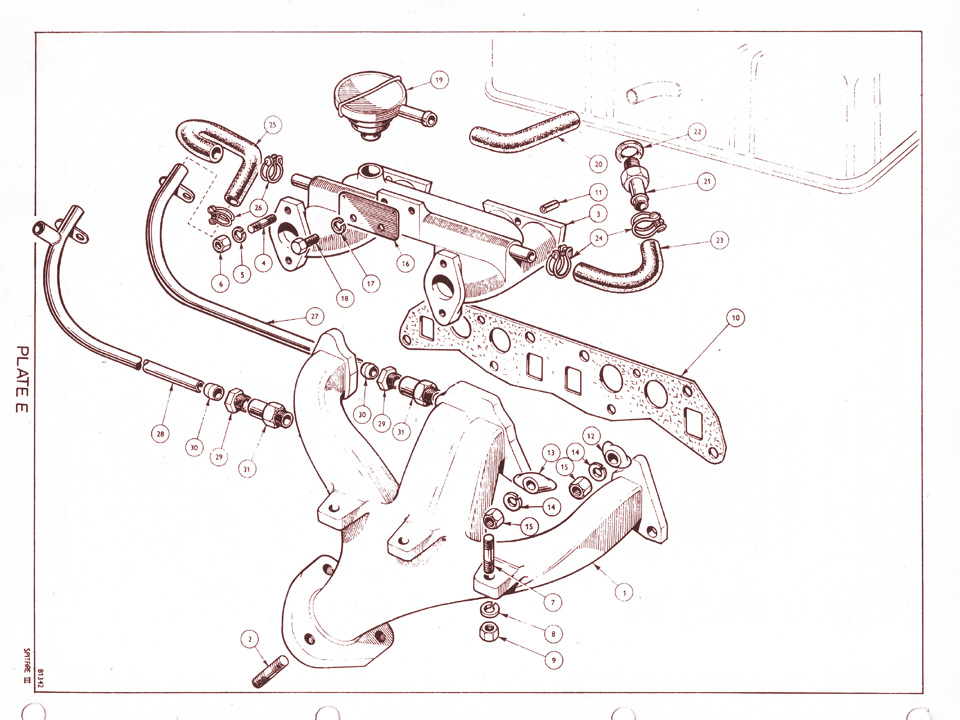
Actually, they did. This diagram from Canley Classics shows how it was done on the Mk3 Spitfires, including the pre-1970 US market cars:

spitfireiii_plate_e.jpg


I have a fond memory of my Mk3 idling fast and running not so well, and I couldn't quite figure out why. Fortunately, the guys at my local gas station were pretty fair mechanics (even if they did "hate dem furrin' cars") and discovered that the PCV valve was a bit loose where it fit into the manifold. A couple of seconds' worth of hammer and punch action to carefully peen the edges of the hole just a bit got the valve back snug, and I never had problems again!
 
Andrew Mace said:
including the pre-1970 US market cars:
Er, yeah, I left out the US-spec part. The document I linked to above is the factory training notes for US-spec 1970 emission control systems, which shows the non-valve setup for 1970 US spec.
 
Back
Top