• Hey Guest!
    British Car Forum has been supporting enthusiasts for over 25 years by providing a great place to share our love for British cars. You can support our efforts by upgrading your membership for less than the dues of most car clubs. There are some perks with a member upgrade!

    **Upgrade Now**
    (PS: Upgraded members don't see this banner, nor will you see the Google ads that appear on the site.)
Tips
Tips

Number 1 cylinder, top dead center

2wrench

Luke Skywalker
Country flag
Offline
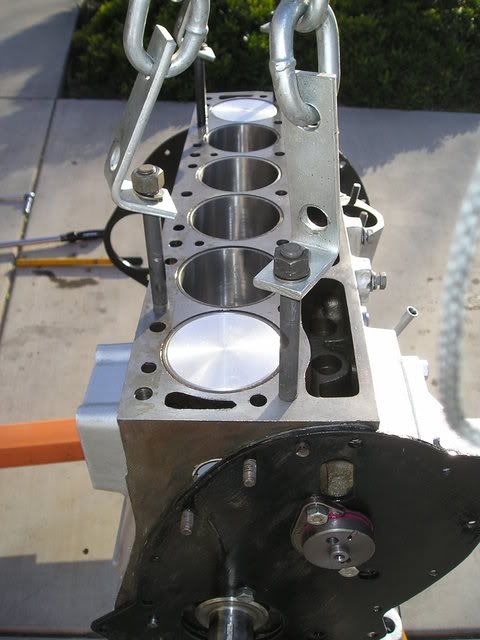
Well, Dale, you asked to see the number one cylinder
at top dead center, so here she is.
P1010016-12.jpg


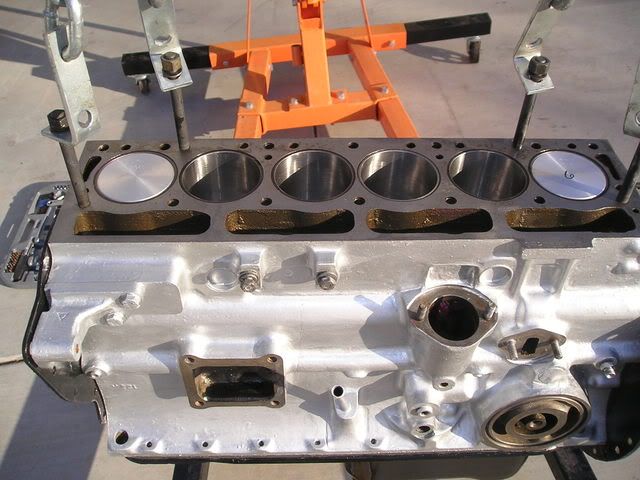
Notice that number six moves in unison with number one,
P1010014-15.jpg


And referring back to the first photo, the bolts that hold
the cam in I tightened to about2 20+ pounds. Because the
cam would not turn, I backed them off until the cam would
turn, but they were still snugged down.

Can somebody confirm that this is correct? They certainly
do not seem to be very tight at all, but the cam binds and
stops if I go tighter.

Thanks,
 
Reinstalled the old spigot bush into the flywheel
for now. Couldn't find a new one in my parts.

So ordered a new one and it will be here next week.
I'll be busy from the time it comes in and right on
through the weekend, so will not have time to work
on the car.

Better to go slow and do it right, I guess.

Next up, maybe tomorrow, will be all the stuff that
goes on the front of the engine: Timing chain,
gear sprockets; spacers; oil thrower....all that stuff
and some I probably didn't mention.

Kinda concerned onacountabecause I ain't never done
this befoe and the darned little buggers gotta line
up right or she ain't gonna run.

If I got problems, I'll come a-call'in.
 
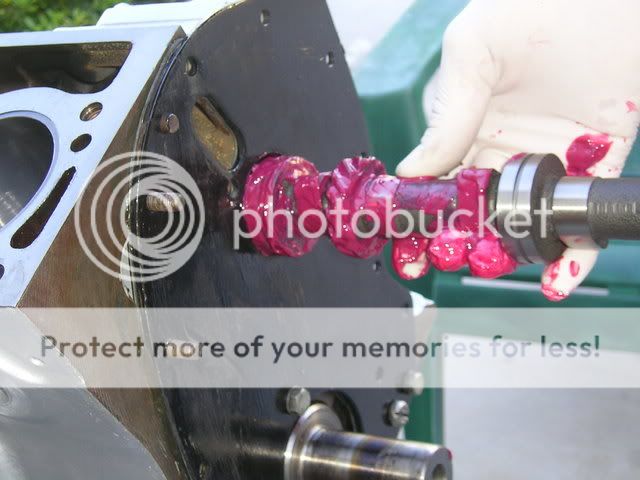
A picture of my cam offered up into place. Placed
the lubrication on in stages as it went in.

Distributor gear was in place too soon and prevented
the proper install of the cam. Pulled the gear
out and the cam moved right into place.

P1010011-17.jpg


Also, I ordered a dial indicator on line and it came
in the mail. I read everything and follow directions
carefully, hence I just can't quite figure out how this
tool is gonna work for me. Read the verbiage on the
box it came in and I'm sure you'll appreciate what
I mean.

P1010013-15.jpg


At this rate, this tool otta last me a long, long time.
 
2wrench, you don't have an engine stand to work off of? Would be might helpful. You <span style="font-weight: bold">are</span> going to bolt the tranny up before you try and stab that engine into the engine bay?


What are you using for a timing wheel? Go to www.kolumbus.fi/triumph.tr6pi/cam.htm for a really cool picture of a cam timing wheel that if you read over it 100 times you will get the actual functioning of the TR6 engine in yer brain as a reflex. Makes it easier that way. Too, this download I believe is printable and can be used as a timing wheel.

Remember there is a difference between TDC and BDC in relation to the cam.

No, that bracket that holds the cam in the block should be quite snug, and the cam should be turnable with heavy finger pressure.
 
Thanks Dennis !!

Really interesting photos !! I,m just guessing here that
No.1 is compressing and No.6 is exhausting.

What the four very large openings beside the 6 cylinders?

Good Job, indeed.

dale
 
The "very large openings" are the gallery where the lifters live and work.

Dennis, the retainer shouldn't bind the cam, no matter how tightly you torque it. Cam should have a bit of "float". With the retainer off can you push the cam further back into the block?
 
Ah!! The skinny rods that go up and down and
slowly spin around. Of course!

thanks

d
 
DrEntropy said:
The "very large openings" are the gallery where the lifters live and work.

Dennis, the retainer shouldn't bind the cam, no matter how tightly you torque it. Cam should have a bit of "float". With the retainer off can you push the cam further back into the block?

Doc, I'll check it out, thank you.
 
TR6BILL said:
2wrench, you don't have an engine stand to work off of? Would be might helpful. You <span style="font-weight: bold">are</span> going to bolt the tranny up before you try and stab that engine into the engine bay?


What are you using for a timing wheel? Go to www.kolumbus.fi/triumph.tr6pi/cam.htm for a really cool picture of a cam timing wheel that if you read over it 100 times you will get the actual functioning of the TR6 engine in yer brain as a reflex. Makes it easier that way. Too, this download I believe is printable and can be used as a timing wheel.

Remember there is a difference between TDC and BDC in relation to the cam.

No, that bracket that holds the cam in the block should be quite snug, and the cam should be turnable with heavy finger pressure.

Bill: Yeah, got an engine stand. Bolted it up to the back of the engine --
without the back plate on, though. So, had to take it off the stand to get
the back plate bolted on. If I'm using the stand incorrectly, let me know.
I figure it is possible I've got an incorrect stand for my engine or something.

Also, it is my plan to bolt the tranny on and tip and slide the whole
enchilada into place at one time.

Still wrestling with this "timing" concept between the crank and cam.
I figure the plan is to read and proceed, showing my ignorance along the way
and letting you good folks educate me as I inch my way along. Don't know any
other way.

I will be checking out the web site you suggest re timing.

Thanks, Bill, and congratulations on getting your cam into place as well.
Happy to hear you've got so much behind ya.
Cheers,
 
Several years ago I made a degree wheel (timing disk) template for a friend who needed one in a hurry. I like the one Bill posted the link to better. However, if you want to print an 8" diameter degree wheel you can get a copy of mine at:
https://home.mindspring.com/~purlawson/files/DegreeWheel2.pdf


So what would prevent the cam from being able to move back further in the block (which would result in binding when the bolts are tightened)? If nothing is behind the cam, would this imply the cam length is out of spec? Would it be acceptable to shim behind the retainer plate... even if that meant shimming the timing gears so they still line up?

EDIT: I updated my degree wheel and thought that you might like a link to yet another printable online one:
https://www.tavia.com/free_degree_wheel.html
 
Yeah, I love those "Do Not Open" stickers too. They are actually intended for the warehouse workers, telling them that the tape designates a combination of items to be sold only as a set, not "opened" to ship the pieces individually.

I agree, the camshaft shouldn't become tight as you torque down the retainer; in fact it should be able to move fore/aft a small distance (.004" to .008" according to Mr. Haynes) with the retainer torqued down hard. Possibly you've only got assembly lube trapped between the back end of the cam & the plug in the block, which would be no big deal. But, IMO, now is the time to sort it out, don't just assume everything is OK. I would probably try gently rapping on the cam with a brass hammer; if it's just trapped lube, that should drive it out enough to give you the required end float. But if that doesn't work, pull the cam back out and find the problem.
 
2W,

Make sure that the shop did not install too deep an oil plug at the back fo the cam. That would prevent it from going back far enough and having the proper "float" mentioned above.

The plug for the back of the cam should be a "SC" or shallow cup design.

Please check this before you go any further. You do not want the retainer loose, nor do you want the cam pushed too far forward.
 
2wrench said:
Still wrestling with this "timing" concept between the crank and cam.
What part isn't clear ? What you are setting is where the valves open and close relative to the piston position during each cycle.
If, for example, the intake valve opens too soon (during the exhaust stroke), there will still be pressure in the cylinder and exhaust gas will flow backwards into the intake manifold, reducing power. If the intake valve opens too late, there won't be enough time to completely fill the cylinder with fuel/air mixture and the engine will make less power.
Similar arguments apply to the other 3 valve events (intake closes, exhaust opens, exhaust closes).

Of course it's actually much more complicated than that, but fortunately the camshaft designer has figured all that out for us, leaving only the need for us to set the cam timing per specification to get all those events the way he intended. And missing the mark by even 10 degrees or so isn't TOO serious, it just means the engine won't run as strong as it would otherwise. Sometimes folks deliberately offset the timing a bit (tho not by 10 degrees), to emphasize performance at one end of the rpm range (at the expense of performance at the other end).
 
2wrench said:
And referring back to the first photo, the bolts that hold
the cam in I tightened to about2 20+ pounds. Because the
cam would not turn, I backed them off until the cam would
turn, but they were still snugged down.

Can somebody confirm that this is correct? They certainly
do not seem to be very tight at all, but the cam binds and
stops if I go tighter.

Thanks,

I had the same problem with the new cam plate I ordered for my engine. It seems like some of them are being made a bit to thick. Maybe so that if the cam needed machining??? In any case, I eventually looked at the old cam plates I had and since the wear was very minimal I decided to use the best of them. If you decide to use the new cam plate, I would carefully thin it down a very small amount. The best way to do this would be to put some fine wet / dry paper on a sheet of glass, and carefully polish. The plate is not hardened so that it and not the cam wears so it shouldn't make a difference, just be careful to apply pressure evenly.
 
TR3driver said:
2wrench said:
Still wrestling with this "timing" concept between the crank and cam.
What part isn't clear ? What you are setting is where the valves open and close relative to the piston position during each cycle.
If, for example, the intake valve opens too soon (during the exhaust stroke), there will still be pressure in the cylinder and exhaust gas will flow backwards into the intake manifold, reducing power. If the intake valve opens too late, there won't be enough time to completely fill the cylinder with fuel/air mixture and the engine will make less power.
Similar arguments apply to the other 3 valve events (intake closes, exhaust opens, exhaust closes).

Of course it's actually much more complicated than that, but fortunately the camshaft designer has figured all that out for us, leaving only the need for us to set the cam timing per specification to get all those events the way he intended. And missing the mark by even 10 degrees or so isn't TOO serious, it just means the engine won't run as strong as it would otherwise. Sometimes folks deliberately offset the timing a bit (tho not by 10 degrees), to emphasize performance at one end of the rpm range (at the expense of performance at the other end).

Randall: I'm going to have to chew this a bit to digest it. Let's revisit
it again after I've gotten past why I can't torque down the cam properly,
okay?

Thanks,
 
<div class="ubbcode-block"><div class="ubbcode-header">Quote:]why I can't torque down the cam properly[/QUOTE]

2W,

This is the plug that is listed for the back of the cam in the Dorman catalog. It is deeper than the original and deeper than the steel plug that I got from TRF. We caught it at the machine shop before installation when we matched old parts with new.

I don't know where you (or they) got yours, but that may be your problem.
 
Okay. Seems the cam shaft length is not a problem.

Seems the freeze plug depth is not a problem

The cam will slide back farher into the block than it
needs to.

Seems to me the tolerances between the groove machined
into the end of the cam and the retainer that is fitted
into it are just a weee bit on the snug side.

My guess is something has to give....like thinner
retainer clip (by maybe .003 or so, maybe) or the
lesser of the two choices (machine the groove at the end
of the cam to be a weeee bit wider.)

For research, I pulled out my old cam; slide the retainer
into the end groove and it was a rather snug fit there as
well. Cannot forsee any amount of end play being there,
either; but, these parts were off a running engine....
one that exploded on me....but a running engine,
nonetheless.

Guess I'll confer with bpnorthwest, from whom I purchased
the cam, as well as the machine shop.

Wonder if the new/different cam requires a special-sized
retainer clip?

Another thing occurs to me: Could it be that the
retainer is slightly warped, causing it to bind when
snugged?
 
Paul, we musta been posting right about the same time.

Thanks for your time and effort in assistance.
Excellant photos and I really dig that tool you've
got for measurement.

As I mentioned just above, though, the cam will actually
slide farther back into the block than you would
want it. I mean, the slotted groove in the end of the
cam that the retainer fits into will actually be lost
into the block. It can go that far (1/8, 3/16) in.

From this it seems the freeze plug is not a problem,
or is there something I am missing?
 
No, I misunderstood the problem. I thought that it would not go all the way back.

My cam and lifters came from BPNW also. Which profile did you get? I got the TH5, which is just about the same as the GP-2, but has slightly less lift, but a longer duration.

EDIT: They just shipped the Vernier Timing Gear that was on back order, so my engine is not assembled yet. I didn't want Bob to start the machining until all of the parts were here and it looks like Tuesday will be the day for that.
 
Back
Top