• Hey Guest!
    British Car Forum has been supporting enthusiasts for over 25 years by providing a great place to share our love for British cars. You can support our efforts by upgrading your membership for less than the dues of most car clubs. There are some perks with a member upgrade!

    **Upgrade Now**
    (PS: Upgraded members don't see this banner, nor will you see the Google ads that appear on the site.)
Tips
Tips

New Brake MC & Warranty with DOT-5 Fluid?

The "best" conversions to DOT5 involve completely rebuilt Master, booster (if so equipped), calipers and/or wheel cylinders, new flex hoses, and NEW steel lines, plus a new or totally cleaned reservoir.

If you've ever tried to get DOT 3 or DOT4 off of something, you'll know what I mean.
Good luck!

And, I am not trying to throw a wet blanket on this, just share information.

Dave
 
Methanol (methyl alcohol) was recommended to me many years ago, as both being harmless to brake materials, and dissolving the glycol. When I did the TR3A conversion, I did replace all the seals and flush everything with methanol. No indication that there was any glycol remaining in the system. Note please that there are lots of kinds of "alcohol" around, methanol is NOT the same as rubbing alcohol, denatured alcohol, white lightning, etc.

For all the other cars I've converted, I've just not worried about it. Yes, the glycol & silicone remain separate. But they are fully compatible with each other, neither causes the other to deteriorate any faster than it would otherwise. What happens is that any remaining glycol tends to vacuum up water, debris from worn seals, etc. and of course it continues to deteriorate as it always does, so that many years later you may find some black goop in 'dead' areas (like the bottom of brake slaves). In my experience it has not been a problem.

I'm suspicious of one thing in the link to the RR article above; he says that water content in glycol systems tends to maximize at 3%. That seems to be a direct contradiction to a paper presented to the SAE, which examined several "real world" examples of cars on the street, and found water contents as high as 11.1% ! This, BTW, is far above the concentration used for the "wet" boiling point specification.

It also neglects another finding from that paper, that glycol can suck not only water, but salt, right through soft brake lines. I believe this explains some of why it seems to promote corrosion so much in Triumph cylinders with aluminum bodies and steel pistons.

Interesting comment about corrosion ... My experiments show that even with deliberately introduced water, the silicone surrounds the water and keeps it out of contact with the metal. This is the "barrier film" referred to in the above article. Of course, adding water to brake systems is something I try to avoid, so it's no wonder I've never seen any corrosion from it in practice

grin.gif
 
TOC said:
I guess one of my "buttons" is safety.....for many reasons.
BTW, I lost a TR3A because the glycol brake fluid ate it's way out through one of the hard lines; and I drove the car that replaced that one every day on Los Angeles freeways for almost 20 years (hoping to get back to that point again). To my mind, DOT 5 is far safer simply because I am much less likely to have brake problems with it. It works for me.

The "lost" car was parked in overflow parking on a hill roughly parallel with the roof of the 3-story apartment building I lived in at the time. The building was converting to condos, so we had to move out. When I hopped in to move the car to my usual parking space in the underground garage, I was already turned around and headed downhill into the garage before I discovered the total lack of brakes (the e-brake cable had failed some time before and not been replaced yet).

I did everything I knew to get the car stopped, including over-revving into 1st gear (no synchro in 1st) and shutting off the ignition, plus literally dragging my feet. When I finally ran out of garage, I honestly thought it would hit the curb and stop, but instead it jumped the curb and hit the wall hard enough to jam the front apron back into the radiator and dump the coolant.

The apartment manager promised me I could leave the car in the overflow parking for a month, until I could come back with a trailer for it. However, when I got back, I discovered that the condo manager had ordered it towed the very next day, and it had already been crushed.
 
Your graph is interesting, explains why we flush our DOT 3 and 4 every couple of years.
But, at least it holds it in suspension!
I just point out the stuff.....and there is more where that came from!
I have literally seen the bottoms of calipers, cyliders, rusted so badly you cannot save them.....with DOT5.

Water is one of those oddities.......like, high humidity, for one.

I would imagine Phoenix has a lot less water content in brake fluid than, say, Charleston SC or Seattle.

This one:
"glycol can suck not only water, but salt, right through soft brake lines."

Simply for the purpose of discussion, I would certainly like to hear more about that.

Dave
 
Actually I bet Charleston is twice as humid as us.
 
In summer, not winter.
Lived there.
Back when the Navy had Nuke Subs at Pier November.
But here, with all the rain, and there, with the humidity, I could see more moisture absorption conent.
 
I'd like to thank those who have contributed to this thread. It has run a different course and direction than most arguments pro and con DOT-5 fluid and some new/different points have been brought up.
 
TOC said:
This one:
"glycol can suck not only water, but salt, right through soft brake lines."

Simply for the purpose of discussion, I would certainly like to hear more about that.
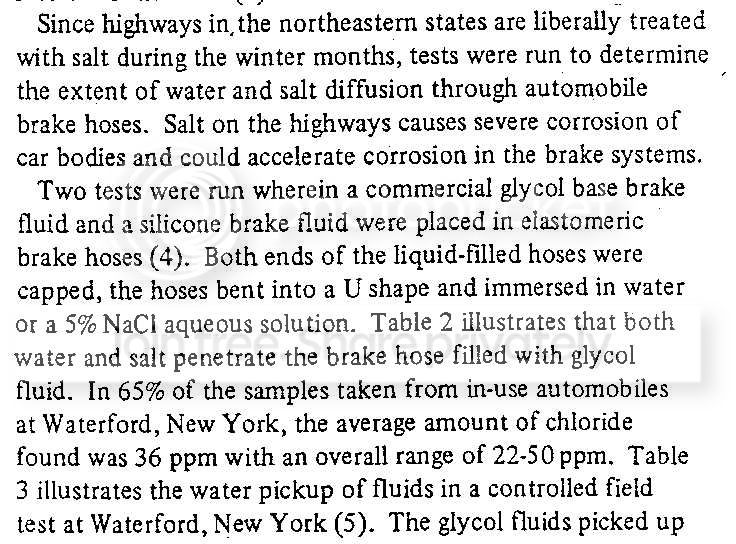
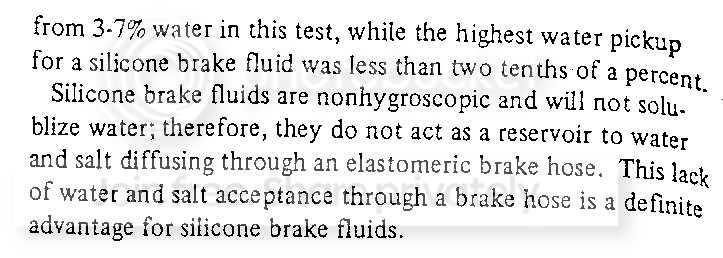
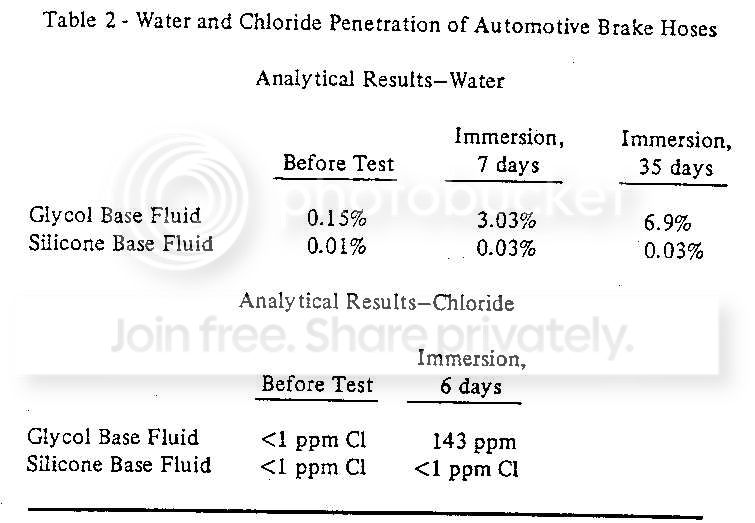
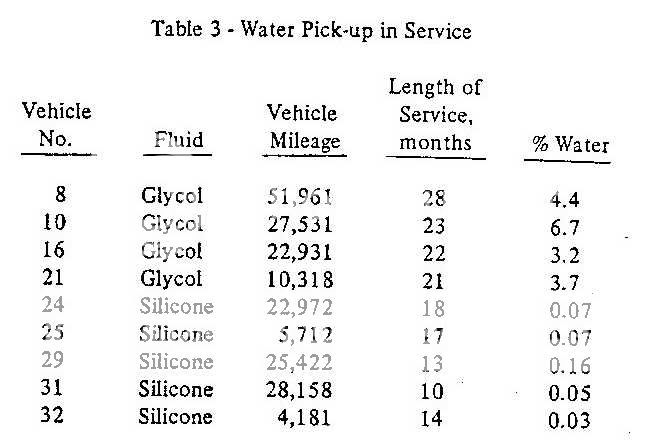
That same paper, presented by G.R.Browning (of GE) to the SAE Automotive Engineering Congress in 1974, had this to say (sorry for the poor quality scans, all I have):

Browing1.jpg

Browing2a.jpg

Browing2.jpg

Browing2Table3.jpg
 
Like Frank, I started using Silicone brake fluid when I restored my TR4A in 1985 since I was really concerned about damage to the paint and at 25, all the money and effort I was putting into the car! It was a daily driver for 75,000 miles and I never had any problems. Also, did the same for my wife's 1968 Spitfire when I redid the brakes and clutch hydraulics in the 80's as well.

All of my British car hydraulic work has been with Girling rebuild kits during the 80's and early 90's including lightly honing the cylinders. I'm not sure how that plays into the comment regarding Silicone not being compatibile with the surface finish with current replacement parts.

Scott
 
I am still wondering about surface finish, too.

In New Yawk, I would imagine more of an isue with salt getting past boot seals, onto surfaces of wheel cylinders external of inner seal, and ingress as seal wiped edges during normal operation, especially if exposed surfaces were rust pitted.


That one has me stumped.

If salt is going to ingress, one would imagine brake fluid (especially the "thinner" DOT5) would egress through the same point, no?

This REALLY reminds me of Lithium Battery debates.
There are those who say they are wonderful, and those who have websites with pages of houses, cars, etc. catching fire from Lithiums, blowing up on and off charge, laptops going up on film, even.

For a study done in 1974, one wonders why that isn't a main "propoganda" point in this, and why is is ignored by most (like, first time I've ever heard of it).

I don't know, on some, but I do know that anything you put into your brake system that will magically clean DOT3 or 4 out cannot be good for the rubber bits.

One of those things that need to be scrubbed, not washed.

Having black stuff in my fresh fluid can be dismissed.....but I would want to know where it came from.
Hoses?
Residual glycol-based (as one of the links purported)?
Seals going bad?

Any of the above cannot be good.

And why do some sites warn about flushing MORE frequently with DOT5?
And why do racers recommend bleeding WATER out of calipers with DOT5 before races?

Did they just make that up, or, like most racers, is it based up hard-learned experience?

Why do some say DOT5 holds the water encapsulated, yet others say it doesn't get any water at all?

If it doesn't get any water at all, why do racers bleed water out of DOT5 equipped calipers?

Why have some of us in shops had rusted tracks on the bottom of cylinders with DOT5?

Why the warnings about DOT5 turning to silica during combustion if the booster fails?

I mean, simply for the higher heat handling, I do use it in the clutch on my street rod, so I am not saying I don't use it.

But, when the suppliers tell me, as a shop, that the seals will NOT handle DOT5, NOT to use it, and as we see from the first post in this thread, "warranty void" if you DO use DOT5?

Why do you not use it in ABS equipped cars?

Why is the US Army, biggest user of DOT5, investigating using something else?

Lots of questions, and, unfortunately, too many varying answers, it seems.
 
FWIW, I worked for a company that was one of the early users of Lithium batteries in portable devices; and we did have a problem with them blowing up. It was possible for the wires from the battery pack to get caught in the seam of the case when assembling the unit, and sometimes they would short out. When they did, the battery would overheat and explode. But at least for our unit, the explosion wasn't strong enough to rupture the case and only wound up with battery guts blown all over the inside (and dripping from the seams). I fortunately was not involved, but I recall a friend complaining bitterly about being assigned to clean those units up so they could be returned to the customers (we didn't have enough new units available at the time to replace them).

Not long after, the battery makers started putting fuses inside the packs, so a short would just disable the pack.

As far as racing with DOT 5, I don't believe it's a good idea. There are plenty of better fluids for racing (where they get replaced every season). And DOT 5 does have an unpleasant characteristic: it gets more compressible at high temperatures.

As to all the other things; all I can say is that they seem to be urban legends to me. Everyone you talk to says it happened to "someone else", or on someone else's car where they don't know for sure what happened in the meantime (eg, not getting ALL the alcohol cleaned out before filling with DOT 5). Everyone I know that has tried it for themselves seems to love it.

The cynic in me wants to say that of course any maker of replacement brake parts doesn't want people to use DOT 5, because they would soon have no business!
:jester:

And I still get warnings every once in awhile about coffee exploding in the microwave oven. Maybe we should get MythBusters to test DOT 5?
 
TOC said:
By 1972, hadn't Triumph gotten clear of the Girling requirement in brake fluids?
I don't know when it happened; but I do know that American brake fluid ate the genuine Girling seals that I bought new in 1978 for my TR3A. I redid the seals at all 4 corners plus the MC, with all new fluid (Wagner brand I think) and after a brief test drive parked the car for several months. When I returned to it, the system was nearly dry and 3 of 4 wheels were leaking noticeably. The fluid in the cylinders was dark, the rubber seals were gooey to the touch, and would leave black marks on your hands.

Made a believer out of me.
 
As Randall pointed out above, my concern regarding the DOT-3 recommendation on the new TRW master cylinder I purchased was that I was always advised to NOT put DOT-3 (American DOT-3) in British cars for the very reason Randall experienced. TRW cannot know if all the seals in my car are of the same standards as their new cylinder. Therefore, their recommendation that I use DOT-3 fluid (or void my warranty) seems a lot more dangerous than my use of DOT-5.

I also agree with Randall that MOST of the reasons cited for NOT using DOT-5 fall into the urban legend category. They are always something reported as happening to a friend of a friend.

As for racers recommending flushing DOT-5 at each race... I don't know any racers who use DOT-5 so I can't comment. Most racers I know (vintage crowd, not SCCA or other) use other brake fluids so they have not said anything about flushing at each race.

I am NOT in the military nor have I been and I invite comments from those who are. However, I have noticed a common theme on other topics regarding why the military may choose one item or another. There is frequently a focus on choosing things to be easily field serviceable with consistent results. As was pointed out earlier in this thread (and in countless others) the need for DOT-5 to be carefully bled and the need for the fluid NOT to be shaken to trap air bubbles seem like immediate red flags against its use by the military. Again, not being a military guy this is only speculation on my part.
 
dklawson said:
There is frequently a focus on choosing things to be easily field serviceable with consistent results. As was pointed out earlier in this thread (and in countless others) the need for DOT-5 to be carefully bled and the need for the fluid NOT to be shaken to trap air bubbles seem like immediate red flags against its use by the military. Again, not being a military guy this is only speculation on my part.
:iagree: Another possibility is that the requirements that originally led to the development and adoption of DOT 5 no longer apply. Legend has it that the requirement was to be able to store vehicles at remote, unattended locations for years or even decades and have them ready to go at a moments notice. DOT 3/4 is clearly incompatible:
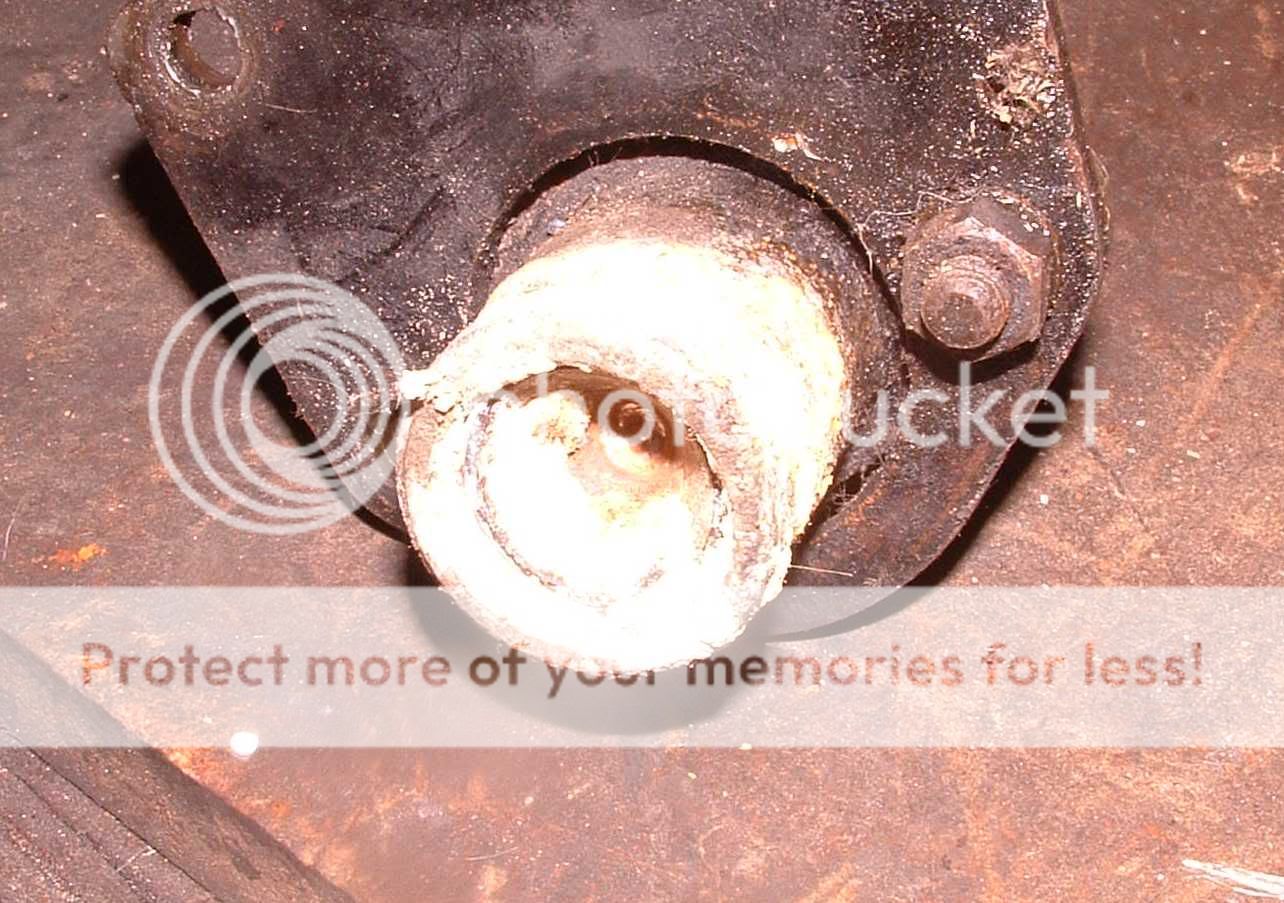
DSCF0002_cropped.jpg


But perhaps today they have enough airlift capacity that the need for keeping caches of vehicles all over the world is reduced. And there is a big advantage to not having a mixed fleet of vehicles. Likewise, just a WAG, I don't claim to understand military thinking.
 
And, since most of the bigger trucks seemed to have gone to air brakes?
 
TOC said:
And, since most of the bigger trucks seemed to have gone to air brakes?

I assume you mean a large truck like a semi. I'm unfamiliar with truck air brakes. Are you talking about the cab or the trailer? If trucks utilize air brakes the same way trains do, the air holds the brakes "off" and applying the brakes means dumping the air pressure so springs apply the force. It's a dead-man, fail-safe type system. How are air brakes used on a truck?
 
The primary brakes are applied when you valve air to the actuators. The emergency brake system is on by springs in the actuators until you apply air to the actuators.
 
And, no brake fluid of any type.

Been around a fair abount of "bigger" units.

Huge springs in the cans form somewhat of a failsafe, applying brakes when the air is gone for any reason.

One other item on DOT5.

The ONE application I use it in, on 5 current vehicles, is the clutch on my Willys.

I have never, and I mean ever, seen the wear that the slave exhibits on anything else.

I usually cannot even rebuild them, as not only the piston is shot, but the bore is wobbled out.

I keep a spare cylinder on the bench so I am not "stuck" when it fails.

Why?

No idea.

When I used DOT3 and 4, I would have vapor-lock in the clutch in parades and such, but never destroyed the cylinders like this.

I've had this vehicle since, oh, 1976, and had a hydraulic clutch since about 78 or 79.

Probably 6 ot 7 complete slaves.
 
Thanks to you and startech47 for the explanation on truck brakes.

TOC, on the Willys perhaps it's time to try DOT-5.1. I found the following web link when looking for the boiling point of DOT-5.1
https://www.tccoa.com/brake-fluid/
It has some interesting comments about the original question I asked at the beginning of this thread (concerning DOT-5 and seals). Regardless, maybe DOT-5.1 will be the answer on the Willys.
 
Back
Top