• Hey Guest!
    British Car Forum has been supporting enthusiasts for over 25 years by providing a great place to share our love for British cars. You can support our efforts by upgrading your membership for less than the dues of most car clubs. There are some perks with a member upgrade!

    **Upgrade Now**
    (PS: Upgraded members don't see this banner, nor will you see the Google ads that appear on the site.)
Tips
Tips

Crypt Car Progress Stalled

Peter,

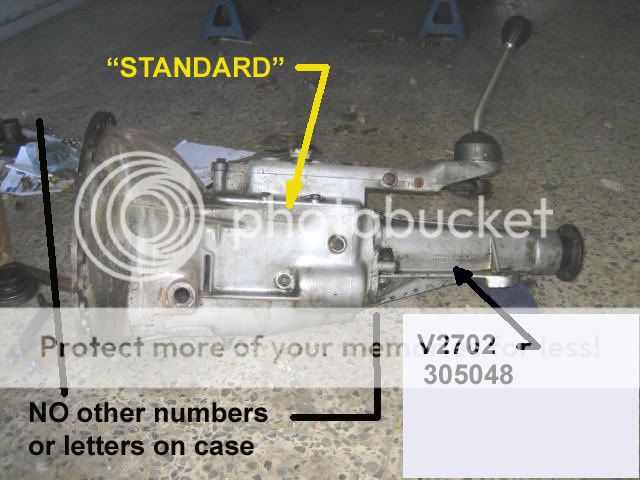
I have the tranny turned this way and that
and even upside down. I have posted and photoed
ALL the ID numbers I could locate.

Here is another photo of the tranny
with location of IDs I found.

thanks, Dale

trannyid2.jpg
 
Hi Dale

On my TR6 gearbox the date of the casting was scratched into the mould so on the "passenger" side (i.e. not the side shown in your photo). It didn;t look like anything until I looked very closely and then I could make out the date (5th Jan 75, for a car with Feb 75 build on the commission number plate, fact fans!). Might be worth having a look for something like that - if the date is '69 or later, at least you would know it was really a TR6 gearbox!

I have a spare gearbox here (from a '70 or '71) if you want any measurements etc. I just had a look and it doesn't have the date scratched in, so maybe that was just done on later ones? The numbers on the rear extension are the same as you show, but on the opposite side mine says "PBM" and on the opposite side of the body (opposite the yellow "Stanpart" on the photo) it says "306812SM V2947"

I hope some of that is useful...
Cheers
Alistair
 
Dale,
The commission number is stamped on the clutch shaft boss as indicated by the green arrow.

Ray
 

Attachments

  • 4164-trannyid2.jpg
    4164-trannyid2.jpg
    75.6 KB · Views: 135
Dale, the "stamped" number is usually very light and hard to see, especially if dirty. The casting numbers (red arrows) are very visible. Look for a machined flat and the number is stamped on it, same as the number plate in the engine compartment.
 
Peter,

Thanks for the advice, I'll try to look closer.

Sadly, there is no number plate in the engine
compartment. Just an empty hole in the wheel
well where a plate once was.

No number on the differential that anyone
could see either. We looked close with the diff
out of the car and cleaned up nice.


Plainly stamped on the engine block tab is
CC4195E which I am pretty certain is a TR250 engine No.

I was hoping the tranny might be original so I could
identify a "real" manufacture number. Looks like
I am out of luck there as well.

dale
 
Even though this is a TR4 gearbox, maybe the photos will help...

4031-4031-111032_34non-odgearboxlh.jpg


In the above photo you see the location of the serial number arrowed. It should be in the same place on your car. It's stamped into the metal, not embossed as a part of the casting.

4032-4032-111032_72non-odgearboxrh.jpg


This particular photo doesn't help much with your questions, but it points out a few other variations as compared to TR2/3 gearboxes. (Note: one exception, TR3"B" would have same gearbox as TR4.)

Notice the bellhousing mounting flange in either photo. This is how thin it was on TR3 and TR4. It was beefed up once or twice later on.

Also notice how this gearbox has to stand on a couple blocks of wood, or else the input shaft (which protrudes approx. 1/2") would hit the floor and cause the gearbox to tilt to one side or the other.

Looking at your photo, I can only guess it's a TR4A, TR250 or early TR6 gearbox. But, I was under the impression the heavier mounting flange (which you have) wasn't used until the 6-cyl. cars.

If it has a "CT" prefix, it is TR4A.

If it has a "CC" prefix, it's TR250/5 through 1972 TR6. CC20000 or higher indicates a 1970, '71 or '72 build date (TR6, of course).

If it's "CD", the gearbox is from '73 through '74 TR6 (this series started with CD75001 and went up from there).

If "CF" it's TR6 from 1975 or '76.

The embossed numbers in your photo are the *part number* for that particular piece. They are cast along with the part and are not sequential like a serial number. That's the part number of the tail piece, in particular. "Standard" is the name of the manufacturer: as in "Standard Triumph". Throughout the car, some parts continued to have either the "Standard" or "Stanpart" label on them even after British Leyland took over in the early '60s.

Regarding the "anti-rattle" plunger and spring you ordered and installed, that part is pretty much universal to all the gearboxes (and just as frequently lost when the shift lever is removed). So I'm not surprised it fit fine, no matter what year was used for reference. I think at some point they used a ball bearing, but the replacement part is now the same for all TRs AFAIK.

As a side note, the gearbox now in my TR4 has an "MG" prefix on the serial number, meaning it came out of a Triumph 2000 (so it would date from 1963-69). This doesn't really tell me, though, if the internal parts are the slightly later ones as well.

For the large part, as complete units the gearboxes are interchangeable, with their most notable external differences being the length of the input shaft and the thickness of the mounting flange (TR2/3 g'boxes have more differences). However, there are enough differences internally that it's useful to know the specific model, if, for example, a rebuild is ever needed.

Glad to hear you have the 3/4" wide shaft bushings in the bellhousing. Those are definitely preferable over the later narrow type. However, although you have the earlier type of bushings, it looks from your photos like you have the later type of cross-shaft that doesn't provide any means of greasing them (you can see the 90 degree grease zerks in the ends of the shaft on either side, in the above photos).

I hope this clarifies.

 
Alan_Myers said:
Also notice how this gearbox has to stand on a couple blocks of wood, or else the input shaft (which protrudes approx. 1/2") would hit the floor and cause the gearbox to tilt to one side or the other.

Yep, TR4's had a longer input shaft than the TR6. The transmission for a TR6 should be able to stand upright on its bellhousing without any aid. Such as Alan's wood blocks. At least that has been an easy identifier between six and four cylinder transmissions in my experience.
 
Alan et al:

I went over to the Crypt this morning and cleaned
off the tranny area where the ID number should be.

Whoa!! I found a number etched.

CD5909

Also, on top of the tranny is some type of
switch with two cut wires coming out of it.
What were (are) they?

My engine No is CC4195E

Question now- I have the 3/4" width new
bushings for the fork bar. Once I pound them into
the case, how do I ream them out so the fork bar
will go thru them? The bushings are solid with no
slice thru them.

thanks,

d
 
Tinster said:
Alan et al:

Also, on top of the tranny is some type of
switch with two cut wires coming out of it.
What were (are) they?

Question now- I have the 3/4" width new
bushings for the fork bar. Once I pound them into
the case, how do I ream them out so the fork bar
will go thru them? The bushings are solid with no
slice thru them.
d

The two wires are for backup lights.

The bushings should not need reaming. If they do, you have a parts mismatch. The missing slot (slice) indicates you have bushes for a later 6 transmission as discussed earlier.

Ray
 
Thanks Ray,

Heading out to a custom fastener store
to pick up some SAE #8s to replace the
DPO's K-mart junk.

I have one Moss bushing with a slot,
part No. 330-230.

Can anyone identify my tranny yet?
and is this bushing correct and I need to
order one more?

BTW. There is only one existing shaft bushing
in the tranny housing. No wonder things got screwed up.

I.m looking for what model and year my tranny is.

thanks,

D
 
Dale,

Alan wrote:
If it's "CD", the gearbox is from '73 through '74 TR6 (this series started with CD75001 and went up from there).


I can only assume that there is a "7" before the CD5909 you mentioned in your previous post and you missed it. This would mean you have an early 73 transmission gearbox with serial number CD75909.
 
Tinster,
You are a real hero. I am sure that I would have given up by now. You keep me entertained here in Scotland during our long winter evenings. Good luck to you.
Nick
 
Anyone with his patience has my vote:

Dale for President!!
 
Harry,

No mistake, I cleaned and looked very close.

I Googled the CD5909 and came up with 1968 TR250

The engine CC4195E is clearly TR250 block.

I am going to bite the big bullet and take the TR6
clutch shaft to the machine shop and have it machined
into a TR250 shaft as close as possible.

I will also have the taper pin thru drilled and a
second thru drill and fasten the fork as recommended
by most.

I posted a photo of the new Crypt at the funeral home
on the Pub forum.

Dale
 
Ned,

While you're here and Dale has everything apart, did the copper gaskets we discussed several months ago, work on the engine lift bolts to stop the oil leak below the cylinder head?
 
Dale

I have a spare TR6 gearbox here - you can have it for the price of shipping if you want. Probably still more expensive than what you have in mind, but it's another option...

Alistair
 
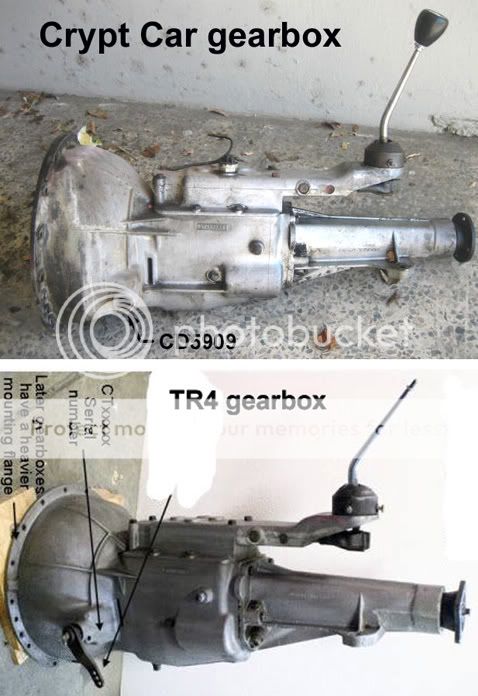
Here is a side by side photo with
Alan's TR4 gearbox cut and pasted for
reference. I stood the tranny on the
wide end to see if the grooved shaft
protruded.

It DID NOT....
but I made a huge oil mess on the floor.

So, since the engine block is without doubt CC4195E
a TR250; is the tranny also a 250 and thus properly
matched?

Everything seemed to fit together well when
I took it apart. My only real issue is the new clutch
fork bar has no groove in the end, but the one I removed
did have the groove to hold it in place with a thru-bolt.

Thanks as always--Dale 83* sunny Bayamon, PR

cryptgearbox.jpg
 
Back
Top