• Hey Guest!
    British Car Forum has been supporting enthusiasts for over 25 years by providing a great place to share our love for British cars. You can support our efforts by upgrading your membership for less than the dues of most car clubs. There are some perks with a member upgrade!

    **Upgrade Now**
    (PS: Upgraded members don't see this banner, nor will you see the Google ads that appear on the site.)
Tips
Tips

carb mixture H6 - exhaust

The older type graphite coated cork seals work very well and are some what compressible. The graphite lubricant makes pulling out the choke easier and allows the return spring to move the jets up against the mixture adjustment nut when the choke is released. If the are allowed to dry out however they can crack resulting leaks. This usually occurs after the car has sat idle for an extended time.

The o-ring solves the problem of the cork seals drying out. The draw back is that the neoprene o-ring is not as "slippery" as the cork seals. They need some type of lubricant to allow the jets to move when using the choke. Silicone encapsulated o-rings include the lubrication need for the use of the choke.

Do the jet move up and down easily when you use the choke? Sometime if the o-rings aren't lubricated they will grab and roll along the jet.
 
TR3driver said:
That's probably total gibberish, but hopefully you get the idea ?

TR3driver... You keep sprouting this gibberish, because it's obvious that you've probably forgot more then I'll ever know about these cars. I read your posts very carefully, learn alot and try to put the info into the memory banks. Somewhere down the line it will come in handy.

/bcforum/images/%%GRAEMLIN_URL%%/cheers.gif /bcforum/images/%%GRAEMLIN_URL%%/thirsty.gif
 
MGDave: "Do the jets move up and down easily when you use the choke? "

Yes - finally. After I replaced that bent jet a few weeks ago the (vaseline lubed) jets now react easily to the choke cable. That was the first thing I tried to "fix" back in March - only took four months ....

Art: "Somewhere down the line it will come in handy."

Absolutely. But I'm still trying to learn enough to have something to be *able* to forget!

Thanks guys. I'll be back at work (OSV.org) for the next couple days, but you know what I'll return to doing come next week ....

Tom
 
One other tidbit that might help someone : the outside finish on new jets is supposed to be mirror-smooth. The new jets I've seen recently were much rougher than that. A little bit of polishing in this area should go a long way towards easy choke action and long seal life.

I buffed mine up using proper buffs and a series of abrasives from HF; but you could improve them just using toothpaste and your fingers.
 
Tom,
I am no expert on this, but from what I can remember the upper bearing is held in place by the spring pressure of the spring between the two cork jet glands. The main nut holds everything in place, but I don't think it will move the upper bearing up or down in the body.
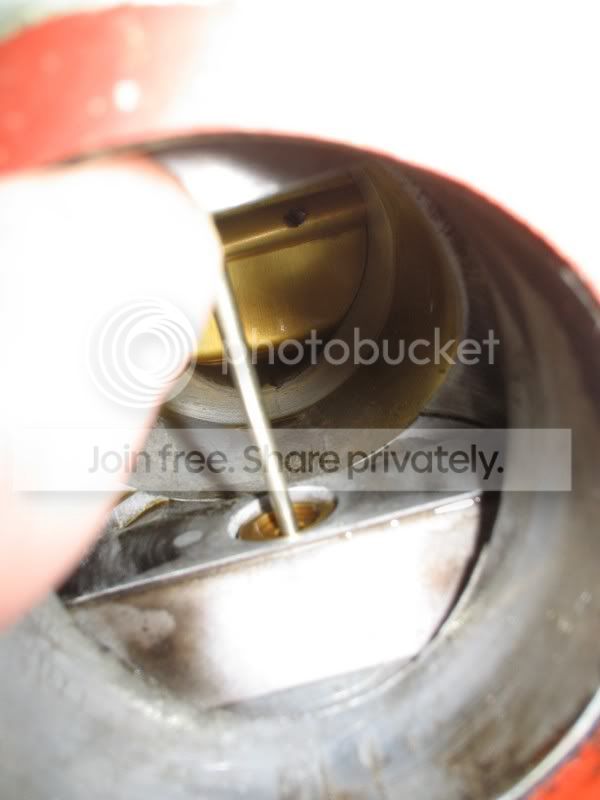
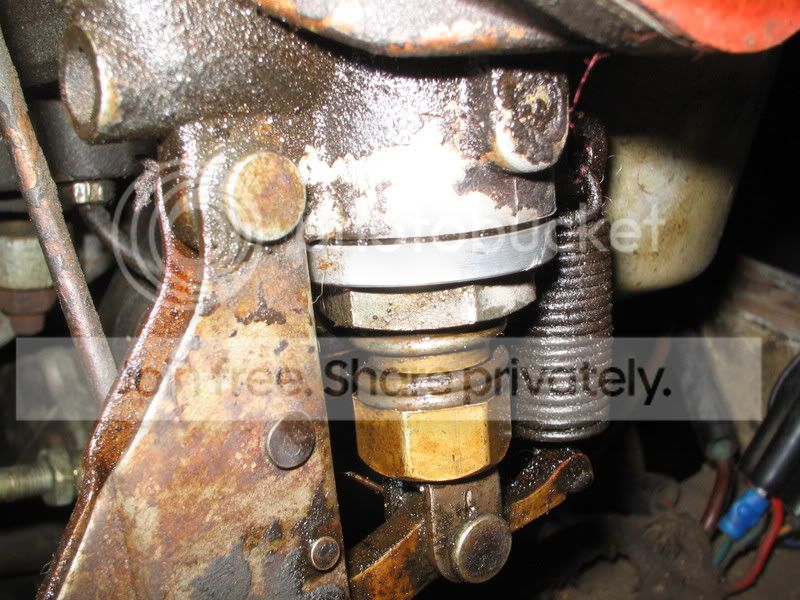
As it is a typically wet Saturday here, I have taken the opportunity to pop into the garage and have a look at my carbs. My upper bearing sits about 1 mm below the top of the bridge and the jet is about another 1/2 mm below that. My main fitting nut is quite close to the body of the carbs. I can remember when fitting these in the past that they seem to come to a stop as a result of tightening against something more than the cork washer.
If you excuse the dirt, have a look at the pics.
2007001.jpg

2007005.jpg

By the way we were on Islay and spent a day on Jura and a day on Colonsay. Highly recommended for the scenery, wildlife and whisky!
Nick
 
I went and pulled a jet assembly from the parts bin just to be sure my memory was correct.

The nut presses against a thin copper washer (96 in the diagram on page 2 of this thread), that in turn presses against the lip of the lower bearing (95), which presses against the upper bearing (91), which presses against another washer (90), that presses against the carb body.

The upper bearing is a very loose fit in it's hole; as this is what moves when you center the jet. (The lower bearing also moves in the nut.)

The spring (94) only provides tension for the two cork washers (92) that seal the jet to the upper and lower bearings; through the two cupped washers (93).
 
Nick - thanks for the picture. That is almost exactly what my bridge area looks like, except the jet assemblies are slightly higher up than yours. Randall, what you describe exactly matches what I've got here. Thus, I'm thinking mine are set properly.

Summing up - seems like this rich mixture issue came up when I replaced the unmatched needles with proper SM. The other issues have been resolved, other than the varying idle speed.

When I got the car last February:

- the jets wouldn't lower due to having a bent jet; now fixed by installing new jets (and SM needles).

- the idle speed wouldn't go below 1500, even with throttle screws full out and choke idle cam disengaged; now fixed with proper timing, new points, dizzy lubed, etc.

- idle would slowly vary +/- 300rpm of whatever it was set to (including the "no screw" default 1500rpm).

- there was no evidence of rich mixture (no soot in exhaust or on plugs).

- Champion plugs were gapped properly and had light grey
coating.

- jet nuts were down about 8 turns.

- dash pot oil level was ok.

- old throttle linkage very loose at ball joints.


Currently:

- choke and jets work beautifully

- new SM needles and .100 jets

- idle speed can be set anywhere I want, but if set to spec (600rpm?) the idle will slowly drop and engine gets very shaky and usually dies around 300-400rpm.

- plugs get black soot, exhaust gives slight black soot only when engine is revved.

- jet nuts are fully screwed up.

- dash pot oil level ok.

- all throttle linkage firewall to front carb is new.


Today I'm once again going to try to balance carbs and set mixture (again ...) following factory Service Instruction Manual procedure. But this time with my new throttle linkage completely disconnected (the vertical linkage at the front carb).

Naive question: if throttle linkage is disconnected at front carb, and throttle screws are fully out, and jets are fully raised, and butterflies are fully closed, should engine still be able to idle? Mine does.

Onward. Thanks all.

Tom
 
NutmegCT said:
Naive question: if throttle linkage is disconnected at front carb, and throttle screws are fully out, and jets are fully raised, and butterflies are fully closed, should engine still be able to idle? Mine does.
Mine doesn't. IMO that would indicate a problem : somehow fuel/air mixture is getting past the closed butterflies. Might be that they are poorly centered or worn undersize (or even installed backwards). Another possibility is that the carbs are synchronized so badly that one of them is holding the other open enough for the engine to run (try loosening the coupling between the carbs). Yet another possibility is that the throttle shafts are drilled wrong, so the stop levers hit the stops before the butterfly is closed all the way.

More likely, IMO, your throttle shafts &/or carb bodies are so worn that they are letting the butterflies bind against the carb throats. If so, the only cure is new shafts; but note that replacement shafts (at least the ones I got from Moss many years ago) do not come drilled for the stops. My rear shaft has an extra hole in it for some odd reason /bcforum/images/%%GRAEMLIN_URL%%/smile.gif

You may be able to just replace the old shafts with new. The test is to remove the throttle plate and slide the old shaft over so it's unworn portion comes into play, then try to move it up and down. My bodies were worn and I couldn't find an oversize piloted reamer at a price I was willing to pay, so I drilled the bodies for bushings.
 
Tom,
I can only imagine that either the jets or the needles are not correct. I presume that the jets are supposed to be a standard size and that different needles can be fitted depending on engine specification.
Nick
 
Back
Top