• Hey Guest!
    British Car Forum has been supporting enthusiasts for over 25 years by providing a great place to share our love for British cars. You can support our efforts by upgrading your membership for less than the dues of most car clubs. There are some perks with a member upgrade!

    **Upgrade Now**
    (PS: Upgraded members don't see this banner, nor will you see the Google ads that appear on the site.)
Tips
Tips

Bolts on straight vs tapered steering coupling

tdskip

Yoda
Country flag
Offline
Hi guys - so despite being a later TR4A the flexible steering coupling (#32) she had on her TR4A had straight bolt holds whereas the coupling I received from Moss had tapered bolt holes.

She has straight bolts (#30) currently. Do I need to track down some tapered bolts to match the later coupling? Do I need to track down a different coupling?

I did a test fit and the bolts do snug up and the assembly is solid, but not sure if that will have accelerated wear etc due to the above.

What do you think guys?


TRI-027.gif
 
I'd say if the threads are the same, get tapered bolts or a coupling to use the bolts you have. Don't "mix" the wrong fasteners/couplers (not that you *could* get the tapered bolts to go thru the straight coupling).

It may be fine as-is for a bit, but taking the chance it won't loosen up from vibration or a sudden shock from a pothole or other unseen hazardous thingie is in the category: "Not worth th' risk", IMO.
 
Agreed Doc. I need to get her back as a rolling/steering car so the rebuilt engine (yeh!) and rebuilt overdrive (yeh!) can go in. But won't drive her until I get this sorted.

It looks like Moss only has the straight bolts. Anyone know differently or if TRF has better ones?

Thanks!
 
Tom-

I thought all the flexible couplers now are the countersunk kind - is that what you mean by tapered? I didn't think you need to use any special shouldered bolt for them, but I might be wrong.

Randy
 
Here are pictures to help, I've not been very articulate;

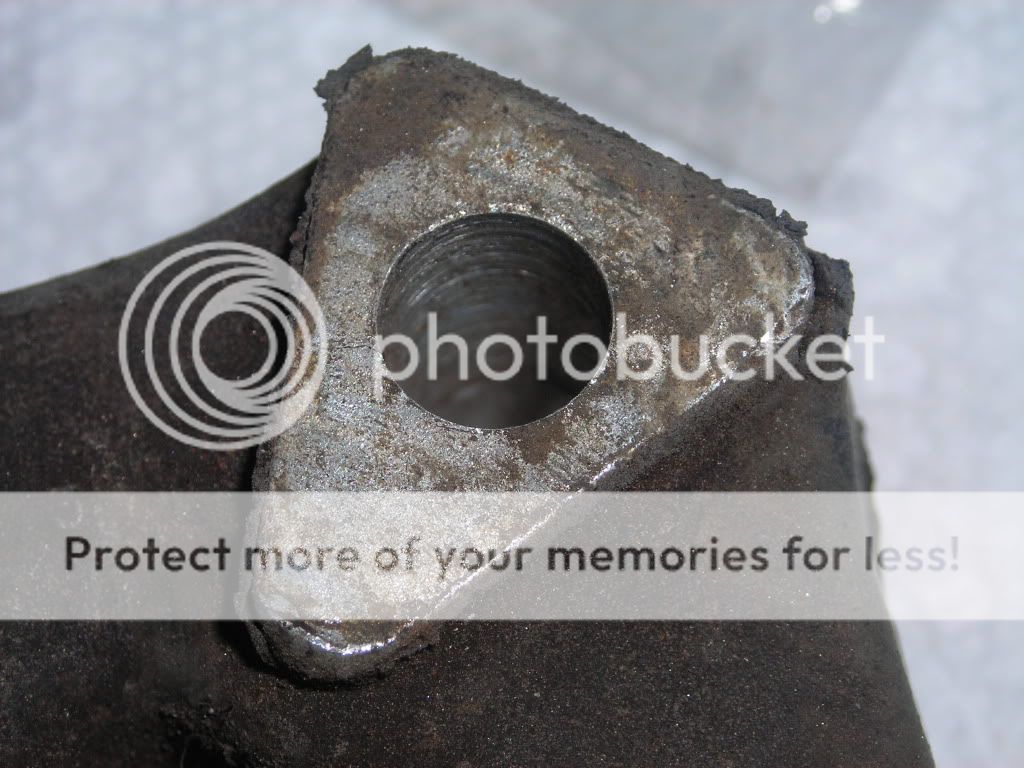
Coupling that was on the car;

TR6couplingquestion6-3-101.jpg


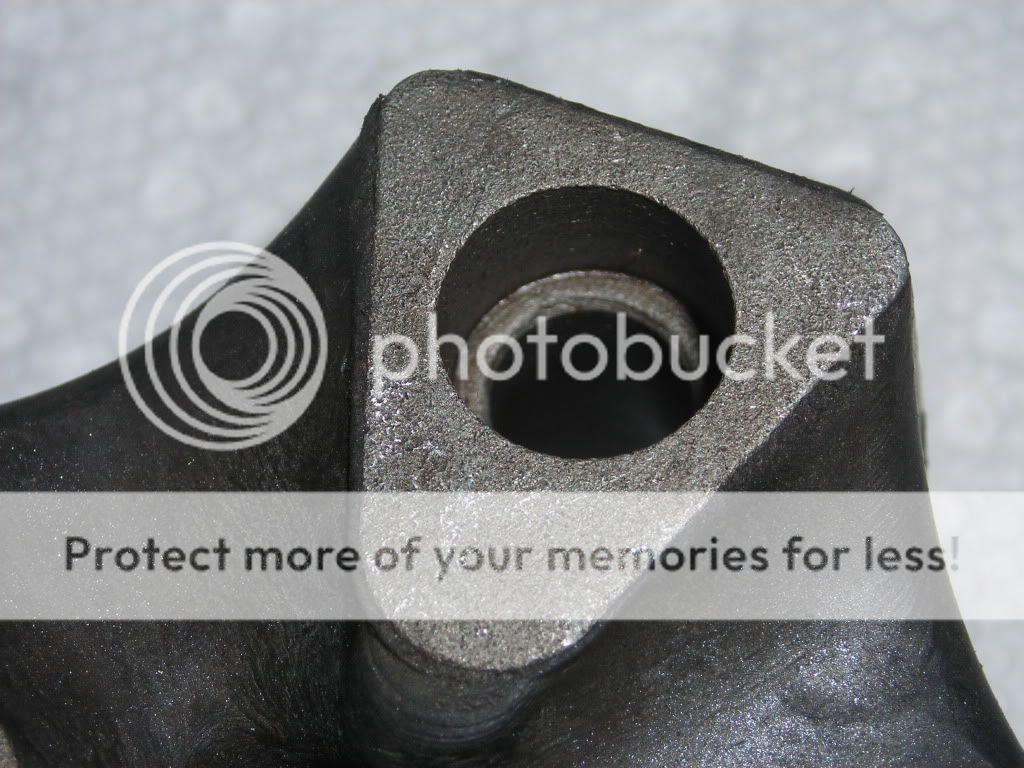
Coupling from one of the Big Three;

TR6couplingquestion6-3-10.jpg


See the offset on the new one?
 
That's so a screw like this will fit right in
standardhead.gif
 
My local Home Depot (OSH, Ace, etc.) has a modest collection of socket head cap screws (like Don's photo). Might be easier to just pick some up than worry over whether a hex head will work OK. (But I think it will.)
 
"Allen head cap screw"... NOW I'm gettin' deja-vu. Get some ~shouldered~ ones of proper length, at least half the length of the bolt should be without thread, better 3/4. I thought TRF had 'em.

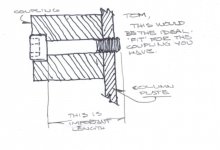
Pardon the poor graphic, done by hand... you can find shouldered cap screws at any good "house-o-threads". Match diameter and pitch, shoulder depth. You can cut off excess threads (hacksaw) and chamfer the ends at a 30° bevel with a file.
<span style="font-style: italic">
EDIT: You guys came in while I wuz playin' "Pictionary"</span>. :jester:
 

Attachments

  • 21627.jpg
    21627.jpg
    53.3 KB · Views: 208
OK What the heck are you talking about doc
This is a shouldered bolt

shoulder_diameter_130x70.gif


That what you meant?
Cause I don't think that will fit
 
Nononononnooo.... just unthreaded. Also termed "shouldered". A bolt can have any diameter shoulder.

...now I gotta go wrest th' camera outta Horsemit's ummm... mits?!? I may not be back...

:jester:
 
Don't you want to use the original bolts (either the TR4A or the TR6 Allen head bolts) as they have holes in them for safety wires? I'm pretty sure that I just used the original TR4A bolts as this looks familiar but I'll check when I can get over to the car tomorrow.

Note that I did convert the lower joint to a TR6 metal coupling (and I believe that I had to replace the lower section of the column as the length is slightly different due to the different coupling).

Scott
 
So what he needs is this
91251A478L.GIF


Which is what I said he needed in the first place :laugh:
Can't remember what size it is so I guessed 3/8's
 
I 'grees with Doc's point, but not his terminology. I think he means "shank" instead of "shoulder". Just like his diagram above shows, you should choose a bolt that has an unthreaded shank.

At least the way I was taught, "shoulder bolt" implies that the unthreaded portion is a larger diameter than the nominal diameter of the threaded portion, as shown in Don's diagram. Typically a shoulder bolt would only be used in cases where you don't want the head of the bolt to clamp tightly, like a pivot point. That is clearly not the case here.
 
Your first suggestion showed threads all the way to the cap, that would tend to allow movement under the typical side loads that particular fastener is under. I thought it should be suggested that a shouldered bolt be used instead, to eliminate the possibility... we've seen bolts with full threads used in similarly inappropriate applications WEAR THE SNOT outta the piece they were wound into over time.

Glad we sorted that out.
 
DNK said:
That's so a screw like this will fit right in
standardhead.gif

We can argie tensile load vs. side load (of fasteners) 'till the cows knock onna front door, y'know. :smirk: :jester:
 
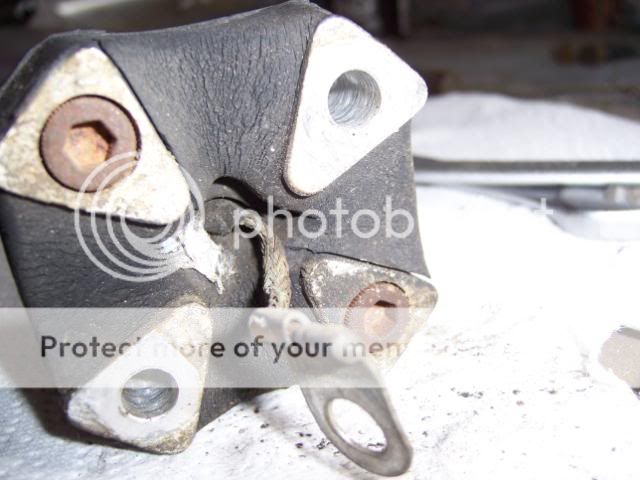
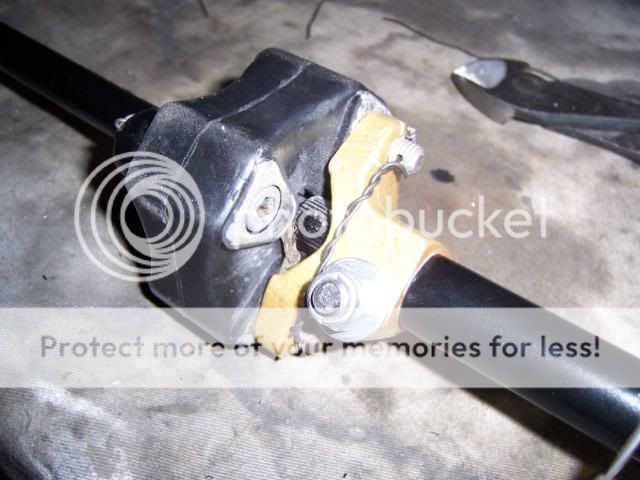
pics of mine as I disassembled it Skip

100_5888.jpg


and re-assembled

100_5912-1.jpg


Cheers,
Dave
 
Got any pix of the bolts themselves, Dave?
 
Oh wait, not all the holes are recessed so can't you just rotate it so the recessed holes are against the threaded adapters and the original bolt heads are on non-recessed holes?

Scott
 
Back
Top