• Hi Guest!
    If you appreciate British Car Forum and our 25 years of supporting British car enthusiasts with technical and anicdotal information, collected from our thousands of great members, please support us with a low-cost subscription. You can become a supporting member for less than the dues of most car clubs.

    There are some perks with a member upgrade!
    **Upgrade Now**
    (PS: Subscribers don't see this gawd-aweful banner
Tips
Tips

1940 Stearman restoration (moved from Triumph forum so all can enjoy)

John, I'm pretty sure that 3mb is the largest a photo can be. I usually scale my photos down to 50% or so to get them under the limit.
 
Thanks, guys. I had to switch computers to one that had the "easy" app to resize. Let's see how this goes....

IMG_3854.JPG


Success! OK, I had a time with the fuel tank. It has seven baffles that are first riveted and then rose-bud welded. All of the baffles in my tank were popped. That is fixable (with a lot of work), but someone had also painted the tank, making the job that much more difficult. So...there are no new tanks available, and all the used tanks look like they were trampled. Actually...they were all trampled! The tank is hard to reach at the top of the wing, so there is a tendency for fuelers to sit on, stand on, and otherwise abuse the tank. I found this tank, and I know from experience that it is the best tank in the country. It cost an arm and a leg in barter parts - and cash - to get it. But, all done and here it is installed in the upper wing center section.

Now I finally get to the wings. The lacing along the ribs prevents the ribs from being moved as the covering is shrunk. Since the front of the wings are covered by thin sheet aluminum, I chose to apply a layer of padding to minimize the dents from normal use.

IMG_3855.JPG
IMG_3856.JPG


IMG_3864.JPG


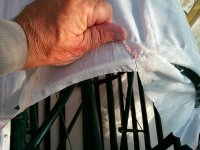
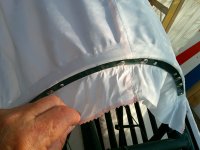
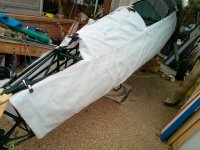
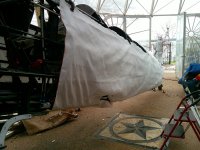
The old Juki sewing machine I have used on my Triumphs for 15 years came in handy to sew envelopes to cover the wing. The covers are then installed like putting socks on your feet.

IMG_3868.JPG


The shrinking with a household iron is done at exact temperatures and using a lot of care to keep the fabric seams centered on the ribs. The end is carefully trimmed and glued down neatly

IMG_3869.JPG
IMG_3870.JPG
 
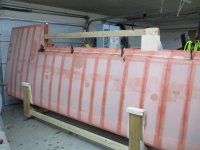
Now, a coat of polybrush sealer is applied by brush. This effectively locks the tautness into the fabric. Unlike dope, is does not shrink the fabric...that was all done by the iron heating in the prior step. In the next photo you can see a reinforcing strip is laid down over each rib, and then the stitching is applied to hold the covering tight against the ribs. Spacing is specifically called out, based on the plane max speed (182mph for a Stearman), and also the area affected by the propeller circle. Each stitch has to go around the entire rib, get knotted with a special sein knot, and then the continuous lacing thread is run through to the next knot. In this area on the lower wing within the prop circle lacing is at least every inch! while this is being done, you must take care to avoid fowling the control rods that run to the ailerons. The darker coloring is 4 coats of polybrush laid down to saturate the cloth so the tape that goes over the lacing will stick permanently.
IMG_3961.JPG


IMG_3962.JPG


Now the wing is pre-coated where the tape will go. The odd dark areas are for "patches", which are additional cloth that reinforces areas that need it. Form here, the additional coats are sprayed. They include:

2 coats of pink sealer (polybrush)
4 coats of aluminum sealer (polyspray)
A sanding down of imperfections
2 more coats of silver...this polyspray blocks the sun's UV light from rotting the fabric, and goes back to the same aluminum impregnated dope used on zeplins.
Finally, 2 coats of final paint (polytone).
Finally, each layer must dry a day before doing any detailing in the paint.

IMG_3955.JPG


IMG_3958.JPG


IMG_3954.JPG


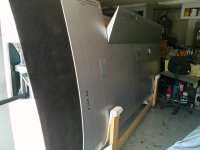
These are the finished top wings. I have been slowed, in that addition to having to spray at least 7 times, spraying must be done above 60 degrees...so the winter weather is slowing me a bit. Fortunately there is still enough things to do indoors on the cold days.

Anyway...Happy New Year to all!!
 
Everything you have posted in this thread is just amazing. Those wings are beautiful although it’s a shame that the structure is now hidden. Fantastic workmanship!
 
Bravo! You obviously care about details, and you've sure studied the construction and airframe in depth.

Next question ... how's the engine and prop?

Tom M.
 
Absolutely stunning work. Bravo on those wings.
 
Very nice work! Years ago I restored my 1929 Great Lakes and I still have nightmares about rib stitching. I swore that I would never restore another biplane, and your wings are much bigger.
 
Thank you, guys. Doc, I hear ya! I watched Youtube for years preparing for the stitching. I realized almost everyone has a slightly different technique to get the same sein knot. I think now I could tie the knot in my sleep...from right side up, to sideways, or even backwards, LOL. On the Stearman wings, the middle foot of each rib is the hardest, as my arms are not long enough to reach and "see" at the same time. I think all the stitching is done now...bar anymore re-dos?!?

And thank you all for teaching me about the on-site picture downloads. Much easier than fiddling with a third party website!
 
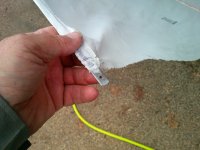
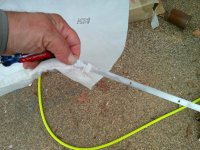
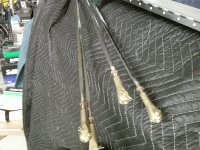
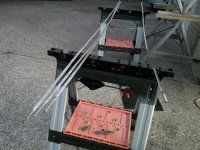
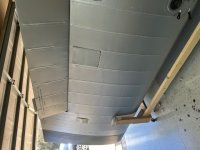
Of interest, there are 2 ribs underneath the walk area of the lower wing near the cockpits. If you think about it, there is no way to stitch around the entire rib, since the wing-walk plywood is in the way. These 2 ribs on each side had to be built with holes every inch, so the stitching can be done around the rib caps strips. There is still no access, though! The solution was to modify a curved needle to reach into the small stitching holes and back out. Those were the slowest stitches by far!

In the third pic you can just make out the stitching holes I circled...

IMG_3531.JPG
IMG_3459.JPG


IMG_3460.JPG
 
Remembering my old Stearman being re-fabricked. I had it done as I had zero time to do the work on it, working 10 to 12 hrs a day, 90 miles from home. You have done a beautiful job putting your plane back together from the mess it was in when you bought it! It will be such a treat to see it done, and I'm sure your feelings are very much the same!
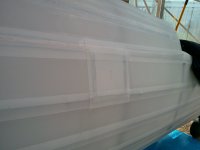
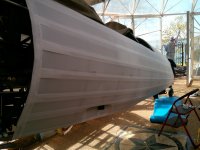
I forgot to mention, I had mine done in Ceconite; my original fabric failed the punch test. PJ :love:
 
Last edited:
Back
Top