• Hi Guest!
    If you appreciate British Car Forum and our 25 years of supporting British car enthusiasts with technical and anicdotal information, collected from our thousands of great members, please support us with a low-cost subscription. You can become a supporting member for less than the dues of most car clubs.

    There are some perks with a member upgrade!
    **Upgrade Now**
    (PS: Subscribers don't see this gawd-aweful banner
Tips
Tips

Dampner Replacement In or Out?

I didn't modify the damper, mounted it as per instructions. Someday, I guess we'll both find out how hard they are to remove...
The first time I installed mine, it wasn't seated all the way. I was able to tighten it further without an impact wrench, just a very long handle.
 
Quick update guys.... Just received all my parts and tools and started today. Made some good progress and took off the starter dog, PIA.

Question, I have the motor-mounts 3/4 backed out, how far from here do I have to jack up the engine? Ive called it for the night, but thinking im not seeing enough clearance from the damper and brace. Im not sure if it needs the whole 3" from crank tip to bottom of damper or leave and just get it loose with a puller and wiggle?

On replacement, do you put a block of wood over and tap it home or the nut to pull in?

Thanks Guys


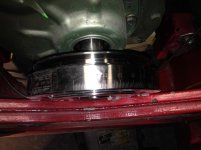
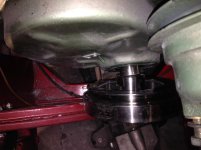
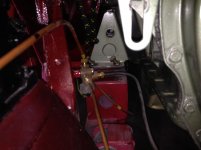
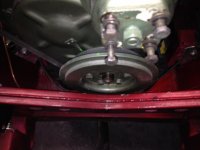
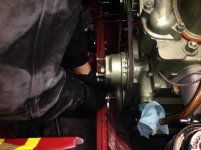
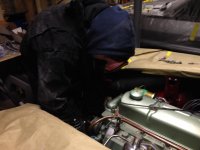
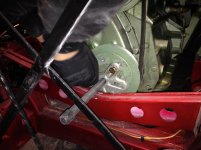
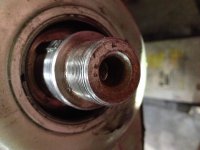
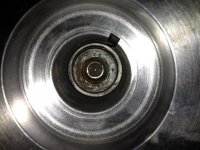
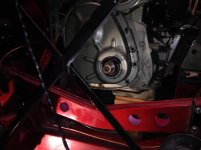
. photo (4).jpgphoto (5).jpg
 
First you'll need to undo the ring of bolts to separate the damper from the pulley, then raise the engine an inch which will give enough clearance to firstly get the damper out then the pulley. A couple of pieces of inch thick timber work well under the engine mounts.
 
Perfect, thanks for that. I'll pull apart in the am. On the re-install, to seat the balencer, do you hit it home with a block across the center, or use the starter nut to pull it in?

Per randy an instructions, I bake the balancer for 20min at 250 then seat quickly. Wondering how snug it is when hot.


QUOTE=57_BN4;918550]First you'll need to undo the ring of bolts to separate the damper from the pulley, then raise the engine an inch which will give enough clearance to firstly get the damper out then the pulley. A couple of pieces of inch thick timber work well under the engine mounts.[/QUOTE]
 
Never done one of those new fangled ones. The stock one can be tapped home with the copper hammer so as a guess that'd be a start and then if it doesn't go all the way crank it up with the nut. 250F isn't very hot in terms of expanding metal so you'll have to be quick as it'll cool rapidly on touching the crank snout.

Look for a groove in the stock pulley near where the seal runs first off and if there is one you'll need to centralise the timing cover as the new hub will rub on the metal lip behind the seal. Recently found that out the hard way. You can use the old pulley for centralising if it isn't pushed all the way home. Andy.
 
Oh you're going to have to use a hammer__a heavy one__so be prepared for that ahead of time too! I don't remember what I used between the hammer and damper, but you definitely want the driving force directed at the hub of the damper, NOT the outer ring. Good chance I just put that impact socket against the hub, and wailed on it.

As Andy alludes to, you're not going to get much expansion at 250* (I still have a higher number in mind, like maybe I went to at least 300, but you should probably stick with the instructions that came with your unit) so acting quickly, and using a lot of force is required.

The threads on the end of the crankshaft snout are very fine, and I would not recommend that you rely too heavily on using them to draw the damper on, even though it makes a nice even tug. I'd keep using the hammer until the "note" of the ring changes from a "ting" to a "thud". Similarly, I wouldn't be too concerned about your thrust washers, As I did the same operation pretty close to ten (<10) years ago, and the engine still hasn't been torn down.
 
All good advice from Andy and Randy, If I may add one thing before you attempt to shrink fit the dampner on...I would first use a micrometer to measure the O.D. Of the shaft, then preset a telescopic gauge to the bore size "I.D" Size of the damper. This way, as your heating the damper you can keep checking to see how much the damper bore size has expanded...the trick is not to under or over heat the bore, just keep using the preset telescopic gauge as you are heating. For a slip fit onto the shaft. I don't know what shrink size your working with here..but I would imagine that it would be somewhere around .001 to .002, you will have to check that before you start. You will need a pair of aspestis gloves and work fast! And yes, keep a nice heavy steel mallet and impact socket ready to use if need be. I hope you have enough working room to swing the mallet if needed! Good luck.
 
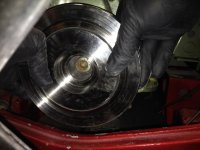
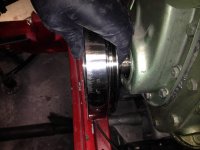
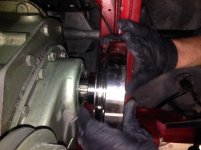
Thanks guys, now at a hair pulling point. Pulled the old pully, but the new one just doesnt have the clearance even with jacking up 3". Any ideas? The bottom lip of the balencer just keeps hitting the cross member causing it not to line up on the crank. Ive tried to lower slowly hoping it would push on a bit, but the angle gets worse.

I have already pulled off a air cleaner from the front carb, now having to pull the next with the choke. looks like I have to loosen the gearbox from the engine to let it seperate for another couple inches?

Have Avery, our HS sophomore doing the gear pulling but its soooo cold and were bundled up in the garage today. Was -10 last night and taking a long time to warm up.

photo (8).jpgphoto (7).jpgphoto (6).jpgphoto (4).jpgphoto (4).jpgphoto 3.jpgphoto 4.jpgphoto 5.jpg
 
Hmm. I loosened them at the point where they come to the cross beam, but you might be right. Eating lunch and thinking of how simple it would have been before i put the motor together and put it back in the car! I also had to loosen the exhaust from the muffler, disconnect the throttle linkage just to get here!

Wonder if it would be easier to loosen the transmission mounts and jacking the engine and tranny up together rather than undoing the bellhousing?
 
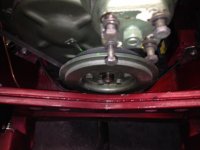
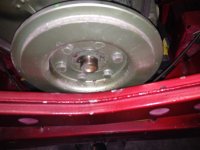
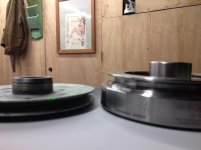
Couple more pics....You can see the nose is a lot taller on the balancer, causing me to need the clearance

photo 1 (1).jpg


photo 2 (1).jpg.
 
Just one more thing I might add to my last post.. In conjunction with heating the bore of the dampner, You can also quick freeze the shaft with a can of compressed air such as they use to clean computers,turn the can upside down as you spray which will release fluorocarbons that will quick freeze "shrink" the O.D. Size of the shaft. Make sure you wipe off the frost on the shaft before sliding on the Heated dampner. The combo of heat and freeze it should fly on! And you may have to hold in place until it locks up. As I said, you need asbestos gloves and work fast! I have used this method on unrelated projects at work. Heat and freeze, of course I use measuring instruments, micrometer, telescopic gauges or inside mic's to measure my progress before I slide the part on the shaft or sleeve a small bore. I have seen guys at work grab a fire extinguisher off the wall to freeze a shaft in a panic! I don't suggest that practice.

I also worked in a machine shop that tapped right into the buildings main gas line with a giant rose bud torch head to heat up giant bearing boxes.. We would place the giant bearing box on a slow turn table, set the giant rose bud torch in the center of the giant bearing box and go have lunch! When we returned, we would check the 5 foot bore with a very large caliper and when it was expanded enough, we would lower in the giant bearing with a overhead crane. Not that all of this pertains to your question, but I thought it might be interesting to some of you.
 
Time to consider getting your original damper reconditioned/rebonded? That looks like a no-fun operation and you're not at the hard bit yet.

The original pulley has a fair size groove from the timing cover touching it.
 
photo 1 (2).jpgphoto 2 (2).jpgphoto 3 (1).jpgphoto 4 (1).jpgphoto 5 (1).jpgOk, it fits!! Was able to get past the cross member by lifting another 1" disconnecting the tranny from the car by the tunnel, Healey Ricks idea!

Now, had to pull the friggen timing cover to change the timing cover seal. I see the ridge in the old pully but it looks like its from machining not the seal?

Question, do I leave just the one thrust washer, balancer, then washer starter nut ?
 
I see the ridge in the old pully but it looks like its from machining not the seal?

That is cut in there by the sharp metal lip on the timing cover because it isn't on central. Change the seal and put the cover back on briefly then reinstall the stock pulley far enough to locate the cover centrally on the seal but not all the way on. Then see if all the bolts will still go in. You may need to enlarge a few bolt holes as they are the reason it wasn't on centrally in the first place. Not a brilliant bit of engineering. Once you are sure that the cover can go on centrally and all the bolts can take a thread then apply a reasonable amount of silicone sealer to the gasket- they normally leak around the flange if a regular smear of sealer is used. Then refit the stock pulley as before to centralise it again and tighten the bolts. You should then have moved the sharp edge of the cover far enough away from the new pulley so it can't cut another groove in it.

Andy.
 
If you leave the garage unheated, I think -10 degrees is about as good as you can get for freezing the shaft. Heat the damper and you should have a good bit of size difference.
 
If you leave the garage unheated, I think -10 degrees is about as good as you can get for freezing the shaft. Heat the damper and you should have a good bit of size difference.
Yes working in a frozen garage will help for sure! I have used the quick freeze method as I described getting the surface to - 58 degrees or more. Anyway, it looks like kkaa has everything under control and is making good progress.
 
Strike two. The first strike was the trying to get the space needed for the balancer to get started. The second, failed getting the balancer seated today completely. Thankfully, I had my gear puller near by and we were able to pull off, but have to say, this is a TIGHT TIGHT! We boiled the balancer in water per instructions, used a jack pipe handle against a piece of 2x4 that rested flat on the balancer. Pummeled the pipe till the wood had 1" holes and couldnt get it more than half way seated. What took the longest was making sure the keyway was lined up, that was probably just 2 min, but enough to kill us.

I think for sure I had the power was enough behind the blows, but the give in the wood block took away the inertia I needed to send it home im thinking. Below is a witness mark of how far it made it on, only half way.

Tomorrow, im going to grind down the socket to fit into the balancer like Randys, or send to him. Ill also build a pipe or box tube with a flat end to hit with a sledge! Its on like a prize fight now!


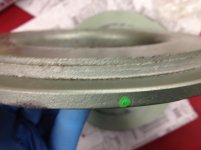
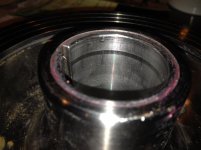
Also, some pics of the old damper. Please please tell me it was bad, that the preventive maint was for sure saving me from a certain catostrophic event and this was worth my time. Like, a story that was certain to unfold, like that the car at high RMP would have sent the starter nut into space and taken out an orbiting satellite, landing on my lawn!. Please tell me this!!
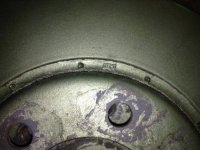
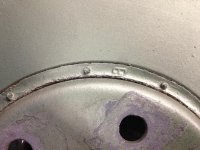
photo 1 (3).jpgphoto 3 (2).jpgphoto 4 (2).jpgphoto (9).jpg
 
Good idea. I can run to the auto store in the am and see if they have cans of it. I think this time we bake the balancer ( the second option per instructions) and then freeze right before we give it a go. Ill try to video tape it, but im thinking you need to be aware, it may contain profanity :smile:

Yes working in a frozen garage will help for sure! I have used the quick freeze method as I described getting the surface to - 58 degrees or more. Anyway, it looks like kkaa has everything under control and is making good progress.
 
Cant go that low, would freeze some pipes, but will look for the quick freeze at the auto store when they open..... Good idea!
 
Back
Top