• Hey Guest!
    British Car Forum has been supporting enthusiasts for over 25 years by providing a great place to share our love for British cars. You can support our efforts by upgrading your membership for less than the dues of most car clubs. There are some perks with a member upgrade!

    **Upgrade Now**
    (PS: Upgraded members don't see this banner, nor will you see the Google ads that appear on the site.)
Tips
Tips

Where does it end....

davidk

Jedi Trainee
Offline
I recently pulled the head and sent it to TSI to have it rebuilt and shaved to raise the compression. To confirm the total compression ratio, I filled the cylinders with acetone. I found that two of the cylinders leaked down pretty quickly (50 ml in 10 minutes or less). I really, really don't want to pull and rebuild this engine. I'm considering buying new rings, rod bearings, and maybe rod bolts, lightly honing the bores, and putting it all back together. Will this last a while? Has anyone done this? Thanks for your help.
 
The rings are just supposed to keep most of the oil out of the combustion area. I don't know if even brand new rings in a newly machined cylinder would keep Acetone from leaking through.
 
Hard to say how well it will work based on that information; but if the walls look to be in good shape, new rings will almost certainly help. Look for scoring or discolored areas; plus of course how big the ridge is at the top to judge the condition of the walls. Even with visible damage, new rings will still help, some.
 
David:
I have no idea what "confirming the compression ratio" means.
The compression ratio is a calculated figure, derived by comparing the volume of the cavity in the head where the valves and spark plug sit, with the overall volume of the cylinder, measured from the top of the stroke to the bottom. This is assuming that the pistons are flat topped, and nether extend above the level of the block, nor are the pistons dished or depressed below the level of the block. The volume of the head cavity is measured with the head off the car,upside down, while a liquid is poured into this cavity to determine its volume.
At this point in time you probably just want to insert a compression guage in each plug hole and measure the compression developed, comparing each cylinder with each other. This might give you a better feel for the ring comdition.
If your engine is high milage, and using oil, you may find that your new valve job has increased these problems, and a ring job may be in order.
Good luck, Emmett
 
I agree with Tony and Randall.

Remember that the compression ring has a gap and the ring below it has a gap and the ring below that has a gap. Over time, a liquid as thin as acetone will leak down through the gaps and even in behind the rings themselves if left in long enough.

To Randall's point, once you get the pistons out, look at the cylinder walls and you will see if there is any damage that a light honing will not remove. I suspect that if it took 10 minutes to leak down, that you have pretty good compression and you may still even see the original cross hatch pattern on the walls as when I took mine apart.

It's probably better that you do this now. Raising the compression ratio and sealing the head tightly will put more stress on those 30+ year old rings and bearings. You know that you will be running it harder just to enjoy your efforts. Swap them out and drive another happy 50,000 miles.

Last recommendation. Install a new oil pump while you're in there. JMHO.
 
Okay, using a solvent on top of the piston tops will give an indicator on what shape the ring seal is on MODERN engines... Your engine has many years on its belt and many miles under it's oil leaks.

Like the others have stated. The gap in the rings, when properly assembled will not be aligned. But after many miles I have torn engines down that often do have the top two ring gaps aligned... And on tighter bores with modern chromemoly rings...


So, either tear it down or put it back together and use some GM top end cleaner to soak away the carbon buildup.....

Who knows, might get lucky..
 
Thanks for your input guys. I have mic'd the cylinders, and have no more than .003 wear (assuming the original bore was 2.940. The cylinder walls look good, and I can't hang a fingernail anywhere (if that's an accurate test for scoring). I did the acetone test at three heights in the cylinders, and if a cylinder leaked, it was pretty consistent at all heights. The ridge at the top of the bore isn't bad, but isn't there a tool to reduce it? Also, any recommendations on brand for rings and bearings, or for type of ring compression tool to use?
 
David- If the fuzzy memory serves me, when I did mine for Ted it was a brand new (Redone) engine and I had acetone all over the garage.
 
AE makes good rings and King makes good bearings. Make sure, as Ron stated, that you follow the manual for the clocking of the rings to get the positioning of each row correctly with one another and that all pistons go back in with the arrow pointing to the front of the engine.

KD Tool used to make good cylinder ridge reamers and hones. I'm sure that Matco, Snap On, Craftsman or any of the big suppliers will have good tools for this at reasonable prices. Well, maybe not Snap On, but the rest will.
 
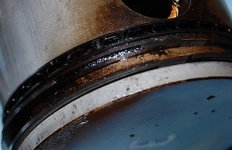
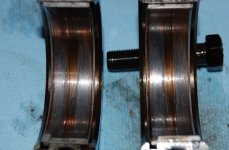
The pistons are out. I found broken edges on the rings of two of the cylinders. I am waiting on a 'dingleberry' hone from McMaster Carr to break the glaze on the cylinders. The rod journals looked great except one. Should I put new bearings on this one, or put the old ones back in since they conform to the uneven journal? My goal here is to get a couple of years out of this engine until I can throw enough money at it to rebuild it right. I have attached pictures of the damaged rings and the very worn bearings. Thanks again for your input.
 

Attachments

  • 14804.jpg
    14804.jpg
    67.3 KB · Views: 268
  • 14805.jpg
    14805.jpg
    66.1 KB · Views: 269
I'm not a machinist, but it looks like you still have a lot of good bearing surface left. The streak of babbitt missing in the middle doesn't look like it came from inadequate lubrication rather from something that the oil picked up that got lodged between the bearing and the journal.
Looks like what damage was done is done and over with.
For peace of mind, at least my mind, I'd probably replace it.
 
Good question Bob. I guess I won't know until it all goes back together.
 
To my old eyes, the bearings look like they have fairly normal high-mileage wear. But I wouldn't put them back in. A new set of rod bearings will help things last for another few years. Be sure to measure the rod journals on the crank just to make sure they are reasonable.

By the way, I see similar wear in the 1500 (Spitfire) engine in my 1500 race Spridget. The 1500 engine is essentially a 2/3 version of the Triumph Six with same rods, bore spacing, etc. I swap out rod bearings on the race Spridget about every 20 to 25 hours and it gets around 15 oil and filter changes during that time. They show wear almost as bad as your's (and my crank still measures perfect from a regrind I did a few years ago).
Don't forget new thrust washers! They're very critical in these engines!

The new rod bearings may slighty bump your oil pressure up a bit too (a good thing).

If your bores are within 0.003", new stock rings will give you a few more years. The dingleberry hone is OK, but wash everything out well afterwards. You do need to get the ridge off the top, though. Even a small one isn't good.

I did a "sympathetic rebuild" on my street MGB last May. Basically the same as you are doing. Didn't pull the engine: just removed head and ground valves plus new rings and rod bearings (but not main bearings). After I honed the engine I put a pile of cardboard and rags under the car and I pressure washed the inside of the engine using soapy water. Then blew it dry and quickly coated everything with WD-40. My "quickee rebuild" has worked out great. Ran 2000 trouble-free miles on it last Summer. But also: I have been gentle with the MGB....it never runs over 4500 rpm. Part of the deal with a partial rebuild is to keep in mind that the engine won't be 100% perfect internally. Keep RPMs lower and driving easy will help get more time out of a quickee rebuild.
My race car gets all <span style="font-style: italic">The Beatin's</span> :laugh:

G'luck!
 
Thanks guys. I'll try to get it back together next weekend and let you know what happens.
 
Back
Top