• Hey Guest!
    British Car Forum has been supporting enthusiasts for over 25 years by providing a great place to share our love for British cars. You can support our efforts by upgrading your membership for less than the dues of most car clubs. There are some perks with a member upgrade!

    **Upgrade Now**
    (PS: Upgraded members don't see this banner, nor will you see the Google ads that appear on the site.)
Tips
Tips

What's the issue with the aux oil line?

swift6 said:
TR3driver said:
70herald said:
The hole there is needed to drill out the oil passage. After the passage was drilled, the plugged it with a bolt. That was the "convenient" way of solving a production problem.
:iagree: Otherwise, it's really tough to drill that hole around two corners inside the head.

Then why go the extra step with tapping the hole for a bolt when they could have simply plugged it like the rear of the oil gallery on the block?

Just a guess, but I would assume that this was the cheapest, easiest and or most reliable method. Or simply they already had the equipment for this available at the time and it wasn't needed for anything else.
 
70herald said:
swift6 said:
TR3driver said:
70herald said:
The hole there is needed to drill out the oil passage. After the passage was drilled, the plugged it with a bolt. That was the "convenient" way of solving a production problem.
:iagree: Otherwise, it's really tough to drill that hole around two corners inside the head.

Then why go the extra step with tapping the hole for a bolt when they could have simply plugged it like the rear of the oil gallery on the block?

Just a guess, but I would assume that this was the cheapest, easiest and or most reliable method. Or simply they already had the equipment for this available at the time and it wasn't needed for anything else.


Kinda like your appendix. Or third molars. Or tonsils.
 
piman said:
Interestingly I saw a picture recently of the Ex Paul Newman Le Taxi (Mk 2 , 2.5 Triumph sedan) racing car which had an external oil manifold alongside the main gallery. Wasn't that one of Kas Kastners engines? I don't quite see the logic in it?
Kas talks about it in his first book. He measured oil pressure or flow at the main bearings and found it to be quite poor. He made the external passages to the mains to get adequate flow or pressure to them to keep from wiping out the bottom end. This is a case of a known problem with an effective cure.
 
foxtrapper said:
piman said:
Interestingly I saw a picture recently of the Ex Paul Newman Le Taxi (Mk 2 , 2.5 Triumph sedan) racing car which had an external oil manifold alongside the main gallery. Wasn't that one of Kas Kastners engines? I don't quite see the logic in it?
Kas talks about it in his first book. He measured oil pressure or flow at the main bearings and found it to be quite poor. He made the external passages to the mains to get adequate flow or pressure to them to keep from wiping out the bottom end. This is a case of a known problem with an effective cure.

But only a problem for racing. Not for the average consumer.
 
Paul (Brosky)
I Quote myself:
"This baffle issue has nothing to do with weather or not to install the extra oil feed line"...
I agree fully that there is absolutely no point putting the alloy valve cover on without a baffle BUT it is still NOT a reason for not using the extra oil feed line. The issue is does it rob oil from the rest of the engine to the point where it is actually detrimental to install it?

Like I said Paul, I do not think that the extra oil feed line is the full cause of oil going out the unbaffled hole. there is oil up there without the oil feed line.
The point is that it is necessary to put a baffle on the alloy valve cover regardless if you have the extra oil feed or not. (I knew it need a baffle before it went on the engine). But this is not the issue...

I Quote Ron:
"The auxiliary line was a patchwork to "bandaid" without rebuilding your rockershaft assembly."
I am not sure why you would say this Ron. I do not think I am alone in saying this is NOT what I was thinking when I installed The extra oil feed line. I think every single supplier of LBC parts might have a different opinion also.

It is like everyone is "skirting" around the question and talking about adding valve seals and a baffle to an alloy valve cover.
Does anyone really know if it ( adding the extra oil feed line)does harm to my engine or not?

OK.... so Ron, just so you do not have to continue to have that new alloy cover collect dust, here is what I did.. (sorry not sure how to put pics right in here).
https://s270.photobucket.com/albums/jj97/ickard/Valve cover oil baffle/
It has been on for 2 summers now and I am not worried about it comming off or loose. It has to be very flat so as not to come in contact with rocker assembly.
It also must be full height of inside wall and only a hole at the bottom.
I am not trying to be controversial...just want to know if I am doing harm to my engine or not.

Rickc

 
Rick I can't really comment on the baffle issue,but seeing how a stock valve cover is baffeled ,that would indicate there is plenty of oil up there in stock form requiring same.A tired stock engine will put oil by the baffle as well, unless by that time there is minimul oil flow due to wear and sludge etc.
That is what Ron is referring too imo.If the rockers are anemic on oil in a tired engine,the bypass line will probably keep things oily.It doesn't repair the underlying reason tho.External oilers were a common add on back in the day on domestic motors.
Will the add on line damage your motor? I doubt it,as long as your oil pressure is with in factory spec.You indicate running the line for two summers so i'd say keep on :driving:
 
I wasn't going to jump back into this but Rickc above stated what I was trying to say from the beginnig. That is that there's lots of speculation here about the oil line, but no proof that it's detrimental in any way. Per Paul's earlier dilemma I welded in a baffle to my alloy cover with no ill effects. That out of the way, and with a young an healthy engine, is the oil line beneficial or not?
 
Rickc, please keep trying to post the pic. I'd like to take a look,too. Thanks.
 
The last time we went round and round on this issue it seemed that there was no conclusive proof either way, just opinion. It also seems that the last word seemd to be do what you feel is best for your situation.
 
Shawn
yes I suppose it could go on forever. I do not plan on taking it off my engine.

Casey (Opa) I agreed fully that there is an absolute need for a baffle on the alloy valve cover and the OE valve cover and as I said, it does not matter if the extra oil feed line is on or not (you still need a baffle).

Casey, a slight misunderstanding. I have had the alloy valve cover on with the baffle for 2 years. The extra oil feed line has been on since I completed the restoration back in 2001.

Sorry guys, I will have to learn how to put a pic right here. Sounds like I need a personal WEB page to do it. You can do a copy and paste of the HTML link into your browser and it will go to my Photobucket.
I admit even with the baffle I have made, there is still a very small amount of oil getting past. My first attempt had more "holes" in it so I re did it with just a small cut out and at the very bottom. This drastically reduced the amount. It is very important to have the baffle go to the top (full height) of the valve cover.

Rickc
 
Testing 1 2 3

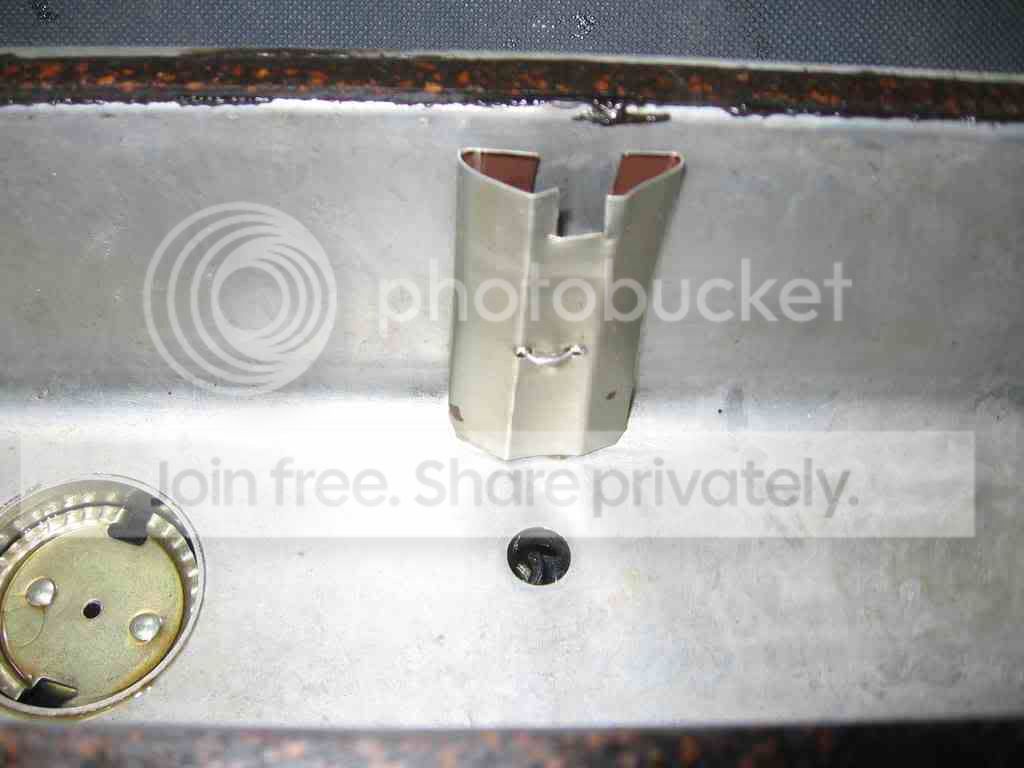
IMG_15055.jpg
 
Wow it worked.
I do suggest you go to my Photobucket page to see the rest of the pics on how it is fastened to the exit pipe.

I guess I need to make the pics a little smaller:smile:
Rickc
 
Or, you can do as I have done and just use a GoodParts oil separator where I dump the oil back into the pan.
 
Bill,

It looks like Rick has found a way to beat the $139 oil separator blues. And my oil pan is drilled and fitted with bungs on both sides in case I decide to go that way.

Rick, now that I re-read my reply, I want you to know that I did not mean to come off as a twit about it. I was sincere about you finding a way and it looks like you did.

I can tell you this. I had 53,000 mils on my engine when I installed it, along with a new oil pressure relief spring kit from TRF. (another potential 50 posts coming up on that comment) My oil pressure was good before the install, and it was just as good after the install. Did it hurt the bottom? I don't know, because after 5 quarts of oil in 1,000 miles, I took it off.

Will I put another one on my new engine? I don't know. I am having valve seals installed, so I can with the stock cover, unless I baffle the alloy cover like you did. Tom Spadafore, who I respect as a builder at TRF loves them, but again, they sell them as well.

I'm going to talk to my machinist about these before I make any decision. Erik of Her Majesty's is up in the air with no preference one way or the other. I can always bolt one on in 10 minutes if I decide to make the move.

There is one thing certain. You can see by the amount of oil in my intake, that they do get oil to the top of the engine in copious amounts!!
 
Can't see the picture.

How is the engine operating? That should answer your question.

A tangent but similar reasoning. Why do some TR's use, successfully, oil coolers and others don't. Not necessarily due to ambient temperature and driving style. More on the condition of the engine and what shape the oil clearances internally are.

If you get a chance, do some of Smokey Yunick's and Grumpy Jenkins readings. Especially on lubrication systems. If I remember right Carroll Smith brought it up in several of his books, but he didn't get into as much detail as Smokey Yunick.

I think you will find Smokey's dissertations on lube, pressure, quantity, volume, and proper flow quite revealing.
 
This is for Paul.

Brosky, take a real good long look, study, of the rocker shaft and where it gets its feed for the valve train. If I remember properly it's off of the 3rd main. If the oil feed hole in the rocker gets any blockage at all, then lube oil to the valve train is cut drastically. I always considered the easiest procedure to correct any possiblity of this(besides keeping the oil clean and sludge free) was to enlarge the rocker stand oil supply hole to at least as large as the feed from the head.


I have never gotten down into studying the flow cycle from the main bearing, but I always wondered what grooving the 3rd main insert would do as far as oil supply uptop. But then realized that the main bearing width is probably borderline for continual heavy load and would not be "happy" taking some of the surface area away.

So, the best solution would be roller rockers, they require lots less oil......
 
RonMacPherson said:
Can't see the picture.

How is the engine operating? That should answer your question.

Ron if you are talking about not see the pics at my photobucket site.
https://s270.photobucket.com/albums/jj97/ickard/Valve cover oil baffle/
then make sure you are looking at the album labeled "valve cover oil baffle".
My engine sounds and runs fine. But then I am not an expert engine rebuilder who definitely knows that the extra line robs oil from the lower end.
Please cut to the chase Ron...does Smokey say not to use it?

Paul (Brosky) hay man, no big deal. I re-read my posts and think I came on a little strong. Not my intention. Just tryin' to get a good reason to remove it...not that I wanted one. So make yourself up a baffle and put the valve cover back on. I must add that the '71 engine also has that extra "breather assembly" on the "out" side of the valve cover. It traps virtually all the oil that comes out the pipe. I drain it once/year and get less than an ounce of oil.
One other small point. Probably goes without saying but I glued the valve cover gasket to the valve cover. Can be reused every time I check and set the valve clearance.
Rickc
 
<div class="ubbcode-block"><div class="ubbcode-header">Quote:]So, the best solution would be roller rockers, they require lots less oil......[/QUOTE]

And all of the roller rocker guys say that they want the oil line added to give them more oil??????

Ron,

I'll be taking the head over to the machine shop in the next two weeks. He will be cooking the block in the next day or so and then it will be in line for all of the work. He's going to match the head to the cylinders as would be expected and also machine the guides for seals. At this point the springs will be checked and the heights will be matched. I'll have him see if he can match the oil passages between the head and the rocker stand.

The two holes pictured below (one on the block, right of the stud and one on the head, left bottom of the stud hole) look to be the same, but I don't have a picture of the bottom of the rocker stand. If I remember correctly, it is somewhat smaller.
 
Back
Top