• Hey Guest!
    British Car Forum has been supporting enthusiasts for over 25 years by providing a great place to share our love for British cars. You can support our efforts by upgrading your membership for less than the dues of most car clubs. There are some perks with a member upgrade!

    **Upgrade Now**
    (PS: Upgraded members don't see this banner, nor will you see the Google ads that appear on the site.)
Tips
Tips

turbo

Offline
i did a bit of searching for this, and didn't see any titles that jumped out at me for the topic.
i'm thinking of getting a TR6 or TVR 2500 and am wondering what the possiblities for making a custom turbo set up are. i have seen complete systems made of other cars, but this engine is surely a bit differnt. i'm wondering about where to get the oil pick ups and whether stock compression is low enough to handle it. is ther any big problem stopping me from just getting a turbo, making a new header, and putting a carb on the outside?

also, i'm not interested in the moss supercharger. the big key here is CHEAP!
 
haha i posted too soon. i did the google search and found the same one. thanks.
but anyway, does anyone on here have experience in this? how did it turn out? what was the cost? what were the snags?
 
valenciamidget said:
i'd also like to do this without "megasquirt" help and possibly using the stock intake manifold

I live pretty close to Lee and have talked to him about his project and toyed with replicating it as well. His project is the correct way to undertake turbo charging a TR6 if you are going to go that route.

A couple of problems you are going to run into, first you need a fresh strong engine, since you are now going to try and push a lot more horsepower.

Carbs respond poorly to turbo charging, which means you need to run some sort of fuel injection. You can either go for port injection like Lee or some sort of dual throttle body injection if you want to keep the stock manifold. So then you will need all of the supporting fuel injection mods and an ECU to run it.

Then you will need to fabricate all of the supporting turbo mods as well. Unfortunately, you do not have the numbers of TR's to necessitate a huge aftermarket crowd, like the turbo kits for NA Civic's, etc. Also, those cars are really much stronger and are already fuel injected as well. The metallurgy on the old British engines is fairly soft and doesn't have the performance margin that some newer imports have.

I am afraid there is no simple way to turbo charge a TR on the cheap or easy, you have to pay to play.

If turbo charging was easy Moss would have come up with a turbo kit, instead of a draw through carb surpercharger set up. Also a point of note about the supercharger kit, they are not seeing a huge increase in power because without all the sensors and optimization afforded by an ECU system, the engine can't safely be pushed.

Good Luck and I don't mean to be a nay sayer but this is a subject that I have already pursued.
 
kas kastner did this back in the 80's ive heard. in case you dont know kas was the triumph competitions dept. head when the tr6 was new. if you go to his site, kaskastner.com you can send him an email about any tech problems/advice, ive spoken with him before and he is helpful and a nice guy. if you do go this route maybe you could post what he has to say here.
Randy
 
crj7driver said:
valenciamidget said:
i'd also like to do this without "megasquirt" help and possibly using the stock intake manifold

Also a point of note about the supercharger kit, they are not seeing a huge increase in power because without all the sensors and optimization afforded by an ECU system, the engine can't safely be pushed.

Good point. Just about the only reason you can get big, easy horsepower from turbocharging modern engines is because of the extremely fine control of both mixture and ignition timing that the combination of O2 sensors, knock sensors and an ECU running it all gives you. Without that, make sure you have a good line on cheap replacement pistons, rods and valves, because you'll need them. Or, alternately, run such a conservative setup that you don't make enough extra power to make it worthwhile.
 
How are you going to get a carburettor to handle the overpressure?

You aren't going to try to make a wet turbo setup are you?
 
I've never seen a turbo setup that used a carb... I'm not even sure it would work, since a carb isn't a very good vacuum/pressure metering valve. The boost would just blow the carb open and you'd be running at full throttle. And since turbo's run so hot, there's no way to mount the carb to the turbo inlet. The fuel would just ignite there before making it to the engine.

A TBI system is really the only cheap option, and that means using megasquirt.

If all you want is more HP, a new cam and lifters will get you there. New exhaust helps. Ram air, etc... All the usual tricks still work, even on these old cars. You can even take it up a notch from there, running aluminum heads, decking the block for better compression, and so on.
 
the turbo system that kas used had a carb. if you mount it on the pressurized side of the supercharger/turbo charger you need a rising rate fuel pressure regulator in order that you dont run out of fuel.
Randy
 
you are going to mount a carb on the pressurized side of a turbocharger. good luck with that one...
 
alana said:
You aren't going to try to make a wet turbo setup are you?
Scuse me - But wet turbos can work very well. One of my projects was a Garrett T3 turbo with a Holley 500 cfm carb on the compressor inlet. The power valve control on the carb was rerouted to externally reference it to manifold pressure instead of intake vacuum.

Since the carb is on the vacuum side of the turbo, & the T3 is oil AND water cooled, no heat problems at all.

The wastegate actuator was connected to manifold pressure via a dash mounted pressure regulator which gave adjustable boost.

Boost variable water/alcohol injection was also applied to the compressor intake. Takes the place of a very efficient intercooler on the pressure side. A MSD6AL ignition with dash adjustable variable boost timing retard covered the ignition.

About 50 HP worth of nitrous oxide injection was set to come on at full throttle & cut off at 12 PSI boost. No turbo lag. Boost could be adjusted up to 20 PSI while driving, with no detonation on premium gas.

Needless to say, the entire engine was extremely over built to withstand about 400 HP from a 140 cu. in. engine.

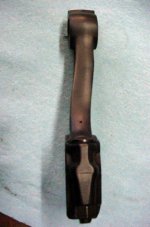
The only real problem was that at full throttle, the stock prepped rods bent fore/aft into an S shape. See attached pic. A new set of Crower I beam rods cured the problem.

Some of the old stuff wasn't so bad, just different.
D
 

Attachments

  • 10823.jpg
    10823.jpg
    98.1 KB · Views: 256
<shudder>

fuel:air mix through a device hooked up to the exhaust pipe.
you are a braver man than i...
 
There is no direct path from turbine to compressor. Not really much different than having an exhaust heated intake manifold. Lots of engines did that.

The engine was originally an early factory 2.3 liter turbo Mustang with boost limited to 10 psi. Apparently, the stock engines didn't have a problem with exhaust next to a wet intake either.
D
 
My experience with turbos has been limited to Diesel engines. The principal is the same, but I guess the gas ones run a bit cooler.

My fear with a pull-through carb setup would be pooling, either in the turbo or the intercooler. If that happened, the fuel could ignite, and then you'd have to stop the engine to make it stop burning.

That just feels dangerous. :smile:
 
Actually the most dangerous situation in a turbo Diesel engine is a failure of the turbo shaft oil seal. The engine's lube oil is drawn directly into the intake as fuel. Goes to full throttle. I saw it happen once on a locomotive engine. Only thing that would shut it down was large amounts of CO2 dumped directly into the air intake with fire extinguishers.

The fuel/air mix is actually "homogenized" by the thorough stirring that it gets in the compressor. Diesel compressors run so hot because there is no fuel to vaporize. Only dry air. Same with fuel injected down stream of the compressor systems.

I certainly wouldn't suggest running air/fuel through an intercooler as you say.
D
 
Most of the modern VWs come with intake shut off valves, which is just a butterfly valve that closes when the ignition is shut off. That (in theory) prevents runaway. The VW tuner folks have decided this hinders performance, and they remove them. :smile:
 
Geeze guys, short memories, or late into the field.

Ak Miller turbo'ed by Dad's (and quite a few others also) 71 Pinto, this was back in 72. The only failing, that I wish had been corrected at that time, was lack of an oil cooler.

Now this was a pinto commute car, 4 speed. It was a bit faster than other Pinto's around town, but once you got it on the freeway under a load, WOW.

We used to go over the grapevine and backoff on throttle pressure and STILL pickup speed.

So carburetors and turbochargers(properly engineered) can be done quite successfully.
 
Wet turbo again.

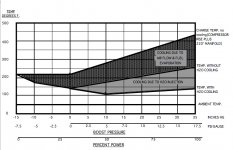
Here is a graph of actual charge temperatures on the 2.3L Ford. I actually installed thermocouples at the intake manifold to head interface.

Interesting how much the wet charge & H2O injection cooled the intake charge.
D
 

Attachments

  • 10826.jpg
    10826.jpg
    130.6 KB · Views: 110
Back
Top