• Hi Guest!
    If you appreciate British Car Forum and our 25 years of supporting British car enthusiasts with technical and anicdotal information, collected from our thousands of great members, please support us with a low-cost subscription. You can become a supporting member for less than the dues of most car clubs.

    There are some perks with a member upgrade!
    **Upgrade Now**
    (PS: Subscribers don't see this gawd-aweful banner
Tips
Tips

TR6 TR4a vs TR6 fulcrum pins [was TR4a shims]

Re: How many shims on your TR4a

this is NOT an area for guess work!! Take the car into a GOOD front end shop and have all the angles read!!!! This is critical in getting the diagnosis right ..
You life depends on good ,safe steering.Damaged vertical links should never be used as they can and do fail.Not to mention tire wear problems.Camber issues of more than a degree or 2 are a major red flag!!!
MD(Mad dog)
 
Re: How many shims on your TR4a

Hi guys - thanks for the input. It looks like I may have an issue with the passenger side vertical link. Anyone has a known good passenger side vertical link, Moss #661-110, I can buy?
 
Hello all,
Just been reading through this excellent topic - as my TR4A has too much negative camber at the front. I'll be checking later to see which way round the fulcrum pins are mounted, but as the camber is greater on the left than on the right I expect I'll need to play with the number of lower wishbone shims too, come what may. Currently there are three shims in each location on both sides. Which leads me to three questions, please. How much, in inches or cms measured at the top of the rim versus the bottom of the rim, does one degree of camber represent? And what is the impact (in degrees - or in distance as measured above) of removing one shim, front and rear? Or putting it another way, if I remove all three shims in one go will this be way too much correction? Finally I know you are supposed to weight the car up, but not having two friends around at present, what, and in which direction, is the effect of weighting the car up? This is just to understand whether my excessive negative camber problem gets worse or diminishes when the car is properly weighted up.
Many thanks,
Tony
 
Hello again,
Further to my above three questions, here comes a fourth, please! I have this evening taken the front wheels off to examine the way the fulcrum pins are fitted : they are fitted curve towards the engine. According to the highly detailed (and TR4A specific) diagram and photos in my original (period) workshop manual this is the correct way round for a TR4A, despite some suggestions to the contrary. My fourth question is to ask whether turning them round (curve towards the wheel) increases or decreases negative camber, and by how much. (I've sort of gathered that turning them round would increase the negative camber and make my problem worse, but I'd just like to be sure I've understood.)
Many thanks,
Tony
 
How badly off is it? I assume you are aware that the TR4A is supposed to be close to zero, not the 2 degrees positive used on earlier cars. (Page 269 in TR4/4A Bentley)

Each degree of camber results in about 1/4" difference (6.6mm) measured between the wheel rims. If you have a nice flat floor, you can make a decent gauge from a carpenter's square with a couple of 6" rulers clamped to it.

I'm not sure about the shims, but I would guess that each shim is somewhere in the region of 1/4 to 1/2 degree.

Another point to check is the crossbrace in front of the engine. If it is missing, damaged or even badly rusted, it can let the frame sag enough to affect the camber. Some racers even modify it deliberately (in classes where suspension changes are not allowed).

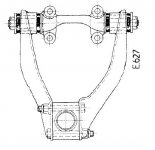
PS, here's a diagram from the TR4A page in the workshop manual
 

Attachments

  • 28653.jpg
    28653.jpg
    31.8 KB · Views: 259
A couple of the TR restoration books point out that the diagram shown in the Workshop manual is wrong and that the "bulge" in the fulcrum pin should be mounted towards the spring tower, even though that looks incorrect. My car had them mounted the wrong way around (probably by me!) after the rebuild and had excessive negative camber. Swapping the top wishbones complete with pins from one side to the other cured the problem. Neil Revington has the full picture here:-

www.revingtontr.com/TR4A-6%20Upper%20Fulcrums.doc

It is not a big job to swap them. Support the lower wishbones on stands and undo 6 bolts per side - 4 on the fulcrum and 2 on the upper ball joint - and change them over. You don't have to disturb springs or brakes etc. Just make sure that you get the 2 bolts holding the ball joint correct. There is a difference. One faces forward and the other backwards.
 
Thank you both for your replies,

The diagram attached by Randall is the one I was talking about - it could hardly be more clear, and it is definitely for a TR4A. Obviously it could have been drawn wrongly, BUT the PHOTOS in the manual also show this same mounting (curve towards the engine). So did Triumph change their minds???

Either way, having spent all night thinking about it (!!! how sad is that? !!!) I realised that turning the fulcrum pins round (moving the curve to be towards the wheel) would in fact decrease the negative camber and so improve my position, thank you.

What is the impact of weighting the car up - what impact on the measured camber? I imagine it will further increase my excessively negative camber? Is that right?

Thanks again,
Tony
 
Foura said:
Just make sure that you get the 2 bolts holding the ball joint correct. There is a difference. One faces forward and the other backwards.

Well after spending a while "in denial" I finally got round to removing the fulcrum pins in order to turn them round - it stripped down VERY easily - just waiting for new wishbone bushes to arrive before putting everything back together - and reporting back to the forum.

So one last question, please... ...what difference does it make which way round the 2 bolts holding the ball joint are mounted? (Looks like either way would be the same to me - I must be missing something?

Thanks,
Tony
 
Tonycharente said:
Foura said:
Just make sure that you get the 2 bolts holding the ball joint correct. There is a difference. One faces forward and the other backwards.
...

So one last question, please... ...what difference does it make which way round the 2 bolts holding the ball joint are mounted? (Looks like either way would be the same to me - I must be missing something?

Thanks,
Tony

And make sure that the inner bolt points toward the front and the outer bolt points toward the rear as shown in all the parts breakdowns. :whistle: WHY?? I ain't gotta clue! :crazy:

So, is there anyone out there that can come up with a logical reason why Triumph put the bolts in that way? Sure doesn't seem like it should make any difference which way they go. Good thing I have a TR3 and don't have to worry about that issue. :laugh:
 
The reason might be that at full lock the inner wheel rim surface can interfere with the excess threads of the bolt if they are inserted F to R. And R to F only leaves the bolt head and no threads sticking out.

On my 4A with alloys, I had to grind a bit of the upper rear arm to clear the wheels.

or not ...
 
I could see that there might be an issue with outer bolt hitting the rim at full lock in one direction or the other, but the inner bolt wouldn't be anywhere near the rim, so why do they reverse the direction? Besides, I can't tell you how many front ends we've taken apart at out Triumph tech sessions, and no one has ever paid attention to which way the bolts were inserted, and as far as I know, never have we run into a problem with any wheels hitting. Of course, there may well be some after market wheels that may hit to due their offset or other issues. Also, don't forget about the adjustable lock stops. I've seen those adjusted incorrectly and the wheels had problems at full lock. Offhand, I don't remember what they were.
 
Back
Top