• Hey Guest!
    British Car Forum has been supporting enthusiasts for over 25 years by providing a great place to share our love for British cars. You can support our efforts by upgrading your membership for less than the dues of most car clubs. There are some perks with a member upgrade!

    **Upgrade Now**
    (PS: Upgraded members don't see this banner, nor will you see the Google ads that appear on the site.)
Tips
Tips

TR4/4A TR4 Valve Recession?

Don Elliott said:
It was then that I had 8 new valves, 8 new valve guides and 4 inserts put into the head for the exhaust valves by an engine re-build shop and since then I've had no problems. Since then, I've driven another 54,000 miles and only once have I had to make a minor adjustment for the gaps on a couple of valve clearances.

When I rebuilt my engine this spring I did the same with SS exhaust valves.

Only two thousand miles earlier I had the valves ground as a measure to get some time to drive until I had time to do the entire engine. When the head was torn down for the eventual engine rebuild the exhaust valve seats were all pitted considerably. Upon discussing this with a few very experienced Triumph engine people I was told that the seats are hardened in the heads but that the hardening is not very deep and can easily be ground through. It was recommended that the exhaust seats be replaced just to be safe.
 
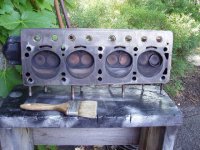
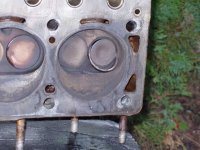
Head is off and much as expected... not horrible but #3 is a bit more recessed than its brothers. Off to the machine shop for hardened seats and whatever else is needed.

I was thinking of using the Stellite exhaust valves -- seems these were the gold standard for years. Are the 'stainless' offered by Moss and others clearly a superior choice?
 
George - In 2000, when I had the engine re-build shop do the inserts for me, I bought and supplied him the new valve guides and new valves. These I bought from Moss. I specified that I wanted whatever they had that would be best for unleaded and I assume that's what I got.
As for the inserts, he said he would supply the hardened inserts. He explained that his machine is set up for his stock of inserts and if I had supplied him with my inserts, he said the interference fit may be different that with his set-up and he would not be able to guarantee that my inserts would not fall out because they might not have sufficient interference fit to hold them in. I had heard about this possibility, so I went with his advice and his inserts. I'm satisfied. More satisfied than a friend of mine who had an insert fall out and jam against the valve, clattering up things and I don't know what else. Luckily, it happened as he was backing out of his garage at home and he stopped immediately so the damage was minimal.
 

Attachments

  • 8259.jpg
    8259.jpg
    68.2 KB · Views: 165
  • 8260.jpg
    8260.jpg
    51 KB · Views: 165
Stellite is a coating applied to valves (and hopefully) seats.

Stainless steel valves are usually very good for a street engineg. Actually both would be good for a street engine. Stainless got it's start in the the dragstrip world where frequent replacement was the norm. Since stainless's start 30 some odd years ago, the composition of the stainless has improved considerably.

For the best treatment, sodium filled exhaust valves would be the "trick" but you're not going to find any at a reasonable price and it's not necessary unless you're building a put it together once, last a lifetime at full throttle engine.

I would recommend going with stellite seats, bronze guides, with seals on the intakes, making sure the guide to stem clearance has been opened, as the bronze guides will expand and can seize on the valve stem, if the clearance isn't enough. Then choose either good stainless or stellite treated valves.
 
Respectful question for Ron (and/or anyone else):
The guy that's doing my head recommended against bronze guides -- so I'm going with what he knows.
What are the perceived dis/advantages of stock/bronze?
 
Bronze guides are somewhat "self-lubricating". Later bronze guides alloys are darn near indestructible. They will last forever. Their wear is less than the iron.

However they do expand when heated up, more than the stock iron guides. so, unless you make sure you have more clearance than with a stock guide you might wind up with valve to guide "hang-up" under a full throttle, heavy load situation.

So if you stay with stock iron guides, might consider sealing them.

I have a friend, a machinist, who has been running double A fuel dragsters for many years now(until Oahu shut it's track down. He uses bronze guides in his Milodon motor(aluminum mostly)
 
There are even some OEMs that used bronze guides in high performance street motors, notably the turbocharged Corvair.

However, the argument goes that the bronze guides have to be reamed larger to begin with and it takes iron guides a long time to wear that much. So, for engines that you don't expect to see a lot of hard duty or put a lot of miles on (which covers most restorations), the original iron guides may be better. Because of the tighter installed clearance, they will actually suck less oil right after a rebuild than the bronze ones.
 
Dropped the head off this morning at a well-respected machinist and had the usual chat about what would be done.

He counseled against the bronze guides, favoring cast iron for pretty much the reasons cited above.

He also suggested that I avoid using valves from Moss as he recently had a serious failure with a valve from them. This was on an MGBGT with 20K on the engine rebuild. I know the car, the engine, the owner and the guy who rebuilt it (very competent) so I think I will heed his advice even though MGBs obviously have a different specific valve.

Valves (stock, stellite, stainless) are available from the usual sources plus he is going to check his own suppliers. Such a (relatively) inexpensive item yet the cost of failure can be high. It's not like we're doing a 12 cylinder engine with a couple of dozen valves.

NOTE: I have no wish to discourage anyone from using Moss valves, indeed that is what I have in my TR3A. The problem cited may be an isolated incident or limited to an MG part. I just pass along anecdotal info FWIW.

I'm sure the mechanic involved (also a Moss distributor) is taking the matter up with them.
 
Back
Top