• Hey Guest!
    British Car Forum has been supporting enthusiasts for over 25 years by providing a great place to share our love for British cars. You can support our efforts by upgrading your membership for less than the dues of most car clubs. There are some perks with a member upgrade!

    **Upgrade Now**
    (PS: Upgraded members don't see this banner, nor will you see the Google ads that appear on the site.)
Tips
Tips

TR4/4A TR4 Body cutting oversize mags Ideas?

mondialo64

Freshman Member
Offline
I JUST PUT A SET OF OVERSIZED PERIOD MAGS ON THE TR4, RUNS GREAT LOOKS SUPER. BUT IN HARD CORNERING THE BODY HAS CUT THE OUTER EDGE OF THE TREAD FROM THE REAR OF THE FRONT FENDER WELL. I THOUGHT ABOUT FLATTENING THE LIP IN THE WELL FLUSH AGAINST THE BODY? A FRIEND SUGGESTED ROLLING THE FENDER OUTWARD. ANY OPTIONS ON LIMITING WHEEL TRAVEL? BEFORE I BEND METAL I WAS CURIOUS AS TO WHAT OTHERS HAVE DONE. THANKS IN ADVANCE CHARLIE /ubbthreads/images/graemlins/eek.gif
 
Install a panhard bar perhaps, to limit side to side axle movement. What kind of static clearances do you have between the tire and the fender lip?
Jeff
 
Hi,

Yes, if you think the axle moving side to side is the problem, a panhard rod might help. There are other things you can do to help keep the axle centered during cornering, though. For example, replace the rubber shackle bushings with urethane. And, one of the British vendors (Revington I think) has special oversize washers to use at the front eye of the springs, to help reduce any flex.

However, I gotta ask a few questions. First, you are talking about a live axle car, right? Not IRS.

Next, just what size tires and wheels are you using? Are they a different offset? I ask because usually clearance issues happen at the front on TR4, not the rear. There is significantly more room for wider tires at the rear these cars. My car had 14x7 wheels on it, fitted with 70-series tires. The fronts would "kiss" the inside of the fender on hard cornering, but the rear tires never touched.

Does your car have all the usually axle limiting buffers and straps in place? There should be two rubber bumpers held onto the axle by wires, and two looped straps over those that limit upward travel. I think it would be easy to change the limit, by adding to the thickness of the rubber bumper or shortening the strap slightly. However, it's hard for me to imagine that would be necessary.

There should also be a sizebable rubber bumper or snubber in the center, too, just above the differential. I don't think this could cause an an issue, unless one of the outer bumpers or straps were missing and the axle were tilting when it came up against the center bumper.

Is there any possiblity the axle has moved forward a little? There are fixing pins on top of the leaf springs, that normally fit into holes on the leaf pads welded to the axle (or into holes in the spacers, if the car uses them). The drive shaft splines could allow the axle to move forward or back a little, if it were sliding on the leaf spring pads.

How are your leaf springs? I've got a heavy duty set on my TR4 right now, can't imagine ever bottoming these out. They are stiff! Bouncing with all my weight on one side or the other hardly moves the car. If I recall correctly, the original springs weren't exactly soft, either.

In answer to your question, yes there are a few ways to flare the fenders. The really Mickey Mouse way is with a saber saw... I've seen that done... on a '63 or '64 Corvette.

Hot rodders used to flare with a baseball bat. Wedge the big end of the bat behind the tire, then lift up as you roll it toward the front and back of the fender opening. A bit crude, but it *will* put a flare in the fender. Some body shops and hot rod shops have a more sophisticated tool that essentially does the same thing, but more precisely with a big roller mounted on an arm that rotates on a spindle that bolts up to the lug studs in place of the wheel.

Flares can probably best be done by a good autobody person who reshapes the fender and adds sheet metal, Or, fiberglass flares can be fabricated and fitted.

However, I gotta say I've seen a couple TR4s with flared fenders and they, uh, left me less than impressed.

Let us know what you do, and post some pictures!

Alan Myers
San Jose, Calif.
'62 TR4 CT17602L
 
In addition to Jeff's questions; what tire and wheel sizes have you installed. What is the offset? I am running 195/65/15 on TR-6 rims with no problems on my 63 TR4.

Edit: Just saw that Alan posted also; he is asking the right questions.
 
The car is not IRS. static it sits with a few inches all around. When I sit on the fender (read that as 200 lbs) I can contac the top of the tire. When coming out of a hard turn the lip was able to slice about two inches in from the edge of the tire.
 
Rubbing is only on the front. Tires are p205 70r14. I will try to post a pic if I can. Not sure the offset?
 
Do you have an anti-sway bar on the front? That would seem like the first step to reducing body roll and better than a sheet metal mod.
 
[ QUOTE ]
...but if I read the original post correctly, the rubbing is at the *front* tires...

[/ QUOTE ]

Whoops, you're right. Don't know how I overlooked that!

Well, basically similar suggestions apply.

However, I'd have to comment that if those tires are cutting 2" in from the edge, they must be extremely wide for the car, and/or the wheels have little offset. There are many other factors that apply, though.

There is supposed to be a rubber bumper/stop on each lower/rear control arm, to limit travel by contacting a bracket on the shock tower at full compression of the suspension. If that rubber "cone" is missing or deteriorated, or the bracket on the shock tower is bent or missing, it's quite likely the wheel & tire would move too far up into the wheel well.

Depending upon when the car was built, there was sometimes a 1.25" thick spacer atop the coil springs. If missing, it would allow the tire to rub. Sometimes "previous owners" removed those spacers to lower the car.

If coil spring length out of the car is about 11", it's the type *not* requiring the spacer. If free coil spring length is between 9 and 10", it very likely needs the aluminum spacer.

A car that was originally fitted with the spring/spacer comboss would be under number CT30000, approx. However, many cars were later changed during servicing... different springs that didn't require spacers would often be fitted to earlier cars. So, the only way to be sure is to remove a spring and check its free length.

There are heavy duty springs that would help prevent tire rub. It sounds as if yours are stock rate and might be getting a bit soft. I have HD springs installed on the front of my TR4, which work with spacers. Bouncing on a front fender with my full weight (180 lbs, approx.) only moves the car down about 1/4-1/2".

One other thing effecting this is a sway bar. My TR4 has a 3/4" bar installed. It would definitely help, if your car doesn't have one.

I've got more clearance than you right now, about 2.5 or 2.75" between the tire and the rim of the wheel well. But I'm currently using 195/60 tires on 15x5.5 KN Minator wheels, which have the correct offset. Also, the front suspension is set up with roughly 3/4 degree *negative* camber, where originally TR4 had up to 3 degrees positive. Negative camber is better with radial tires, plus moves the top of the tire inward for better clearance. These tires, along with sligthly negative camber, do not protrude past the upper arch of the wheel wells at all. They are actually inset slightly.

Frame-main-rail to ground clearance on my car is currently 4.5" at the very front. That will be lowered slightly more soon, simply by inverting the lower control arms, and should end up with 3-3/4 to 4" (90mm) of ground clearance. It looks like there is plenty of tire clearance to accomplish this. In fact, I might end up shaving off a little of the rubber bumper, after tire clearance is checked, to increase travel. However, note that if the lower control arms are inverted this also increases the distance between the rubber bumper/stop and the bracket on the shock tower, increasing suspension travel and allowing the tire to move further up into the wheel well. So, shaving off some of the rubber bump stop may be unnecessary.

Original tires/wheels and suspension setup gave 6" ground clearance on these cars, per the factory workshop manual. You might use this to check if your front springs are sagging. However, tire profile will effect this. Original tires had a diameter just over 25". The lower profile tires on my car are just over 24" tall.

My biggest concern is the outer ends of the upper a-arms, even *after* those a-arms were reshaped a bit to improve clearance. This is largely due to a custom upper suspesion fulcrum, though, that positions the upper a-arms farther apart. There is only about 5/16" clearance between the end of the a-arm and the inner rim of the wheel, when the steering is all the way at one extreme or the other.

Please see Moss Motors TR2-4 Front Suspension Page for illustration. The spring spacer mentioned above is #81. The cone-shaped rubber bumper/stop is #113.

Alan Myers
San Jose, Calif.
'62 TR4 CT17602L

 
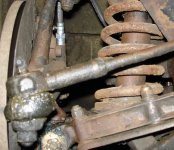
CT is below the cut off, I did notice the spacer per the drawing. Also noticed no bumper. I am leaning, no pun intended, that the springs are pretty week. I will investigate a stiffer spring and bumper before bending metal. THANKS!!! Pic attached
 

Attachments

  • 127094-tr4suspension.jpg
    127094-tr4suspension.jpg
    116.8 KB · Views: 135
Back
Top