Follow along with the video below to see how to install our site as a web app on your home screen.
Note: This feature may not be available in some browsers.
Hey Guest! British Car Forum has been supporting enthusiasts for over 25 years by providing a great place to share our love for British cars. You can support our efforts by upgrading your membership for less than the dues of most car clubs. There are some perks with a member upgrade!
**Upgrade Now** (PS: Upgraded members don't see this banner, nor will you see the Google ads that appear on the site.)
I read in an old thread where someone was asking what to use as a gasket for the end plate of the steering gearbox. There was no real consensus. When I pulled mine apart there was no gasket. I would think that any addition of a compressible material would make it more difficult to set the end float. Randall said he had used copier paper. Why not just use some hylomar or other sealer?
If you use a gasket, you need to include it when you set the float. If you're going to use holymar, you still need to allow a little space for it. I used both and was sure to check it again after it was all together.
I can't tell you how it works, as the rest of the car is not back together yet. At this point it doesn't leak because it has very little oil in it.
I bought a gasket...but really wondered what good it does. I had 4 shims, and no gasket between them. The gasket only seals the cover to the first shim. More British wisdom IMO. I skipped the gasket and used 518 sealant between all.
But the way I see it, both the main casting and the end plate are not perfectly flat (you could still see machining marks on both of mine). The gasket helps take up any imperfections. But the shims are perfectly flat, they have no imperfections to take up; plus they are flexible enough to bend around small imperfections (like those on the main casting).
Call it "belt and suspenders"; I like to use a gasket. I also carefully filed away the machining marks.
Oh and to check the end float, use a dial gauge on which end of the shaft? secure in the vice and set the dial up in a secure way and move or attempt to move it and measure the movement? I guess I don't rally get the process.
Oh and to check the end float, use a dial gauge on which end of the shaft? secure in the vice and set the dial up in a secure way and move or attempt to move it and measure the movement? I guess I don't rally get the process.
The shaft will move the same amount on either end, so it doesn't matter which side you put the dial indicator on. Whichever side is easier to measure, use it.
Put in too many shims so that the shaft moves, measure the end float, then remove that thickness of shims and your end float will be zero.
I would suggest checking the end plate for a flat surface because they can easily warp, especially if the PO tried to stop a leak by over tightening the end plate. I use Indian Head gasket shellac on the shims and end plate. It is very thin and sets up well.
Steve
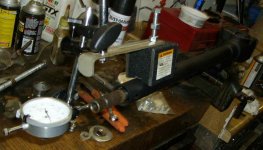
Here's a picture of the set-up I used to do mine (including the jerry-rigged magnetic base). The rocker shaft with peg is removed. Also note the rubber bushing at the end was removed to allow the shaft more free movement. Be sure to move the shaft only in and out in one direction, that is, don't let it rotate or become angled. I used a large flat bladed screw driver between the housing and the worm gear to 'wiggle' the shaft back and forth (adding or removing shims) until there was 0 end float.
When I was done, there was a little resistance felt during rotation because of the imperfections of the bearings. I hope this helps because I didn't really 'get it' until I 'did it'.
This site uses cookies to help personalise content, tailor your experience and to keep you logged in if you register.
By continuing to use this site, you are consenting to our use of cookies.


 Hey Guest!