• Hey Guest!
    British Car Forum has been supporting enthusiasts for over 25 years by providing a great place to share our love for British cars. You can support our efforts by upgrading your membership for less than the dues of most car clubs. There are some perks with a member upgrade!

    **Upgrade Now**
    (PS: Upgraded members don't see this banner, nor will you see the Google ads that appear on the site.)
Tips
Tips

TR2/3/3A TR3 hub removal

bobhustead

Senior Member
Silver
Country flag
Offline
I am leaking rear end grease onto the left rear wheel. It is apparent that the hub has to come off to replace the seals, but I assume that SST puller M86A is not on the loaner shelf at Advance/Discount. Some time ago, for a different problem, I tried a universal hub puller (arms go under lug nuts and the threaded pressure shaft is has a tee on it for striking with a hammer) but failed. If I pull the axle by removing the six flange bolts and brake stuff, can a machine shop press the axle out of the hub? Does anyone have any other suggestions?
Thanks, Bob
 
It takes a GOOD press and slight heating with a torch. When it lets loose, you will have people half a mile away coming out to see what exploded!
 
If this is a Girling axle and you're sure it's diff oil and not grease from the wheel bearing (did you just grease it by chance?) then don't beat on that hub anymore. Just undo the hydraulic line and parking brake, the six bolts holding the bearing housing, grunt and pull the whole assembly out. The axle seal will be revealed and yank it out will a slide hammer and seal hook. Probably should use an appropriate size seal drift, a lot of parts houses will rent out or loan a set. Personally I've screwed up too many seals by not using one. Ciao!
 
Is it grease, or oil? The rear axle is lubricated with oil, the wheel bearing with grease.

If you are getting grease out, most likely the bearing has been over-greased. The factory literature is very specific on no more than 5 strokes per 6000 miles.

If you are getting oil out, then it is the inner seal that is leaking. The inner seals can be replaced without removing the hub from the shaft; just remove the hub & shaft as an assembly and change the seal.

The key to getting the hubs off the shaft appears to be not letting the hub distort during the process. If you just throw them in a press, the press plates are out far enough that the hub tries to fold up like a flower, causing it to pinch the shaft tighter as you apply more pressure. Lots of folks have ruined the hubs that way. The factory tool supports the face of the hub and at least reduces the distortion. There is a dimensioned drawing at the end of this article
https://drive.google.com/file/d/0B2...Y2IzLTg1YWUtZTY0MWFmMWRlMzI3/view?usp=sharing

Here is another man's solution, that reportedly works well
https://drive.google.com/file/d/0B2...OTY1LTljNzEtZDMyNjM5OWFkZTQ4/view?usp=sharing

Personally, I am very leery of applying heat to the hub. Obviously it does get hot in service, but the axles are hardened and as little as 400F can potentially alter the temper, creating a discontinuity that can eventually break. I've never broken one, but I know people who have, and everyone I've asked has used heat to help separate the hubs. So far, I'm having good luck with some very heavy press plates that I altered to fit as closely behind the hub as possible, including machining reliefs for the back of the wheel studs. But I've only done about 5 hubs so far (with no damage), so not really a good test. That includes the one where I destroyed my version of the factory puller, literally crushing a 1" diameter ACME forcing screw until it wouldn't fit back through the nut.

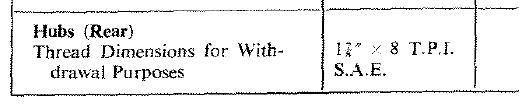
Interestingly enough, I came across a table the other day that describes the thread on the outside of the hub as being for removing them. It would be interesting to try building a puller that screws onto those threads and see how that works.
View attachment 37485

 

Attachments

  • untitled.JPG
    untitled.JPG
    12.6 KB · Views: 160
Last edited:
Should have added, but if it is gun grease then yes by all means take it a shop to have them break it loose. All those three jaw pullers do is warp your hub.

Since Randall has answered, and I apologize for interjecting here, Randall, have you ever considered using a bit less torque in reassembling these Girlng hubs to the axle. I'm thinking about it and then testing for quite a while.
 
If you use the heat properly, nothing gets near 400 degrees, although steel won't loose its temper that low anyway. Aluminum will...but not steel. I do agree overheating is a killer...any critical steel part I have to heat to the point it glows gets trashed. No exceptions.

When done properly, the goal is to load the hub with the press, and then just get the hub warmer than the axle. If you have to hold the torch longer than 30 seconds, refrigerate the assembly a few hours and try again. The heat is worth a good 10k lbs of force, which can be the difference between freeing the hub or mushrooming the end of the axle.


Boy, that "one man's solution" is one of the 7 mechanical wonders of the world!
 
Since Randall has answered, and I apologize for interjecting here, Randall, have you ever considered using a bit less torque in reassembling these Girlng hubs to the axle. I'm thinking about it and then testing for quite a while.
Sounds like a Bad Idea to me. That is what's known as a locking taper, and it needs to be tightly locked. Remember from the hub's point of view, the weight of the car is constantly trying to wiggle it loose. And any movement whatsoever will eventually fret and wear the joint, leading to a ruined (and possibly broken) axle and hub.

John, check the chart at https://www.anvilfire.com/FAQs/temper_colors_hardness.htm (Just the first one I found with a quick Google)
Note how the line at 420F has different hardnesses than the 100F line. (Ok, 420 while I said 400, but who is going to know the difference just looking at it?)

No doubt I'm being overly cautious; but like I said I've never broken an axle shaft while I know of lots who have. And I do run wide, sticky tires, which increase the bending force applied to the hubs in hard corners, and occasionally push them to the limit. See
https://www.tonydrews.com/Jack_Car_2.htm for more info (watch the video). I particularly enjoyed the comment at 1:17
 
I recently replaced the differential seals on my 6. As Randall said, all the plates that I found supported the flange too far out. I built a "tower" and made a set of plates that grabbed it tight around the inner diameter as possible. I used a 100 ton hydraulic CNC press brake we have at work. Started at 30 tons and went up 10 tons at a time. It took 60 tons to pop it. As soon as the ram touched it, it instantly let go with a loud bang. Unbelievable how tight a gradual taper can be !
 
I'm not sure what that chart is used for...but 420 is not enough to heat treat steel. This is what I studied in college. And, I repeat, if you are getting the hub hotter than about 200f, you are already hotter than I am talking about heating it!
 
My press is only 20 tons, but I left out the other step : rap the shaft to set up some vibrations while holding pressure on the joint. So far, 3 or 4 raps is all it has taken to pop it apart.

I gotta ask, John, how are you determining when you get to 200F and not 400F? Holding an IR thermometer while you play a flame on it? In my limited experience, 200F isn't going to do squat with the shaft in such intimate contact. It might if the two pieces were separated and you could chill the other side, but that's not the case here. Maybe my torch isn't big enough.
 
30 seconds with a torch will not get 400f. You heat the hub, not the axle, and that starts a temperature gradient from the outside in. The outer metal is expanding faster than the inner metal. As the temperature gradient crosses the parting line, the hub will part. I've done this on 5 hubs with no issues, and the hub is not too hot to touch afterward. That is how I know I'm not above 200f! The axles are only Luke warm after separating. If the hub gets too hot to touch...you have passed the 200f and need to chill the assembly and try again.

Your answer to the 400f is listed in Colors given in the chart you linked above. That chart looks lke a compilation of various information, not all of which is directly related. For example...color is related to the temperature of steel, but has nothing to do with the temper, grain structure, or hardness. To alter the grain structure, and thus the temper, you must hold the temp above cherry red for several minutes...so time is a factor in changing the temper. The speed of the cooling, however, is what sets the temper. The metal grains form smaller with faster cooling, making the steel hard, brittle, and more susceptible to corrosion. Slow cooling leaves larger grains, making the steel soft and malleable. It's said the best Samuri swords were tempered by running them through a poor slave. At the time the forgers thought it gave the sword a taste for blood...of course we now know it was just a way of controlling the cooling, and thus the grain structure of the blade.

But, to the point, heat is a very effective, non-destructive tool. The problems you see are not from controlled heating, but rather the bozo's who put the torch to the assembly till they see red metal. After all, if a little heat is good, a lot must be better, right?!? Not in this case.
 
30 seconds with a torch will not get 400f.
Depends a lot on the size of the torch. 30 seconds with a big OA is enough to start cutting!
To alter the grain structure, and thus the temper, you must hold the temp above cherry red for several minutes...so time is a factor in changing the temper. The speed of the cooling, however, is what sets the temper.
I'm no metallurgist, so I'm not going to argue the point. But that is NOT the way that every set of instructions I've ever read on hardening and tempering steel says to do it. Hardening and tempering are two separate steps; to harden you heat the steel above it's critical temperature (which is not simply cherry red) and hold it there to ensure the entire part gets heated to temperature; then quench (rapidly cool) it back to (nearly) room temperature.

But then to temper the steel, you reheat it to a much lower temperature, hold to let the temperature penetrate, then cool slowly. The lower temperature is what sets the hardness, not how fast or slow it gets cooled. That chart is a rough guide to the resulting hardness for different tempering temperatures. So the 420F line is saying that if you heat fully hardened mild steel to 420F, you've changed the temper and hence the hardness. And cooling it from there will not re-harden it.

See for example, https://en.wikipedia.org/wiki/Tempering_(metallurgy)
"Tempering is usually performed after quenching, which is rapid cooling of the metal to put it in its hardest state. Tempering is accomplished by controlled heating of the quenched work-piece to a temperature below its "lower critical temperature".
 
Thanks for all the replies. If I had any computer skills, I would preface with about 6 copies of the emotocon of the little guy slapping himself on the forehead. It was 90 wt oil, not bearing grease. Old cracker usage is that 90 wt is "transmission grease". The axle is out, and the axle tube seal is out. The seal was original leather. Excess axle grease is wiped from the tapered wheel bearing. The seal, brake shoes, and lock tabs are on order. Should be up and running in a couple days.

Thanks again, Bob
 
Randall, you are confusing several different processes. "full hardened" is martensite...which you see when you quench something so fast in water that it will destroy even a diamond drill bit afterward. No process used in manufacturing desires martensite, as it will shatter like glass if hit hard and cannot be machined. THAT is what many red necks have done to parts that you see breaking easily...."red hot will loosen it. Too hot? Here, dip it in this bucket". Now you have a hard, brittle, cracked, POS part.

What you mean above is full soft, or completely annealed, for beginning all treating. To get fully annealed it takes hotter than cherry red for a specific amount of time, for all the metal's grain structure to amorphize. Then it gets cooled slowly over several hours. This is how all car parts are treated, including our axles...dead soft...annealed.

Now you can surface harden an annealed part by reheating quickly and controlled quenching. Gears are the only parts we use that get surface hardened.

If you don't like then way I get my axles off...don't use it. But, regardless, it works.

If you hold a CT on one point for 30 seconds, you are right. If you move the torch around the hub, you will never get it red hot in 30 seconds. I've already stated your goal is a couple hundred degrees quickly.
 
Randall, you are confusing several different processes. "full hardened" is martensite...which you see when you quench something so fast in water that it will destroy even a diamond drill bit afterward. No process used in manufacturing desires martensite, as it will shatter like glass if hit hard and cannot be machined.
Yes, of course, which is why it gets tempered afterwards. And as I said, to accurately control the temper, you reheat to a specified temperature, below the critical point, then cool slowly. This is established practice, the web is full of instructions on how to do it. You can yell all you want that it isn't done that way, but it is.
https://www.google.com/search?q=harden+and+temper+steel&ie=utf-8&oe=utf-8

I never said your way wouldn't work, I'm sure it does. And no doubt you've never had an axle break afterwards (although you haven't told us how many hundreds of thousands of miles you've put on an axle that was treated that way).

All I've done is give my reasons for wanting to avoid poorly controlled heating; and an alternate method that works.

If you don't like the way I get my axles off...don't use it. But, regardless, it works.
 
Yes, of course, which is why it gets tempered afterwards. And as I said, to accurately control the temper, you reheat to a specified temperature, below the critical point, then cool slowly. This is established practice, the web is full of instructions on how to do it. You can yell all you want that it isn't done that way, but it is.
https://www.google.com/search?q=harden+and+temper+steel&ie=utf-8&oe=utf-8

Oh you got it off the internet...well then it must be true. Shame I wasted 4 years learning this all wrong.
 
Are you seriously trying to claim that every reference I gave is wrong, and you are right ? LOL

No, I didn't "get it off the Internet"; it's just easier to do a Google search than to copy my text books for you. Besides, it appears you wouldn't believe them either. :smile:

I do agree about the shame part, though.
 
I don't know, but for what it's worth, I did a lot of heat treating of tools and dies at work (I'm retired now), and the process that I used is exactly as Randall has described. Depending on the tool steel alloy, and whether I used O1 (oil hardening) or A2 (air hardening) the process was pretty much the same. Soak at high temperature, usually somewhere between 1350-1500 deg F depending on the steel, quenching it in oil for O1 and still air for A2. Then immediately temper. After quenching the steel is very hard and brittle with a Rockwell C of about 64/65. The steel can be tempered from about 300-1000 deg F depending on what you want the final hardness to be. The lower the tempering temperature the harder the steel will remain. With the small oven we had and the not so perfect system, air hardening provided much more consistent results, so I wound up using that almost exclusively. To counteract the scale that can occur while heat treating, I sealed up the parts in stainless steel bags with a small amount of wood or paper in the bag to burn off the oxygen.
 
Which process Randall mentioned?? They have changed over the thread. The only thing I have consistently gotten is that he thinks I'm wrong.

Art, as I read your description, it sounds exactly like what I have been saying, except I have never seen any grade steel that tempers at 300 degrees. Are you sure about that temp? I bet it was a different material, or it would have no effect on steel.

Randall, all I have said from the start is heating the hub to about 200 will help free it. I do not know what sent you down this path of higher temperatures. I can touch a 200 degree part. I cannot touch a 400 degree part, or my skin blisters. This is very simple. Even if Art used 300 degrees on steel...I am not getting anywhere near that hot. If you don't understand, how about asking instead of getting all upset?

And, I have not said you are wrong...I have said your correct information is out of context.

Edit...Art, after thinking a bit, I realized you were working on tools. Is there a chance the 300f quenches were for surface treating? I'm thinking it was to burn a corrosion treatment into the metal surface?
 
Back
Top