• Hey Guest!
    British Car Forum has been supporting enthusiasts for over 25 years by providing a great place to share our love for British cars. You can support our efforts by upgrading your membership for less than the dues of most car clubs. There are some perks with a member upgrade!

    **Upgrade Now**
    (PS: Upgraded members don't see this banner, nor will you see the Google ads that appear on the site.)
Tips
Tips

TR2/3/3A TR3 break light switch.

D

Deleted member 451

Guest
Guest
Offline
I just noticed again that I don’t have break lights on my TR3. I have changed the pressure switch out about 5-6 times in the last 4 years. This can’t be normal. Can the break fluid gum them up?
Everything else works fine with the breaks, just a small leak at one of the wheel cylinders.
/ubbthreads/images/graemlins/confused.gif
 
Not sure if this will help but it's worth checking into. When my TR-3 was on the road I had a similar problem with the brake lights. After a lot of cussing and fussing a friend figured it out for me, the rear lights weren't grounded properly due to the body filler a PO had used under the lamp assembly, the ground screw was barely touching metal. We attached a wire and ran it to good metal in the trunk, worked fine after that.
 
[ QUOTE ]
...I have changed the pressure switch out about 5-6 times in the last 4 years. This can’t be normal. Can the break fluid gum them up?

[/ QUOTE ] I have heard a number of tales over the years of folks having such problems with these switches after converting to a silicone brake fluid. Which fluid are you using?
 
Go down to radio shack and buy a cheap digital volt meter. Have them show you how to test for continuity (when you touch the probes together the meter will beep)

unplug the two wires from the brake switch and put the probes on the switch connectors.

have a friend hit the brakes. If the switch is ok the meter will beep when the brakes are on and stop beeping when the brakes are off.

I'm willing to bet that the switch is OK.

Once you have confirmed this then the fun begins. Are any other seemingly non-related electrical items not working? I ask because I had a short that came and went and when the fuel guage stopped working I knew my brake lights weren't working either. Turned out to be a bad connection at the fuse block.

That being said, bad grounds at the rear are the most common culprit like jkent59 said. Mine are still a little flaky on one side because of the part that touches the bulb has a crappy connection where it is riveted to the plate and floats around.
 
When mine stopped working, I bought two new ones. I checked that they both worked by using my compressed air nozzle and a continuity checker to see that they switched when I applied the air pressure. They both worked at about 30 - 35 psi air pressure. I put one in and it was good for 5 years. Then it failed so I re-tested the new spare I had in my tool box for 5 years. It wouldn't work even at 110 psi. So I chucked it in a lathe and turned it to find out why. There is a disc about the size of a dime that closes the contact. It was black with oxidation which I assume must have developed over that 5 year period. I returned it to the TR parts supplier and he gave me a new one. It's still working 5 years later.

I don't see how silicone fluid can affect the proper functioning of the switch. The fluid under pressure when you step on the brake pedal moves against a rubber seal that forces the disc to move forward, closing the contact to turn on the rear lights. The fluid stays on the liquid side of the rubber seal. The switching takes place in the dry so I think the problem lies with the oxidation on the contact disc. Mine were in a blue box marked Inter....something, Made in Nottingham UK.

I don't know why they don't use stainless steel for that disc.

Don Elliott, Original Owner, 1958 TR3A TS 27489 LO

https://www.britishcarforum.com/ubbthread...e=&sortdir=
 
I think Don's on the right track. If you're going through them that fast there's somthing wrong.
If it's not on the fluid side, then it may be the electrical circuit. If the circuit is in a poor state the it may be causing the switch to burn out. Check all your connections and sockets and make sure everything is in proper condition.
Any chance you're using bulbs that are brighter than the originals? A brighter bulb= a larger current draw = greater chance of component burnout.
just some stuff to think about.
 
The explanation I have heard for silicone fluid interfering with the switch is if the switch has some standard brake fluid left in it, they don't mix very well and can gum things up. One of the reasons why it's important to get as much of the old fluid out if you switch over, but I'm pretty happy with the silicone myself. Now if they keep failing, I'm with Don and Jim in that it could be electrical, although as Don pointed out, the switch could be corroding. Regular brake fluid has the nasty habit of absorbing moisture from the air and corroding brake systems from the inside out. Silicone doesn't do this, which is why I switched after I rebuilt the brake hydraulics.
 
I truly hope you are buying the OTC 3$ switch (early ford) it is cheap and lasts and lasts. Forget lucas on this one.
While you are at it have you changed your TR3 to the 4 brake lamp system???? and if not Why??? Safety is nothing to laugh at here, our LBC's need to be seen!!!!In the last several years several cars in our club have been severely mauled from the rear. One couple was nearly killed and lost their tr3.
MD(mad dog)
 
When I did my full restoration from 1987 to 1990, I changed all the rubber parts in the clutch and brake systems and have used silicone fluid ever since.

I bought some halogen bulbs from JC Whitney that are a perfect fit. They are about 50% brighter when running and also when braking.
 
Aloha All,

I've noticed that about every 2-3 years the hydraulic switch fails in my car and I average about 6500 miles a year. A quick test to see if the fault is the switch is to use a short wire with alligator clips on each end and connect it to each contact on the switch. If the switch is at fault the lights will work. NAPA carries replacement switches for about $7 in Hawaii,the part numbers are ECH SL144 (screw post terminals) or ECH SL143 (blade type terminals). I've taken apart a few of the failed ones and the failure is because of arching between the disk and contact posts inside. The build up of crud eventually blocks the circuit. I have been using silicone brake fluid (DOT 5) for several years and have not observed any deterioration of the diaphragm that separates the hydraulic side from the electrical side.

Mad Dog is correct about improving the visibility of the brake lights. I search now for an additional light to mount near the gas cap on my TR3.

Safety Fast,
Dave
 
[ QUOTE ]
...I search now for an additional light to mount near the gas cap on my TR3.

[/ QUOTE ]

I've posted it elsewhere, but here is one half of a set of magnetic towing lights from WalMart...
MVC-728F.JPG


I've used DOT5 for many years w/o a failure of the brake switch (knock wood).
 
Aloha George,

Thanks, I saw that post and also the tech tip of converting the rear turn signal lights to dual filament bulb holders and wiring the second filament as brake lights to give you four. That was my thread asking about a third or high brake light.

Safety Fast,
Dave
 
MGTF1250Dave said:
Aloha All,
I've noticed that about every 2-3 years the hydraulic switch fails in my car and I average about 6500 miles a year. A quick test to see if the fault is the switch is to use a short wire with alligator clips on each end and connect it to each contact on the switch. If the switch is at fault the lights will work. NAPA carries replacement switches for about $7 in Hawaii,the part numbers are ECH SL144 (screw post terminals) or ECH SL143 (blade type terminals). I've taken apart a few of the failed ones and the failure is because of arching between the disk and contact posts inside. The build up of crud eventually blocks the circuit. I have been using silicone brake fluid (DOT 5) for several years and have not observed any deterioration of the diaphragm that separates the hydraulic side from the electrical side.
Safety Fast,
Dave
My car could have been off the jack stands, but no!
My pressure switch is bad.
I took a screwdriver and shorted the 2 terminals and brake lights came on!
So the switch is bad.
I will see if Napa has one.
I just rebiult the entire brake system with Silicon brake fluid. Hopefully I won't loose too much replacing the switch.

While I was searching this I found a thread for a pressure differential valve switch.....PDWA?
My TR3 doesn't have one.
Sounds like a good safety feature!
If I have a leak on any line I loose all brakes, and the emergency brake lever is a long reach!!
?
Lyle
 
Wow, this is an old thread!

FWIW I had the same problem with my TR3A, after switching to DOT 5 and uprating the rear bulbs. Even the old Ford replacement from my FLAPS only lasted about a year. Strange thing is, though, it had been quite a few years after I converted to the DOT 5, and only maybe 2 years after converting to brighter brake bulbs. So I'm still not convinced which one was the culprit. My solution was to install a mechanically operated switch, in the hole in the MC bracket.

If you find a way to partially depress the brake pedal while you are working, you'll lose less fluid. It closes off the valve in the MC, so it can't siphon out of the reservoir down the lines.

The PDWA is found on later Triumphs with dual-circuit brakes. All it does is illuminate a lamp on the dash, not a great deal of help IMO. Lots of folks wind up disconnecting or removing them entirely.

But the dual-circuit brakes do reduce the chances of being stuck with no brakes due to a leak or other failure. It can still happen (both MC seals failed apparently simultaneously) but not as likely.
 
TruCraft said:
...My pressure switch is bad....Hopefully I won't loose too much replacing the switch.
You shouldn't, if you work carefully and quickly. I've actually done such a swap on a Herald without then having to rebleed.

TruCraft said:
While I was searching this I found a thread for a pressure differential valve switch.....PDWA?
My TR3 doesn't have one.
Sounds like a good safety feature!
If I have a leak on any line I loose all brakes, and the emergency brake lever is a long reach!!
?
Lyle
But if all is well with the cables and rear brakes, it is a VERY effective emergency brake, thanks in part to the long lever itself!

Meanwhile, PDWA actually stands for Pressure Differential Warning Actuator. It's not quite the valve you might think, and certainly not a "safety" or "shut-off" valve of any kind. It does nothing except to activate a warning lamp should one of the brake circuits (on a <span style="font-style: italic">dual-circuit system</span>) lose pressure. It's really only a last warning that you've got problems.
 
Andrew Mace said:
PDWA actually stands for Pressure Differential Warning Actuator. It's not quite the valve you might think, and certainly not a "safety" or "shut-off" valve of any kind. It does nothing except to activate a warning lamp should one of the brake circuits (on a <span style="font-style: italic">dual-circuit system</span>) lose pressure. It's really only a last warning that you've got problems.
Will have the new switch ready, with teflon tape for a quick change. And hopefully someone to depress the pedal, when I replace the switch.
Thanks

That is a good point about the PDWA!
So when I hit the brakes and the pedal goes to the floor.......I can look at the pretty dash light, after I crash!
No use in adding that.
Will practice pulling the E-brake lever.
:smile:
Lyle
 
Aloha Lyle,

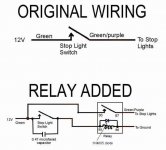
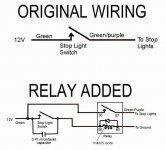
Since I last add to this thread I have added a relay to the electric circuit for the brake lights. It has greatly extended the life of the switch. You should not lose much fluid changing the switch if work quickly, have the new one at hand reinstall as soon as the old one is out. David DuBois gets the credit for the electric engineering and here id description of how to do it:

Installing a Brake Light Switch Relay

The replacement brake light switches sold today are extremely light duty and don't hold up to the 3 amps drawn by the brake lights for very long before the contacts burn again (I have had them burn in just two weeks). Adding a relay to the brake light circuit will remove the heavy current from the brake light switch.
The relay to use is a general purpose 30 Amp automotive relay, sometimes known as a Bosch relay. They are available from Radio Shack and most auto parts stores. The relay can be mounted anywhere that is convenient. I mounted mine close to the original brake light switch, but it can just as well be mounted in the trunk (for the MGAs or MGBs), close to one of the tail light/brake light assemblies (if you do this, you will need to bring a source of 12 volts, other than the 12 volts that is switched by the brake light switch, back to where the relay is mounted). In the accompanying diagrams, I show a 0.47 microfarad capacitor across the contacts of the brake light switch and a diode across the coil of the relay. These are optional parts and can be left out if you wish. I added them as additional protection for the brake light switch. The capacitor is just soldered across the switch terminals. The diode can be soldered across terminals 85 and 86 of the relay. The advantage of the capacitor is that the capacitor acts as an arc suppressor and the diode collapses the field of the relay coil, eliminating any inductive surge across the brake light switch when it opens.
If you feel that you are electrically challenged, or just don’t want to fuss around putting the circuit together, I can supply you with a completely assembled circuit to fit you car. If you would like to purchase one of these relays and a capacitor, the price is $10.00USD (in July 2003). Send me an email to confirm current price, availability and shipping costs to your location. I also need to know the polarity of your car and if it has a hydraulically actuated switch or one that operates off of the brake pedal. Send a check or money order to:
David DuBois
1913 South Marine Dr.
Bremerton, WA 98312

Here is my circuit diagram for a positive grounded car:

 

Attachments

  • 16055.jpg
    16055.jpg
    32 KB · Views: 446
If your car is negative ground, here is the circuit diagram for that configuration:
 

Attachments

  • 16056.jpg
    16056.jpg
    28.8 KB · Views: 423
Hi Dave, that is a good idea.
I did something simular on my Opel GT, the ignition switch burns out from full power going through it, so we add a relay.

The diagram you did looks pretty simple.
Wow, lot's of engineers and clever people on this site.
Thanks for the help.
Lyle
 
Back
Top