• Hey Guest!
    British Car Forum has been supporting enthusiasts for over 25 years by providing a great place to share our love for British cars. You can support our efforts by upgrading your membership for less than the dues of most car clubs. There are some perks with a member upgrade!

    **Upgrade Now**
    (PS: Upgraded members don't see this banner, nor will you see the Google ads that appear on the site.)
Tips
Tips

TR4/4A Sudden total loss of power

Hey dj! It is hard to troubleshoot without seeing the problem, but as I mentioned, I JUST installed the same kit from moss in my TR4 with no issues. I just followed the instructions. So, just a thought, we are all assuming your pully's are stock. Perhaps a previous owner put a larger pully on the generator for some reason?? I measured mine, it is approximately 3.5 inches in diameter. Does yours measure the same?? What are the measurements on your other pully's. I would be happy to compare them with mine. Also, an underhood picture might help... If you would like to see what the mod looks like installed, I can post a pic up in the next few days...
 
Thanks Thechileman, I thought about the possibility of the pulley having been changed by a previous owner however it appears to be the same as what is shown in the Moss instructions. I measured the diameter and it is a bit less than 3.25". I'm not sure, but the TR4A might be slightly different to the TR4 with regard to stock pulley sizes.

I found some other people with the same issue in another forum and they solved it by using slightly longer belts so I think that is what I'm going to have to do. I finally figured out how to get the belt off - one has to loosen the engine mounts and then jack up the engine with a block of wood under the front of the oil pan - that separates the fan extension enough from the steering rack to work the belt through - a little grease also helps.

I finished all the electrical connections - that was quick and easy, so now its off to the parts store to get a few belts to try.

So far I'm up to around 10 hours on this project!!!
 
So if I want to try a slightly longer belt, how do I get the old belt off? I can't slip it between the fan extension and steering rack?

I'm probably missing something obvious, but why not just cut the belt?
 
why not just cut the belt?

You're not missing anything - I guess it's just that if I can't figure out how to get it off how will I manage to get a new one on?

Anyway, It's done. Just have to go get a new belt tomorrow morning.
 
Finally - I have the alternator installed and the belt on. I had to "special order" it from the local Moss distributor - no one in Canada keeps a supply of compatible belts in stock. In the end, the belt I used is only very slightly longer but unlike my original, it is un-cogged. It rolled onto the pulley easily.

I tightened and reconnected everything, turned the key and the car started 1st time.:joyous:

Then I put my foot on the brake and everything went dead again! Arrrgggg!:mad:

So I have solved the faulty generator problem but have not solved the original electrical fault. Going through this conversation again, I noticed Randall mentioned to do the DMM tests while the car is dead. I guess I missed that, so it could explain why I didn't find any fault. Now I'm starting to think that it could be a battery or an ammeter issue. How can I tell if there is an internal problem with the battery (like loose posts or corrosion)?
 
How can I tell if there is an internal problem with the battery (like loose posts or corrosion)?

Swap with a known good battery.

Tom
 
Now I'm starting to think that it could be a battery or an ammeter issue. How can I tell if there is an internal problem with the battery (like loose posts or corrosion)?
Same thing I said before. Get the problem to happen, then while it is dead leave the lights on (or whatever) and start checking with your DMM. If the problem is internal to the battery, then there will be no voltage when you check across the tops of the terminals. Then check from clamp to clamp. If the posts were hot and the clamps aren't, then a clamp isn't making good contact with the post. Etc etc.

Don't dismiss anything just because it "looks fine". I can't tell you how many times I've found a bad connection between the clamps and posts, even when they look fine. In a pinch, I've even gotten home by jamming my pocketknife into the seam between post & clamp.
 
while it is dead leave the lights on (or whatever) and start checking with your DMM. If the problem is internal to the battery, then there will be no voltage when you check across the tops of the terminals. Then check from clamp to clamp. If the posts were hot and the clamps aren't, then a clamp isn't making good contact with the post. Etc etc.

Ok, so I did that last night and I get a consistent 12+ volts from the battery posts as well as the clamps. Also get the same results when testing the solenoid contacts.

So I moved onto testing the ammeter. I get zero when touching both terminals with the DMM. In another discussion I noticed someone mentioned that they bypassed the ammeter temporarily by connecting both leads to the same side (top & bottom contacts). I gave that a try but still no juice.

Now that I have an alternator, I understand I should replace the ammeter with a voltmeter, but how can I temporarily bypass it if it is faulty? Or could the problem be somewhere else - like say at the fuse block? When I first turned the key I got light at the indicator and the car started but it cut out as soon as I touched the brake pedal. Then when I turned the key again, I got a faint light on the dash for a couple seconds before everything went completely dead.
 
Ok, so now you know you're getting juice into the cables; my next test would be at the starter solenoid, from the battery post to a ground on the body somewhere. Then check terminal A1 on the control box to ground. If there is still juice on A1, then the ammeter, control box and the wires to them are OK.

With the ammeter, you don't expect to find any voltage across the terminals. So that would tend to indicate that the ammeter is not the problem.

To bypass the ammeter, you can run a heavy gauge wire from the battery post on the starter solenoid, to terminal 'A' on the control box. Or just pull the wires off the ammeter and securely link them together. But if you are going to eliminate the ammeter, I would prefer the first approach.

FWIW, I ran for many years with a 60 amp Ford alternator and the stock ammeter in my TR3A. It's certainly personal preference, but I much prefer keeping the original ammeter. To avoid having the needle hit the stops, I added a shunt across the ammeter terminals, so the ammeter only indicated about half of the actual current.
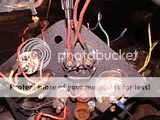
Depending on how your alternator is wired, you may not even have trouble with the needle hitting the stop all the time. I used the external sense line to sense battery voltage directly, so the alternator would go to full output for a few seconds every time I started the car from cold. But if you just jumper the sense line at the alternator (or use an alternator without a sense line), then it won't charge as quickly and pegging the ammeter might not be a problem.

 
I left the Ammeter in my TR4 after the conversion, it has been fine. It sure sounds like a wiring problem somewhere in the car. You mentioned hitting the brakes, and it went dead. Could you have a shorted brake light switch?? I am assuming you aren't blowing fuses. I am not an expert, but are you sure the wires are on the back of the ignition switch properly?? Just some thoughts...
 
You hit the brake pedal and the engine dies.

If the engine is off, and you turn on the headlamps, and you hit the brake pedal - do the headlamps go off?

Tom
 
I think I've isolated where the problem is.

When testing the solenoid battery connection to ground with my DMM (as recommended by Randall) I got fluctuating voltages. It went up to 13v, then dropped to 0.5v and kept fluctuating up and down. After everything goes dead, if I wiggle the wire connecting the solenoid to the ammeter, everything comes back to life and I can run the car, hit the brakes, turn on the lights as normal without problems. So I disconnected the wire and cleaned up the contacts, tightened up the clamp and reattached. Then I went for a short drive and all seemed OK but the car cut out as I pulled back into my driveway and everything went dead again. Wiggled the wire, and back to life it came again.

I guess either the wire is no good, or the solenoid is faulty. How do I tell which it is?
 
As inexpensive as both those items are, I think I would replace both...
 
It's not likely that the post itself is bad; which is the only part of the solenoid in the circuit (when you aren't cranking the engine). So if the connections are OK, probably it is the battery cable itself that is bad. Possibly it is corroded inside the terminal, or under the insulation somewhere.

But just to be sure, try turning on the headlights, then probing with your voltmeter between the cable terminal at the solenoid, and the clamp on the battery while you wiggle the cable around. If you can see any voltage, for sure the cable is bad.

Note that the battery cables sold at FLAPS don't fit very well; the hole at the solenoid end is much larger than the Triumph solenoid post. You can get by temporarily with some flat washers, but it's probably best to buy a proper battery cable for the long term. (Or what I did was to make my own terminal, from a length of soft copper tubing.)
 
probably it is the battery cable itself that is bad. Possibly it is corroded inside the terminal, or under the insulation somewhere.... But just to be sure, try turning on the headlights, then probing with your voltmeter between the cable terminal at the solenoid, and the clamp on the battery while you wiggle the cable around. If you can see any voltage, for sure the cable is bad.

mmmm... I also suspected the battery cable so I already replaced it. I happened to have an almost new cable that I used to attach my trickle charger to the battery over the winter. I re-used the lock washer and nut which I noticed were a bit corroded but I cleaned them up with a wire brush before reattaching. Perhaps the new cable is also not making a good contact - I'll try the flat washer approach and see if that helps.

thanks for all the suggestions :smile:
 
Success at last!!!

I put a flat washer on either side of the battery cable connected to the solenoid and this seems to have eliminated the problem. The contacts are nice and tight and wiggling the cables does not cause the engine to cut out. Next time I order parts I will get a proper matching battery cable, but for now, the new one I installed plus the washers seems to have done the trick!

Thanks for all the help. I'm sure I owe a few guys a beer or two :smile:

Looking forward to a good long drive in the TR4A for the first time in a month!
 
Bring it to Lindsay on Sunday...supposed to be a nice day and that will give it a good run :cool: Cheers, Tush
 
Back
Top