• Hey Guest!
    British Car Forum has been supporting enthusiasts for over 25 years by providing a great place to share our love for British cars. You can support our efforts by upgrading your membership for less than the dues of most car clubs. There are some perks with a member upgrade!

    **Upgrade Now**
    (PS: Upgraded members don't see this banner, nor will you see the Google ads that appear on the site.)
Tips
Tips

SU Rebuilding Questions

Moseso

Jedi Knight
Country flag
Offline
Long ago, thinking I was ordering something else, I got a throttle shaft kit from TRF -- two shafts + four bushings. Recently, I have decided that the installation of, at least, the new shafts would be beneficial.

Q #1: concerns the two little screws holding the butterfly in shaft. They are split and spread to prevent them falling out. I don't worry about wrecking the old shafts. Does one just back them out of their holes, expecting them to squeeze-up as they are removed? Or, does one attempt to squeeze them a bit, with pliers or the like, before backing them out.

Q #2: Are those screws reusable, or is that just asking for one-or-more of them to fail with disastrous consequences?

Q #3: The bushings, should I decide that the new shafts aren't an adequate solution to my slop problem...
I have read the Enco reamer method of SU Carb re-bushing. It looks pretty straightforward. It also looks as though the reamer protrudes plenty far enough through the carb body to get a drill motor onto the shank of the reamer. Is there a good reason that I should NOT attempt to power the reamer in this way? The nut, with the setscrews just seems so Mickey Mouse...
 
Moseso said:
Long ago, thinking I was ordering something else, I got a throttle shaft kit from TRF -- two shafts + four bushings. Recently, I have decided that the installation of, at least, the new shafts would be beneficial.

Q #1: concerns the two little screws holding the butterfly in shaft. They are split and spread to prevent them falling out. I don't worry about wrecking the old shafts. Does one just back them out of their holes, expecting them to squeeze-up as they are removed? Or, does one attempt to squeeze them a bit, with pliers or the like, before backing them out.

I just backed my screws out. I was careful and took my time but they seemed to squeeze back together.

Q #2: Are those screws reusable, or is that just asking for one-or-more of them to fail with disastrous consequences?

They can be reused but I ordered new ones just to be safe.


Q #3: The bushings, should I decide that the new shafts aren't an adequate solution to my slop problem...
I have read the Enco reamer method of SU Carb re-bushing. It looks pretty straightforward. It also looks as though the reamer protrudes plenty far enough through the carb body to get a drill motor onto the shank of the reamer. Is there a good reason that I should NOT attempt to power the reamer in this way? The nut, with the setscrews just seems so Mickey Mouse...

I can't help you on this one.
 
Sorry my answers are stuck after each of your questions.
 
I squeezed mine back together a bit, before trying to back them out. One actually broke, so I would not try to reuse them after they have been spread. But don't spread the new ones until you are absolutely certain you are happy with the new shafts, the throttle plate centering, etc. A dab of Loctite will hold well enough for some test driving (if you want).

Oh, and don't forget that the throttle plates have a front & back. It's not obvious, but the edges are slightly tapered and the engine won't idle properly if the plates are backwards.

IMO, you really want the level of control that you get with hand reaming. You don't have to mess with the nut if you don't want to; for example you can grind flats on the reamer shaft and grab it with a tap handle (or just clamp it in the bench vise). Tony Rhodes wrote a nice article showing the use of a tap handle, which might be on his web site.

But the carb bodies are soft (as metals go) and you are trying to remove rather more metal than is usually taken with a reamer, plus the new cutting edges may not be just right. Turning it by hand means you can stop if the reamer starts to dig in and bind.
 
Like Randall, I squeezed the screws together a bit (using pliers) prior to backing them out. I re-used the screws. However, I cleaned them on a wire wheel to expose shiny metal and I soldered the heads to the throttle shaft after tightening them. You need a big soldering iron and it is almost permanent, but it does work. The solder was not my idea but something I remember reading (probably in a Vizard A-series book) about how to secure the butterfly to throttle shafts that have been narrowed down.
 
The faster you turn that reamer the more material it will remove and a good chance to oversize the hole. Us it at the proper speed it was designed to be used at and use plenty of cutting oil.
 
Thanks for all the insights, guys. The reamer should arrive in a couple of days. I still haven't pulled the carbs off the car yet. This weekend looks good for that -- and then the fun begins...
 
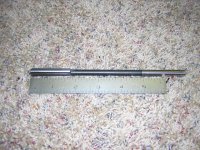
Got my Enco #331-1124 reamer just now. It's rather disappointing. They've changed the spec, or the manufacturer, or something. The shank is no longer fully machined. This is not going to do the job...

Edit: Update: Customer service at Enco is very good. I called and told them that the reamer is not as pictured on the web site and, hence, unsuitable for my, admittedly off-label, use for it. The CS lady got a tech on the phone, and the three of us discussed the problem. Someone is now being dispatched to the warehouse, with a mic, to see if the other 3/8" reamer they sell (329-1124 the slightly more expensive USA made one) is 1) machined along the entire length of the shank and 2) 5/16" shank diameter. Further, she credited me the purchase price of the one I didn't like.
She is going to call me when mic-man returns from the warehouse...
That's takin' care of business!
 

Attachments

  • 25612.jpg
    25612.jpg
    78.1 KB · Views: 283
Mic-man says, the other one, 329-1124, is just what I want. It's on the way...
 
Thanks for the heads-up, Moses. I guess Enco's Chinese supplier found a way to make the product even cheaper, as the "import" reamers I've gotten from them in the past have all had fully-machined shanks (as the web site shows).
 
I ordered the reamer from Enco by the part number. There was an option for a cheaper one (like 2 dollars),which I didn't go for. I had a little problem in that the carb I needed to repair had already been reamed for oversize shafts. The reamer wobbled a little bit.
 
TR3driver said:
Thanks for the heads-up, Moses. I guess Enco's Chinese supplier found a way to make the product even cheaper, as the "import" reamers I've gotten from them in the past have all had fully-machined shanks (as the web site shows).
Mine came labeled "India."
I guess it's cheaper, but not in a way that most reamer users would care about. This using the shank as the pilot, and drawing it through the work backwards, is definitely not that for which they are designed.
But, yeah... The import model is no longer the way to go. Hopefully, the USA version is...
 
Back
Top