

-
 Hey Guest!
British Car Forum has been supporting enthusiasts for over 25 years by providing a great place to share our love for British cars. You can support our efforts by upgrading your membership for less than the dues of most car clubs. There are some perks with a member upgrade!**Upgrade Now**
(PS: Upgraded members don't see this banner, nor will you see the Google ads that appear on the site.)
You are using an out of date browser. It may not display this or other websites correctly.
You should upgrade or use an alternative browser.
You should upgrade or use an alternative browser.
Smitty trans Master cylinder
- Thread starter simco
- Start date

dougie
Luke Skywalker
Offline
Stock worked fine for me. Suggest lightening the flywheel while its out to really get the performance out of this conversion.
https://www.tomsimport.com/new/parts/parts.asp?sect=14&new=1
https://www.tomsimport.com/new/parts/parts.asp?sect=14&new=1

steveg
Yoda
Offline
Rich Berman has some pictures of the installation. You have to scroll through them to find the ones you want. See:
https://plus.google.com/photos/110087349657726745747/albums/5528813397849858337
https://plus.google.com/photos/110087349657726745747/albums/5528813397849858337


Offline
Pay close attention to the pivot stud, lack of a better word to call it, that the clutch arm pivots on. The stock one is too short by about 3/8”. Best to install the bell housing without the trans attached and operate the clutch to be sure the clutch arm doesn’t dig into the bell housing.thanks for the info. Got the trans back and sorting last of the pieces for a go.
dougie
Luke Skywalker
Offline
Pay close attention to the pivot stud, lack of a better word to call it, that the clutch arm pivots on. The stock one is too short by about 3/8”. Best to install the bell housing without the trans attached and operate the clutch to be sure the clutch arm doesn’t dig into the bell housing.
Or scrap the whole stock slave cylinder and throw-out bearing for a Tilton hi-performance full hydraulic system.
Offline
Costs?Or scrap the whole stock slave cylinder and throw-out bearing for a Tilton hi-performance full hydraulic system.
View attachment 51542View attachment 51543View attachment 51544
steveg
Yoda
Offline
The Tilton TO bearing looks like a great solution on an unlimited budget.
For almost free, I made a slightly longer stud to move the operating lever to the front of the opening.
Make sure you mock all this up by mounting the bellhousing sans transmission up to the engine and checking the operation. The length of the clutch pushrod also bears on this.
Some of these issues may have been resolved by Pete Delaney.
Some of it has to do with the relative thickness of the three different clutches.
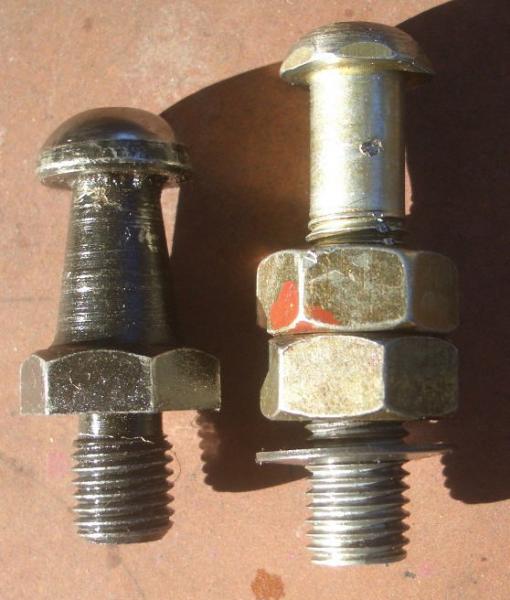
For almost free, I made a slightly longer stud to move the operating lever to the front of the opening.
Make sure you mock all this up by mounting the bellhousing sans transmission up to the engine and checking the operation. The length of the clutch pushrod also bears on this.
Some of these issues may have been resolved by Pete Delaney.
Some of it has to do with the relative thickness of the three different clutches.
Offline
I just put a 3/16” washer under the original one and works good.The Tilton TO bearing looks like a great solution on an unlimited budget.
For almost free, I made a slightly longer stud to move the operating lever to the front of the opening.
Make sure you mock all this up by mounting the bellhousing sans transmission up to the engine and checking the operation. The length of the clutch pushrod also bears on this.
Some of these issues may have been resolved by Pete Delaney.
Some of it has to do with the relative thickness of the three different clutches.
View attachment 51554

I understood - perhaps incorrectly - that the replacement dynamo bearing was supposed last longer than the original bush. Is it time for a Dynamator - a 45amp alternator that looks like a generator? I paired it with a lightweight aluminum pulley from DW Motosports. GONZO

Offline
I don't know whether Pete Delaney has reworked anything but the original Smitty's setup was less than perfect. I put in my Smitty's kit at his--Smith's--shop in Thousand Oaks and we went through a couple of different bolts with the heads/threads cut off until we found the right length. Even then the alignment of the arm/actuator rod/cylinder was not exactly wonderful and when I got home to MD I wound up installing a BJ8 clutch and modified the lever and pivot so that things worked better. The later BJ diaphragm clutch is a vast improvement over the early spring versions.
As Dougie suggests a Tilton annular clutch would be wonderful but probably a bit of overkill for a road car. I have them in all of the race cars and though the engagement is a bit more abrupt than a conventional type the feeling is very positive and the rotating weight savings results in less loss, etc.
As Dougie suggests a Tilton annular clutch would be wonderful but probably a bit of overkill for a road car. I have them in all of the race cars and though the engagement is a bit more abrupt than a conventional type the feeling is very positive and the rotating weight savings results in less loss, etc.

Randy Forbes
Yoda
Offline
I agree that the later__diaphragm sprung__clutch covers (aka pressure plates) are an improvement over the Long-style actuator, but one must be very careful installing one in any non-standard setup to prevent the spring from going over center, which can fracture it. In the BJ 7/8 and assuming all the correct associated parts, there's less worry, but still prudent to check.
If your method of actuation, via depressing the pedal, allows the spring to pass through center, then a clutch pedal stop should be used. Once the clamping is released, there's no benefit to additional travel anyway, and theoretically, you could shift faster (well, de-clutch & clutch faster, we're still at the mercy of whatever gearbox is in use).
If your method of actuation, via depressing the pedal, allows the spring to pass through center, then a clutch pedal stop should be used. Once the clamping is released, there's no benefit to additional travel anyway, and theoretically, you could shift faster (well, de-clutch & clutch faster, we're still at the mercy of whatever gearbox is in use).

Bob_Spidell
Yoda
Offline
... Once the clamping is released, there's no benefit to additional travel anyway, and theoretically, you could shift faster (well, de-clutch & clutch faster, we're still at the mercy of whatever gearbox is in use).
I've always thought that, yet my Mustang's owner's manual states emphatically: "During each shift, the clutch pedal must be fully depressed to the floor[sic]. Make sure the floor mat is properly positioned so it doesn't interfere with full extension of the clutch pedal."
The Mustang's clutch is hydraulic, and behaves pretty much like my Healeys'--it dis/engages at about the same height, and it might be just a tad lighter--and, just so it's habit, I do the same in my Healeys, though I don't understand the theory behind this dire warning. Anybody?
Offline
I agree that the later__diaphragm sprung__clutch covers (aka pressure plates) are an improvement over the Long-style actuator,
Keep in mind that BN1's have a mechanically activated (non-hydraulic) clutch which produced, as I recall, rather grabby actuation and required a considerable amount of pedal pressure. So if the ultimate installation of a BJ diaphragm unit was an improvement the initial conversion to an hydraulic system, which is part of the Smitty's kit installation, was positively transformational. Not only did I get rid of the weak (and then broken) three-speed box with its odd shift pattern, I no longer had to deal with a heavy, notchy, clutch.
Bob_Spidell
Yoda
Offline
FWIW, my BN2 has the mechanical, spring-type clutch and it's not noticeably grabby or particularly heavy; took a bit of work to get it adjusted, though. I suspect if the mechanical linkage was worn, bent, etc. it would make the clutch misbehave. Someone--DWR maybe--sells an uprated linkage kit that I'd like to install someday.
Offline
Bob--
If the proposed 2019 Conclave in the Black Hills becomes a reality I may very well drive out for it.
Perhaps we could meet there and switch cars to compare systems.
If the proposed 2019 Conclave in the Black Hills becomes a reality I may very well drive out for it.
Perhaps we could meet there and switch cars to compare systems.
Bob_Spidell
Yoda
Offline
Black Hills of South Dakota? That's a ways from San Jose--I'll likely be moved to the Central Valley by then--but if the Conclave is in late May I might be on my annual road trip and could swing by (almost went there this year, but we were hot-footing it to Canada). Hydraulic clutches are superior to mechanical/cable in most every way; I just never get in the BN2 and think 'Man, this clutch really sucks.' The one thing that gets me is the difference in pedals; the Mustang and BJ8 have them 'hung' from above, but the 100's pivot at the bottom. Not a big deal, but it's the one thing I notice.
Offline
I had a few problems with the Smitty kit and it was a combination of things but when the new improved bellhousing arrived the odd angle of the slave Rod was taken care of by modification to the bellhousing to make it go straight in.
Offline
Bob--
That's less than 1400 miles to the Black Hills for you and over 1700 for me!
I don't think the plans to hold Conclave there is yet definite but it would be in 2019, so think it over.
That's less than 1400 miles to the Black Hills for you and over 1700 for me!
I don't think the plans to hold Conclave there is yet definite but it would be in 2019, so think it over.