• Hey Guest!
    British Car Forum has been supporting enthusiasts for over 25 years by providing a great place to share our love for British cars. You can support our efforts by upgrading your membership for less than the dues of most car clubs. There are some perks with a member upgrade!

    **Upgrade Now**
    (PS: Upgraded members don't see this banner, nor will you see the Google ads that appear on the site.)
Tips
Tips

Salt and rust/corrosion

T

Tinster

Guest
Guest
Offline
Originally Posted By: Brosky
If you live on an island and a storm hits your shores, where did it form? Over the ocean?

And what is the ocean made up of? Saltwater?

When it storms are you not getting a higher percentage of saltwater in the rain than those who live inland?

Maybe that and your very high humidity is why you have surface rust on things overnight.

Just a simple question that will probably start another interesting debate.


And by the way, Rhode Island doesn't count in this discussion, since we're not really an island. We're just faking it for the New Yorkers who visit the beaches every summer.

Reply:

Rain does not contain salt. Wind-blown ocean spray contains plenty of salt! Parts in a garage are probably 99.97% safe from ocean spray, so I would tend to blame island humidity for causing rapid rusting of parts in the garage.
Cars parked close to the beach on a regular basis get salt water on 'em. I grew up in San Francisco -- home of "California Cars." Not all "California Cars" are created equal. The ones that spent years near the beach can be as badly eaten-up as the "Mid-western Cars" I live with now.
 
Rain does not contain salt. True statement. A rain
drop DOES contain a tiny core of particulate matter.
Hench dust on your car after a rain.

I live about 2 miles inland and newly cleaned, ferrous
materials will be covered with a thin layer of rust within
24 hours. I think high humidity and warmer temperatures are
both culprits. NOT salt.

Salt spray, when driving the ocean highway, leaves a sticky
coating that washes off immediately with water.

I lived in PA and MD most of my life with salted roads.
Never had a car rust out on me.

So here's the debate!

Are old British cars really so prone to rusting? Or is
it just that most owners are afraid to wash down their
vehicles or don't like cold weather?

The debate is open! What's the thoughts on salt?

d
 
Salt certianly kills cars in New England. Had an 8 yr old Land Rover Discovery that was rusted through in a number of places. In fact the usable life of cars in New England seems pretty short, with the salt, pot-holes and damp (and Boston drivers). Modern cars are far better rust-proofed than our old bangers, but still suffer.
 
Dale,
I agree with everything you say there, although you will rarely see a car in Scotland that is over 12 years old. 8 - 10 must be the average life-expctancy of a car here (British, German or American).
I never wash my cars in summer, as I don't mind a little dirt. However, I wash them every weekend in winter and give them a good hose-down underneath to try and get the salt off. The problem is that as soon as they are used again they become covered in salt. There are also various little hidden areas that may not be cleaned by hosing - inside cavities, etc.
I never used my first car in salty conditions, but it lived outside all year round. It is now 33 years old and is still going (although no longer owned by me). My brother-in-law had an identical car (Renault 12 estate) that he used all year round. His went to the crusher when it was 12 years old (along with most other Renaults of its age). Personally I think the difference was the salt.
How about my other TR3 that I completely re-built. I put a replacement Moss bumper on that and towed it to a different garage one salty, winter weekend. When I returned to it the following weekend the bumper was orange!! My current TR3 is also fitted with a Moss bumper. It is used during the summer in all weathers, but never in the salt. The bumper is still immaculate.
I rest my case ...!!
 
I had a '64 TR4 that only saw one upstate New York winter in '68-68. Although some roads were salted, most were not. I had no rust from that experience, but spent a lot of time chipping ice out from the fender areas.

The problem today is that a 30 some year old car has rust in places you cannot see. This is also true on the "fully restored" cars some of us now have. Given their age, just like people, what they could endure when young, is stressful when old.

I live a couple of blocks from the Monterey bay. My California TR6 has always been a California car, but here with the salt laden fog, it has rusted and pitted. Salt is bad except on eggs. (which are bad for me)
 
Well, I've already said that salt is the work of /bcforum/images/%%GRAEMLIN_URL%%/devilgrin.gif

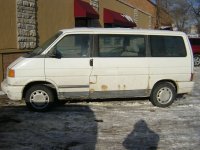
In Minnesota, it's just not really possible to keep a car, driven in winter, free of the stuff. As soon as it starts to snow, they start throwing it all over the road and it gets all over your car -- and worse -- all under your car. Then the temps drop to no degrees, or worse. It's not possible to keep a hose hooked up. It'll freeze. The prospect of hosing-off a LBC, top and bottom is, indeed, a terribly uncomfortable one -- at best. I think "suicide" might be an appropriate term. Let's just say, garaging an irreplaceable old car over the winter makes the most sense.

LBCs are no more prone to being dissolved up here than anything else. It's just that everything that runs in Winter gets wrecked. All the little nooks and crannies get salt in 'em, and every little chip in the paint is exposure.

Here's a pic of my VW van taken in the parking lot just now. Would you really want to do this to your TR?
 

Attachments

  • 8863.jpg
    8863.jpg
    204.9 KB · Views: 168
Dale. Here in Upstate N.Y. we look for cars from southern PA, Virginia, MD, and the like. Even just down by the DC area the winters tend to be far milder than up here. Cars that make thier way up here from that area are in wonderful shape compared to similar aged vegicles from here.
Also, N.Y. is a major producer of salt. there's mines under most of the fingerlakes (mostly Cargill) and they're not afraid to "lay it on" whenever there is a chance of ice.
The rust belts are a regional phenomena. But I'm definatly in the middle of one.
It's not just salt alone that does it. it's the right combination of salt, year round moisture (Corning and Rochester N.Y. have both held the record for cloudiest U.S. city in the past) and periods of freeze and thaw.
The freeze and thaw is the muscle behind the moistures ability to breech your cars rust prevention devices. Such as paint, undercoating, and seams. the salt laden water creeps into all the cracks, then freezes, thus expanding, and opening bare metal up to the chemical reaction.
That's whay all the cars up here are rotting around the welded seams of the wheel wells and rockers. as well as anyplace the road crud accumulates and sits.
Along the coast you never have that Freeze thaw cycle added in, and the factory rust prevention devices stay sound.
Also, all the suspension components that only get a light shot of pant, or nothing at all from the manufacturer, rust up and adjusters freeze solid in no time. The salt may not directly cause the rust, but it alters it and definatly acts as a catalyst.
As a professional mechanic, I battle this every day.
It's no wives tale, nor is it a myth...... Hmmmm sounds like a good one for Jamie and Adam.
 
<div class="ubbcode-block"><div class="ubbcode-header">Quote:]Rain does not contain salt. Wind-blown ocean spray contains plenty of salt! [/QUOTE]

Salt is still salt. When you're on an island, you get wind blown ocean spray (most people call that RAIN) and it has salt in it, with the exception of Rhode Island, which as I explained earlier is just faking it.

OK, now I rest my case.

Now that I've covered that touchy subject pretty well, what other chemical or natural weather phenomena would you guys like me to explain to you?
 
Brosky said:
... what other chemical or natural weather phenomena would you guys like me to explain to you?

I've got one for you Paul ... why does it always rain after I wash my car?

/bcforum/images/%%GRAEMLIN_URL%%/grin.gif

Matt
 
pa297pass said:
I've got one for you Paul ... why does it always rain after I wash my car?

/bcforum/images/%%GRAEMLIN_URL%%/grin.gif

Matt

Yeah, why is that? Is it because the water evaporating off the driveway increases the moisture content of the air past the point of maximum saturation therefore forcing precipitation? /bcforum/images/%%GRAEMLIN_URL%%/rolleyes.gif
 
pa297pass said:
I've got one for you Paul ... why does it always rain after I wash my car?

/bcforum/images/%%GRAEMLIN_URL%%/grin.gif

Matt
For the same reason a cat always lands butter-side-down. /bcforum/images/%%GRAEMLIN_URL%%/devilgrin.gif
 
Brosky said:
Now that I've covered that touchy subject pretty well, what other chemical or natural weather phenomena would you guys like me to explain to you?


Paul, what is the meaning of life??
 
TR6BILL said:
Paul, what is the meaning of life??
<span style='font-size: 17pt'>42</span>
 
I hope not, there are things in my past that I would not want to repeat...But on second thought, there are some that would be fun to do again, like Brenda...
 
The meaning of life (for me) is coming home after an eight and a half, yes (8.5) hour drive through the blizzard that hit the northeast today and having a loving wife waiting with a fresh hot pizza. After dinner, she says your computer is started up and your email is downloaded. She then hands me the TRF Christmas catalog and says, "You've had a bad day. I'm sure that you can find something in here to take your mind off of it".

I'll see you guys tomorrow.........
 
Back
Top