
I'm changing out the trunnions on my 3 and changing the top bushings to poly. There are some excellent pics at "TR Album:changing the front suspension" on the Net.The car is supported by two jack stands under the frame and a floor jack under the suspension to lower it when required. My question: a spring compressor is only required when your doing this work and the engine is out of the car and there is no weight there right?


-
 Hey Guest!
British Car Forum has been supporting enthusiasts for over 25 years by providing a great place to share our love for British cars. You can support our efforts by upgrading your membership for less than the dues of most car clubs. There are some perks with a member upgrade!**Upgrade Now**
(PS: Upgraded members don't see this banner, nor will you see the Google ads that appear on the site.)
You are using an out of date browser. It may not display this or other websites correctly.
You should upgrade or use an alternative browser.
You should upgrade or use an alternative browser.
Safety issue:Coil spring compressors
- Thread starter karls59tr
- Start date

Tinkerman
Darth Vader
Offline
Karl, the factory shop manual. "Front Suspension" section page 8 and 9 talk about how to do it. When I did mine I had everything off so I had to use a spring compressor. If you don't have a factory shop manual you should get one at least get the CD thats available. As you may know they are a good source of info.
Good Luck, Tinkerman
Good Luck, Tinkerman

NickMorgan
Jedi Knight
Offline
Karl,
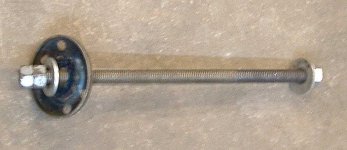
I would always use a spring compressor, as if that jack slips you are in big trouble. A threaded rod with a metal plate on one end does a great job. If you use it in conjunction with a jack under the trunion, then the jack does the compressing or releasing and the threaded rod is there for safety.
I would always use a spring compressor, as if that jack slips you are in big trouble. A threaded rod with a metal plate on one end does a great job. If you use it in conjunction with a jack under the trunion, then the jack does the compressing or releasing and the threaded rod is there for safety.

Don Elliott
Obi Wan
Offline
If your engine is not in the car the jack under the trunnion will just left the whole car and your spring will not compress. I have heard of TR owners putting about 400 lbs of patio tiles on the frame whhere the motor would be to do the job properly with the motor out.
The threaded rod is easy to make. See how Randall did his.
The threaded rod is easy to make. See how Randall did his.
Attachments
Don Elliott
Obi Wan
Offline
The one I made is almost like Randall's. I made it about 20 years ago. Except where Randall has a round plate, which acts only a large washer and anything similar will do, I made and use an aluminium plate anout 1/2" thick with a center hole for the threaded rod and 4 smaller holes that locate on the studs at the bottom to help keep it central and to prevent any side slippage.
The rod is 1/2" 13 UNC threaded rod that you can buy in any Home Hardware, Ace or Home Depot. Very simple.
The rod is 1/2" 13 UNC threaded rod that you can buy in any Home Hardware, Ace or Home Depot. Very simple.

vivdownunder
Jedi Warrior
Offline
Karl,
The advice to use a centre spring compressor as per Don's photo is very sound. They're so cheap to make up. A jack alone is just too risky considering the huge latent energy in the spring.
When returning the spring, as the pan draws up towards the lower wishbone, the spring compressor allows you to juggle the assembly to get the pan onto the two inner bolts.
When fitting the upper inner poly bushes, you will most likely find the fulcrum pins need cleaning up with fine emery or the like. If you remove the upper inner fulcrum pin, it has to go back the same way around so the shocker rubbers clear it. Use the white lube that usually comes with the poly bush packs on the fulcrum pins, or the new bushes can squeak.
After the lower outer wishbone bushes are pressed into the arm, they need to be reamed to fit the trunnion pins, so you may need to outsource this job.
While the suspension is dismantled it is worthwhile to get the vertical links and axles crack tested, for peace of mind. Hairline cracks can develop, usually due to a whack or gutter hits, which can end up in failure with today's grippy tyres.
Best regards,
Viv.
The advice to use a centre spring compressor as per Don's photo is very sound. They're so cheap to make up. A jack alone is just too risky considering the huge latent energy in the spring.
When returning the spring, as the pan draws up towards the lower wishbone, the spring compressor allows you to juggle the assembly to get the pan onto the two inner bolts.
When fitting the upper inner poly bushes, you will most likely find the fulcrum pins need cleaning up with fine emery or the like. If you remove the upper inner fulcrum pin, it has to go back the same way around so the shocker rubbers clear it. Use the white lube that usually comes with the poly bush packs on the fulcrum pins, or the new bushes can squeak.
After the lower outer wishbone bushes are pressed into the arm, they need to be reamed to fit the trunnion pins, so you may need to outsource this job.
While the suspension is dismantled it is worthwhile to get the vertical links and axles crack tested, for peace of mind. Hairline cracks can develop, usually due to a whack or gutter hits, which can end up in failure with today's grippy tyres.
Best regards,
Viv.

TR3driver
Great Pumpkin - R.I.P
Offline
I used 3/4" threaded rod, probably only Grade 2. Wasn't quite 20 years ago, but it's rebuilt several TR front ends and shows no signs of wear.karls59tr said:So before you do anything to the front suspension you remove the shock and install the threaded rod? Wonder what grade of steel and size of rod he used...1/2"?
Although I don't think the holes are essential, the piece of scrap I found for the lower plate (actually a generator pulley half from a VW Bug) was larger than the stud spacing, so I drilled holes for the 4 studs in it. But I believe a simple 1/4" aluminum plate that fit snugly between the studs would work fine (especially since there are commercially available models that are made that way). The piece I used was also pretty stout (and I still added another flat washer to back it up); I would not try to use a simple flat washer there (especially with the 1/2" rod).