• Hi Guest!
    If you appreciate British Car Forum and our 25 years of supporting British car enthusiasts with technical and anicdotal information, collected from our thousands of great members, please support us with a low-cost subscription. You can become a supporting member for less than the dues of most car clubs.

    There are some perks with a member upgrade!
    **Upgrade Now**
    (PS: Subscribers don't see this gawd-aweful banner
Tips
Tips

Rotating the crankshaft by hand

If I cant turn the crank by hand with the fan I have always put it in fourth and pushed it. There is usually a procedure in the manual so you can go from one valve to the next with a minimal amount of turning.

I guess I have always assumed with the plugs out and no compression to overcme it would be easier and that is how I have done it.

Never had much luck with "bumping the starter" not precise enough or I don't react fast enough or something, plus harder to do in sequence I would think, but if it works for you easier than pushing the car I guess.
 
Geo Hahn said:
I usually use the starting handle on the TR3 but without it I find an easy way to move the engine is to have the gearbox in 4th and push the car forward by pushing on the top of the left front tire.

The Herald / Spit makes this even easier by giving good access to the front wheel or rather the mechanics seat.
 
How about you use a socket on the alternator nut, and they are right with the plugs out you dont get the compression you have to over come from the cylinders when rotating the crankshaft,
just put a socket on the alternator nut and push down on the belt half way between pullies, which keeps the belt from slipping and you can rotate the crankshaft very easy and slowly
this is the right way to do it
Hondo
 
I have never done the valves on a car so I may be all wet here....but....

I am looking to do a leak down test on my car and have a need to find TDC. It would seem to me that pulling the plugs would make the engine turn easier and you can do that leak test once you are done with the valve adjustments and then install the plugs.....no?
 
I tried the fan belt method, but it wouldn't budge. But, then, the plugs were still in. When I get ready to do the valves, I'll remove the plugs and give that method a try, along with turning the front wheels.... and see which is best.

Hondo: As far as I know (and I don't know much), I don't have an alternator ... just a voltage regulator. Do you mean the "generator nut?"

Thanks.
 
hondo402000 said:
How about you use a socket on the alternator nut

I agree with Hondo on this one. I've done the rolling back and forth in fourth gear, pushing the front tire so you can watch the valves, backing it up in neutral when you run out of forward room, bumping the starter with the ignition unhooked (or plugs out), etc... The easiest method that I found was to pull the plugs and put a socket or ratchet wrench on the alternator nut. For you it would be the generator pulley nut. Gives you more leverage than trying to pull the fan belt by hand. If your belt is tight enough this should work a treat.

On cars with dirty engines, it is advisable to blow out the area aound the spark plugs before removing them to keep debris out. Other than that there is no reason to not take them out and make the engine easier to turn over by hand.
 
GBRandy said:
I have never done the valves on a car so I may be all wet here....but....

I am looking to do a leak down test on my car and have a need to find TDC. It would seem to me that pulling the plugs would make the engine turn easier and you can do that leak test once you are done with the valve adjustments and then install the plugs.....no?

Yes.

Note: A leakdown test is what aviation guys call a compression test, or, more correctly, a differential compression test.
 
Don Elliott said:
JR - How mad were you when you threw that hand crank ? And who were you mad at ? How do you bend a hand crank handle ?

I bent the handle over Craig's noggin to shut him up!

No, it was that way when I got it. Really!
 
glemon said:
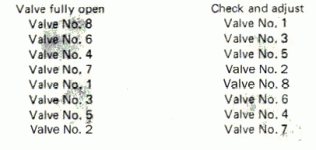
...There is usually a procedure in the manual so you can go from one valve to the next with a minimal amount of turning...

But note that the chart in the Haynes Manual (at least in all of mine) has a typo -- obvious once you're looking for it.
 
Geo Hahn said:
But note that the chart in the Haynes Manual (at least in all of mine) has a typo -- obvious once you're looking for it.
Hmm, I don't see it ...
 

Attachments

  • 24383.gif
    24383.gif
    11.4 KB · Views: 173
Geo Hahn said:
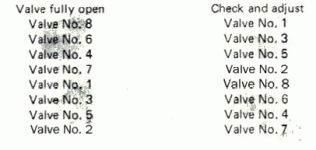
But note that the chart in the Haynes Manual (at least in all of mine) has a typo -- obvious once you're looking for it.
Hmm, I don't see it ...
 

Attachments

  • 24384.gif
    24384.gif
    11.4 KB · Views: 225
Twosheds said:
Note: A leakdown test is what aviation guys call a compression test, or, more correctly, a differential compression test.
Just curious, John, what is the accepted technique for holding the engine at TDC during the test?

Last time I tried something similar, I found that even with my best guess at exactly TDC, and 4th gear with the e-brake locked as tight as it would go, the car had a distressing tendency to run over my toes! Turned out to be a lot easier to just let it turn to BDC.
 
TR3driver said:
Twosheds said:
Note: A leakdown test is what aviation guys call a compression test, or, more correctly, a differential compression test.
Just curious, John, what is the accepted technique for holding the engine at TDC during the test?

If the piston is right at top dead center, it doesn't need anything to hold it there!

I would put the fitting for the test in the spark plug hole and move the prop back and forth whilst holding a thumb over the fitting. When no air came out, that was TDC. Then I would put the tester on the fitting, stand aside, and open the valve to let shop air into the cylinder. If it was on TDC, and it usually was, the prop would stay still.

Then I would grasp the prop by the tip and move it back and forth (but don't go too far!) whilst watching the compression gauge until I saw the highest reading. This is the reading I would record. It was in proportion to the applied shop air pressure. The tester had two gauges, one for applied air pressure and one for the pressure in the cylinder. The applied pressure was 80 psi. If the cylinder pressure was, say, 75 psi, I would record 75/80, pronounced as "75 over 80".

You are allowed a certain percentage of applied to cylinder pressure. If it was low, I would put my ear to the exhaust, carb, or breather to determine what was leaking. Keeping my noggin out of the arc of the prop!
 
Twosheds said:
If it was on TDC, and it usually was, the prop would stay still.
Ok, well I guess I couldn't find that point close enough. What you describe strikes me as saying you can balance a pencil on it's point if you get it perfectly straight up. There is a dead zone at TDC caused by bearing clearance, but with 100 psi of air above the piston, any bearing clearance is removed.

Lessee, 87mm is about 3.4 inches or 9.2 square inches ... at 100psi that's 921 lbf on the piston, so if you are only 1 degree off of TDC, you only get about 2.4 ftlb trying to turn the engine. But you've also got all the other pistons only 1 degree away from either TDC or BDC, so it doesn't take much to turn the engine at that point. Anyway, I tried and couldn't do it.
 
TR3driver said:
Twosheds said:
If it was on TDC, and it usually was, the prop would stay still.
Ok, well I guess I couldn't find that point close enough. What you describe strikes me as saying you can balance a pencil on it's point if you get it perfectly straight up. There is a dead zone at TDC caused by bearing clearance, but with 100 psi of air above the piston, any bearing clearance is removed.

Lessee, 87mm is about 3.4 inches or 9.2 square inches ... at 100psi that's 921 lbf on the piston, so if you are only 1 degree off of TDC, you only get about 2.4 ftlb trying to turn the engine. But you've also got all the other pistons only 1 degree away from either TDC or BDC, so it doesn't take much to turn the engine at that point. Anyway, I tried and couldn't do it.

I can't balance a pencil, and I've never done a leakdown test on a car engine, but don't see what would be different about it. You can even be a little off of TDC and the engine won't turn. You can hold the prop to keep it from turning, but you have a huge mechanical advantage way out on the tip of the prop. Maybe that's the difference. Too far off TDC, and you don't have enough strength to hold the prop to keep it from turning. I have experimented with this.

Dunno.
 
Twosheds said:
You can hold the prop to keep it from turning, but you have a huge mechanical advantage way out on the tip of the prop. Maybe that's the difference. Too far off TDC, and you don't have enough strength to hold the prop to keep it from turning. I have experimented with this.
Makes sense to me. In addition, there is no mechanical play in the connection to the prop, while I was trying to use the drivetrain that inevitably does have some play in it.

And since I was just trying to R&R the valve springs without removing the head, it didn't matter so much whether it was TDC or BDC.
 
Back
Top