• Hey Guest!
    British Car Forum has been supporting enthusiasts for over 25 years by providing a great place to share our love for British cars. You can support our efforts by upgrading your membership for less than the dues of most car clubs. There are some perks with a member upgrade!

    **Upgrade Now**
    (PS: Upgraded members don't see this banner, nor will you see the Google ads that appear on the site.)
Tips
Tips

Rod Bearing bolts

Basil

Administrator
Staff member
Boss
Offline
I have my motor out (78 Spit 1500) and was checking my Big End bearing clearances and ran into a question. In my Haynes manual it has two different torque settings for the Rod Cap bolts; One for "Phosphated" bolts (46lbs) and the other for "Color Dyed" (50lbs). I have no idea what those two references mean. Any idea? How can I tell which I have?

Second question: I have no idea how long those rod beaing bolts have been in this car or how many times they have been torqued/re-torqued. Should I put in new bolts as a matter of course? If so, where is a good source for "quality" bolts?

Basil
 
When I first got my TR6 I pulled the pan and checked the rod bearings. As I reassembling I noticed that the bolts were not torquing up. I got out the veneer calipers and measured a rod bolt that I was trying to reinstall and one that was still on the bench. The bolt had grown. It was stretching under torque.

Long story short. GET NEW ROD BOLTS. Torque them according to the accompanying recommendation.
 
OH YEA. I am using ARP rod bolts in my new motor. Check out my link below and view the pictures. I think there is one that shows the bottom end and the ARP rod bolts. Nothing stronger that I can think of.
 
The Phosphated bolts have a black, matt surface color.

I reused my big end bearing bolts since they all were in good condition, they also all threaded in an out freely with no sudden increase in resistance which would indicate that they were overstretched. Unless you are planning on really stressing the engine this would be quite fine.
Of course you could get the ARP bolts (206-6004) which are about the best quality available, and not all that expensive in the overall accounting. (try Summit Racing, they list them and I believe are cheaper than the "specialists" they were way cheaper when I needed ARP head studs)
 
Basil,

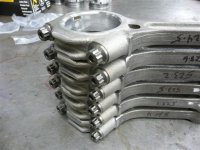
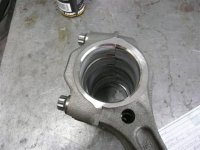
If you do install the ARP rod bolts, you may have to modify the rod cap to properly accept them as I did on my TR6 engine.
 

Attachments

  • 13272.jpg
    13272.jpg
    55.4 KB · Views: 214
  • 13273.jpg
    13273.jpg
    49.3 KB · Views: 222
Paul is correct. I bought a new set of ARP rod bolts (the lesser of the 3 sets they offer) and found that the inner bolts were too long. Not willing to take my head off and pistons out, I opted to re-use my old bolts. For a stock engine, ARP bolts may well be over-kill.
 
Oh, and ARP was NOT helpful with this, denying that they were too long. Maybe I had the wrong salesman. Prolly would have done better going with a reseller with a good return policy. I ended up selling them to a friend. Not a happy camper.
 
Good rule of thumb is when in doubt change them. The colored bolts may be the grade 8 yellow anodized. Weaker bolt then a case hardened phosphated ones.
 
Bill,

Mine were the correct length, but the bosses had to be machined to allow the wider flange of the head to fit properly.
 
Weird, the ones I got, the flanges fit fine but the inboard bolt (which ends up in a blind hole inside the body of the rod) bottomed out way before it could be torqued. The bolts were measurably longer than the stock ones I was trying to replace.
 
TR6BILL said:
Oh, and ARP was NOT helpful with this, denying that they were too long. Maybe I had the wrong salesman. Prolly would have done better going with a reseller with a good return policy. I ended up selling them to a friend. Not a happy camper.
This may be because there are several minor variations in the cranks (of course all with the same part #!!) which superseded each other. The engine which came in my car obviously had a collection of parts in it since two of the rods had holes drill like yours and the other two didn't. They also had slightly different shapes. The rods with the holes are apparently a later version than w/o.
 
FWIW... In a recent refresh (hone, re-ring and rod bearings) I reused mine, which were phosphated. They showed no signs of wear or stretch, and torqued up well. My shop manual gave specs for replacement, I believe. I can check when I get home if you'd like.
 
Back
Top