• Hey Guest!
    British Car Forum has been supporting enthusiasts for over 25 years by providing a great place to share our love for British cars. You can support our efforts by upgrading your membership for less than the dues of most car clubs. There are some perks with a member upgrade!

    **Upgrade Now**
    (PS: Upgraded members don't see this banner, nor will you see the Google ads that appear on the site.)
Tips
Tips

TR2/3/3A Removing front trunnion

Bruce100

Jedi Trainee
Country flag
Offline
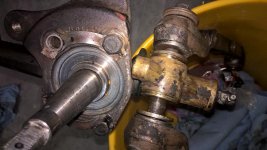
Slowly making my way through the suspension. I am trying now to remove the front trunnion. The manual says removing the steering stop screw and spacer, and unscrew. Did this, but the vertical link body won't allow it to rotate beyond a turn because it hits the trunnion. (Yes, I am turning it the right way :rolleye:smile:. I don't want to force it as I don't want to mess up the gear. THoughts?

Also, the manual says to replace the front trunnion and vertical link as a pair. There is a lot of play IMHO in the trunnion, so I bought a replacement. I didn't see the recommendation to replace them as a pair. Holy Cow the vertical link is 259$ from Moss! What do you all do?

~
 

Attachments

  • WP_20151021_19_25_39_Pro.jpg
    WP_20151021_19_25_39_Pro.jpg
    55 KB · Views: 206
I think you also have to remove the disk brake adapter plate.
Looks like you have already undone the lockplates for it's attach bolts.

M.
 
Yup, got to remove the caliper bracket.

Where does it say to replace the vertical link? I never have.
 
Ok, I got it removed. I have to quit taking the manual quite so literally. I have never taken a trunnion off before, and didn't know what to expect.

Regarding the manual, it was Haynes that says if either the trunnion or vertical link threads are worn, you have to replace them both.

attachment.php
 

Attachments

  • WP_20151022_17_33_25_Pro.jpg
    WP_20151022_17_33_25_Pro.jpg
    45.6 KB · Views: 221
Oh, and how do I check the trunnion for wear/side play? I read https://www.britishcarforum.com/bcf/showthread.php?98492-Wrapped-around-the-(Stub)-Axle and am still unsure how you measure.
 
I used a magnetic mounted dial indicator on the steel vertical link that would measure the trunnion side play. A much less technical way is, if there is enough play for the clean trunnions to "click" when you move it side to side on the link, then the link and/or trunnions are worn. New parts should have just enough play to tell there is play, but not enough to click back and forth.

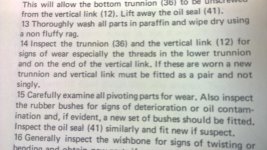
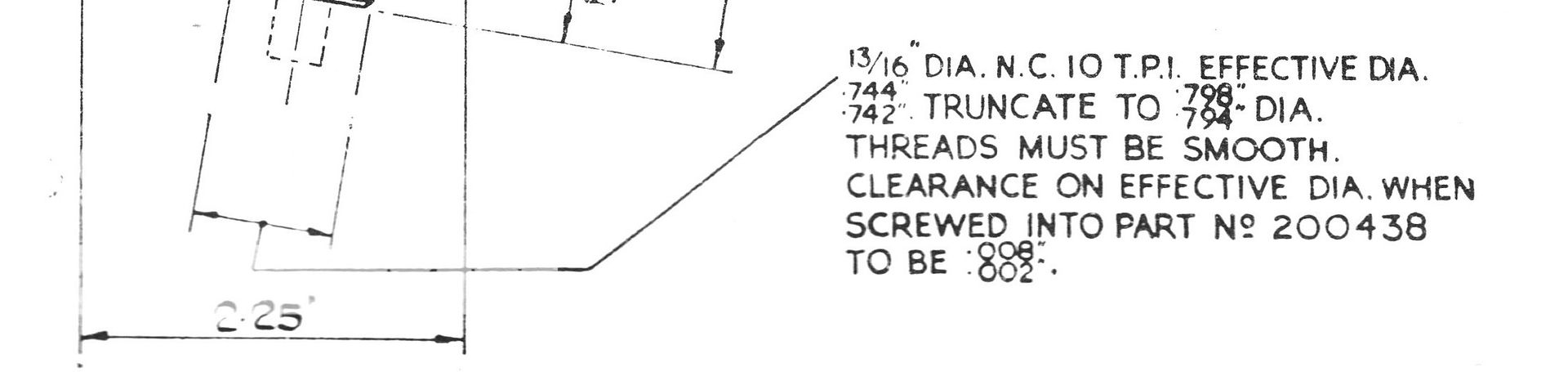
This is an excert from the manual. If you read closely, it specifies the trunnions play as .002-.006". That's not much! Unfortunately the precision on repro parts makes this hard to achieve without luck and parts swapping.

 
FWIW, I'm pretty sure that reads .008" rather than .006". I got curious so I stuck a mike on the VL I've been using for checking hub runout. .7964" right in the middle of the spec.

P25%20Vertical%20Link%20zoom.jpg~original
 
Regarding the manual, it was Haynes that says if either the trunnion or vertical link threads are worn, you have to replace them both.
Thanks, Bruce. I never noticed that before. But then, I've not used the Haynes much since I got a copy of the factory workshop manual. It can still be confusing sometimes, as it wasn't always updated to cover the many changes along the line, but I like it better than the Haynes manual.

Sometimes the TR4 workshop manual is better. If you want, you can download copies of both of them
https://drive.google.com/open?id=0B2H2NJt34OffYWZiN2VlZGMtNTkxMi00NGUzLWE4NzMtMGRkODRkYzU3MDU1
https://drive.google.com/open?id=0B2H2NJt34OffN2FkZjI2NjktNWJiMy00YWExLWIyNjctOTYzNmI3OTg2ODM0
 
Ok I checked the vertical link to see if it is bent. it appears to be .2 inches out. I used my lathe and a dial indicator. Haven't checked play on trunnion yet. I don't have a press, haven't decided what I am going to do
 
Ok I checked the vertical link to see if it is bent. it appears to be .2 inches out. I used my lathe and a dial indicator. Haven't checked play on trunnion yet. I don't have a press, haven't decided what I am going to do

.2" is really pretty close. A large brass mallet and a 6" table vise with soft jaws will work. open the jaws and lay the link across them on the soft pads. Then smack the link in the correct area between the jaws. So long as you don't scar the link you will be good. You'll find it doesn't take a whole lot of force to bend these links. Anything less than 1/8" will be negligible in operation. I shot for zero, but I tend to be anal with tolerances.
 
Thanks John. I was actually thinking about doing that very thing. BTW, I checked my trunnion, and with the new trunnion from TRF I have .004 play, so I am good there.
 
With a copper hammer, it did not take much to get it to .060. I am amazed, based on how little it took, that these work ok on the road! I am going to call that good if 1/8 is good enough! thanks for the help.
 
I'm impressed with the TRF trunnions...good to know theirs are good! The last I bought from Moss had to go back several times until I found a tight set...but it is really worth taking the time and getting all this dialed in. I've had several old gear heads stop me at the gas pump and comment how badly the TR3 steering is. I let them take mine for a spin and they are floored how well it steers. The key is getting rid of anything that can cause a bind through the trunnions...and, of course, getting the steering gear set right.
 
Hey, my club members are expressing lots of concern around bending the vertical link. Do you have any info on whether it is cast, forged, and whether it is safe to bend?
 
Page 3 of the suspension section in the manual calls the vertical link a "carbon steel stamping". In my book, a stamping means forged, as you cannot stamp cast iron. In my experience all automotive forgings are heat treated to dead soft. The ease with which these bend seems to confirm that our vertical links are, indeed, dead soft. A dead soft forging is not in danger of breaking from slight bending.

I am not at all concerned with bending these a small amount on the long arm. I would not try to bend them from the spindle threads up to the stub axle. That lower area takes all of the weight of the vehicle. From the stub axle up to the ball joint merely aligns the link. If the top breaks, the wheel leans in and rubs until you stop. If the bottom breaks, you will have an exciting ride until you stop.

I bet most of those at the club worried about bending the vertical link already have a bent link, but just don't know it. With a bent link, every time you turn the wheel, all the leverage of the wheel and worm gear reduction in the steering gear is imposing a load many times greater than that imposed on a straight link. So a bent link sees a far worse fatigue load than a straight gear, and if anything is much more likely to fail over time, and in the more critical lower thread area. If you look back at weak areas of the TR3, the lower vertical link has a nasty habit of breaking where it enters the trunnion. IMHO, that is most likely due to running a link after it has been bent. I have yet to hear of a link failure in the upper portion that we are straightening.

Most importantly, I straightened mine on the TR3 over 3 years ago and drive it almost daily. So, I'm 3 years ahead of you, and if one ever breaks...I'll definitely update my threads, so you'll have 3 years to replace yours!
 
Last edited:
Back
Top