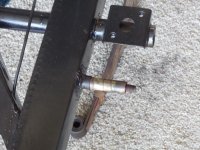
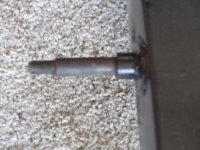
No prying! The side load practically guarantees the pin will bind and refuse to come out. A straight pull is a must.
First start soaking the pins in PB Blaster. The longer the better; last time I waited about 3 weeks. Remove the nut and, if you can, pry the spring away from the frame. Some occasional tapping with a punch & BFH will help, but don't damage the pin. Clean up the exposed portion of the pins.
Use a bottoming tap to clean out the threads in the pin. Then get some high tensile threaded rod, nuts and flat washers, not the old cheese they sell at Home Depot. I use extra-thick "setup" washers from MMC (or any industrial tool supplier).
There isn't room to do it all in one pull, so you'll need a relatively short (like maybe 6") length of threaded rod and an assortment of spacers to fit over the pin. Be sure the bottom spacer also fits over the little tab that keeps the pin from turning. It's easy to mistake it for dirt, but it does stick out a bit. I used a 1/2" drive socket for the first spacer, but don't recall the size. Each time you add a spacer, inspect the rod & nuts and replace them if they show signs of wear. With the 56, I only replaced them when switching sides, but on the 59 I replaced them several times per side.
Double-nut the rod and use a wrench to seat it into the threads in the pin. Doesn't need a lot of torque, but you want to be sure it is in as far as possible. Obviously, clean up the end after cutting it. Add your best extreme pressure lube (I used dry moly) to the threads every time you change spacers.
I'm going to have to be tackling this project again soon (although this time it will be a piece of cake as it's only been a couple of years since last time). I'll try to remember to take some photos.
Oh yeah, a suitable flat GearWrench made the job go quicker as well. But at the very least you'll want a box-end, not open end.


 Hey Guest!