• Hi Guest!
    If you appreciate British Car Forum and our 25 years of supporting British car enthusiasts with technical and anicdotal information, collected from our thousands of great members, please support us with a low-cost subscription. You can become a supporting member for less than the dues of most car clubs.

    There are some perks with a member upgrade!
    **Upgrade Now**
    (PS: Subscribers don't see this gawd-aweful banner
Tips
Tips

TR2/3/3A Rear spring front pin removal

TFB

Jedi Knight
Country flag
Offline
My car sits low on driver side so I am prepping for spring replacement.The front pin removal seems to be where I will likely have most trouble.I would like to not loosen body bolts to gain clearance to slide spring off pin.My Clymer handboodk says thread 5/16-24 bolt in 1/2" then pry out with lever.Not to confident this is going to work so I was thinking of making a puller ,maybe long enough to go through the hole in x brace.

Is there a factory tool for this purpose I can copy,or has anyone else made on?Looks like about a foot of 3/4 or 1"pipe and some threaded rod and washers or?
Thanks
Tom
 
If your pins have not been removed in a decade or so,you are in for a real treat.

You have to try the bolt and prying, but chances are the threads will strip long before the pin loosens. Soak it with PB blaster for many days before getting started. You may get lucky and it will break free. If not...

The factory tool I use is a big ole' hammer. The body does have to lift up a few inches to use it, though.
 
No prying! The side load practically guarantees the pin will bind and refuse to come out. A straight pull is a must.

First start soaking the pins in PB Blaster. The longer the better; last time I waited about 3 weeks. Remove the nut and, if you can, pry the spring away from the frame. Some occasional tapping with a punch & BFH will help, but don't damage the pin. Clean up the exposed portion of the pins.

Use a bottoming tap to clean out the threads in the pin. Then get some high tensile threaded rod, nuts and flat washers, not the old cheese they sell at Home Depot. I use extra-thick "setup" washers from MMC (or any industrial tool supplier).

There isn't room to do it all in one pull, so you'll need a relatively short (like maybe 6") length of threaded rod and an assortment of spacers to fit over the pin. Be sure the bottom spacer also fits over the little tab that keeps the pin from turning. It's easy to mistake it for dirt, but it does stick out a bit. I used a 1/2" drive socket for the first spacer, but don't recall the size. Each time you add a spacer, inspect the rod & nuts and replace them if they show signs of wear. With the 56, I only replaced them when switching sides, but on the 59 I replaced them several times per side.

Double-nut the rod and use a wrench to seat it into the threads in the pin. Doesn't need a lot of torque, but you want to be sure it is in as far as possible. Obviously, clean up the end after cutting it. Add your best extreme pressure lube (I used dry moly) to the threads every time you change spacers.

I'm going to have to be tackling this project again soon (although this time it will be a piece of cake as it's only been a couple of years since last time). I'll try to remember to take some photos.

Oh yeah, a suitable flat GearWrench made the job go quicker as well. But at the very least you'll want a box-end, not open end.

 
Last edited:
I had the body off and it was a week or more of soaking with any kind of solvent I could find, banging, heating, prying and cursing... this is not an easy job! One side was easier than the other I eventually ended up grinding the shaft flat so I could put a wrench on it and twist while hitting the end with a chisel and a heavy hammer. I read somewhere, Roger Williams's restoration manual I think, that one enthusiast's solution was to cut a hole in the fender..... Good luck! Patience will be necessary! I bought new pins from TRF and coated them with anti corrosive just in case this has to be done in the future as I decided not to replace the springs which I hope I will not regret.

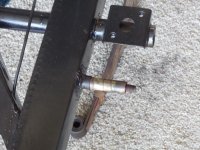
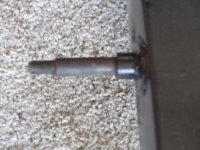
DSC03473.jpg
DSC03474.jpg
 
It takes about three hours to remove the rear Overiders and a few other body bolts and then lift the body about 6". The springs can then be removed without removing the pins. Makes the job easier than the anguish of trying to remove them the factory way.
 
I already regret not replacing mine !
Thanks for replies.Since the body is recently on the lifting may be easier.It looks like even 4" may do it.Funny thing is the car sag seems more noticeable when standing back and looking at rear than the frame to floor floor measurments would suggest.
Thanks
Tom
 
I would be interested to see the results of the new springs. I put in new Moss springs which made little differance. Ended up shimming one side spring. I know its cheating but could do little less.
Yes the Chassis is straight.
 
I'll attest that I used Randall's method a couple of months ago when I had to replace a spring -- the pin was most likely original, unmoved since 1959. After a long time soaking in PBlaster and using the threaded rod -- it pulled out as smoothly as a cork out of a wine bottle.
 
Ended up shimming one side spring. I know its cheating but could do little less.
Maybe not cheating so much. The factory actually shimmed the passenger side spring for some range of cars (early 3A through early TR4).
 
I don't have an exact measurement handy, but it was a lot less than 1". Two spring leaves, or around 3/8" would be closer. You can see them in this photo:


The idea, so I've heard, was to make the car sit level with only a driver on board. This was apparently a requirement for some strange racing category (although I suspect the intent of the rule was to force a co-pilot to be in the car).

Not the same as the aluminum blocks that were added later on.
 
Mine is about 3/8". Actually it is the anchor piece for the Panhard. My imagination tells me that it still sits a bit low on one side but I reconsile that thought by telling myself that in a leaf sprung car the springs will settle after the car has been left standing for long time between driving.
Does anyone agree with that theory? Hoping so!
 
Mine is about 3/8". Actually it is the anchor piece for the Panhard. My imagination tells me that it still sits a bit low on one side but I reconsile that thought by telling myself that in a leaf sprung car the springs will settle after the car has been left standing for long time between driving.
Does anyone agree with that theory? Hoping so!

Thanks again for all replies.Simmo,not sure what you mean by panhard anchor.Non factory add on?
Randall,whats the deal with alum blocks?
Where different length shackles ever used?
Thanks
Tom
 
The factory shim on the passenger side rear spring was two short pieces of 7/32" main leaf. Total thickness 7/16", so that's the amount it raised an empty passenger side.

Often wonder what size passenger they used to calculate the drop to level ?.

Viv
 
Once i got the body off and started disassembly, I went to the rear suspension. After reading of all the horror stories, I armed myself with all kinds of special tools, hammers, punches, etc. Both pins came out with one blow of a soft mallet!
OK, so SOMETHING was easy.
 
The factory shim on the passenger side rear spring was two short pieces of 7/32" main leaf. Total thickness 7/16", so that's the amount it raised an empty passenger side.

Often wonder what size passenger they used to calculate the drop to level ?.

Viv
Thanks.I think you meant lower the passenger side right?My driver side sags so I need a shim passenger side.Or, TRF is having a sale on springs.
Thanks
Tom
 
Yeah, those shims are somewhat counterintuitive... adding shims lowers that side. Actually the shims raise the axle, which has the desired effect of lowering the body.

I made some shims for the TR4 using 2" x 1/8" aluminum bar stock. Thinner than the TR3A style -- but that just means you have to add more (and have a finer ability to set the height).
 
Yes, since the axle runs above the spring (unlike most cars & trucks), adding a shim lowers that side.

FWIW, I have a pair of springs from TRF and they look very good. Free height matches almost exactly with the original shown above; and spring rate seems about the same (although I didn't measure carefully). These are from a new supplier (so Albert told me) and they were worried about how accurate they are. Of course, the real proof won't be until I get one put on the car. Might try and tackle that this weekend.
 
Back
Top