• Hi Guest!
    If you appreciate British Car Forum and our 25 years of supporting British car enthusiasts with technical and anicdotal information, collected from our thousands of great members, please support us with a low-cost subscription. You can become a supporting member for less than the dues of most car clubs.

    There are some perks with a member upgrade!
    **Upgrade Now**
    (PS: Subscribers don't see this gawd-aweful banner
Tips
Tips

question about brake master cylinder

nevets

Jedi Knight
Country flag
Offline
If the MC is not leaking, how can you tell if it is working properly? Put another way, if the MC is not leaking, can it be assumed that it is in good working order?

The reason for my question is that I am having a heck of a time bleeding my brakes (after replacing front wheel cylinders, bridge pipes and flex hoses). I've tried the EZ Bleed product and I've tried the 2-person pump & dump method and still no firm pedal. In fact once the pedal pumps up, it slowly fades to the floor. So maybe it’s the MC…but how do I know?

There have been numerous posts on the topic and I’ve read many of them more than once. I’m hoping for some new insight that will deliver me from the land of endless bottles of brake fluid where I now dwell.

Thanks
 
Do you have a brake booster in your car?
 
Once the pedal pumps up, it slowly fades to the floor., I think this is telling you the MC needs a bit of attention.
 
Inside the master there's seal at the pedal end to prevent dirt access, also prevents any fluid that leaks around the cup from getting out. For working the fluild theres a cup that pushes against the it, and an assembly with a seal, spring and rod that seals the passage from the fluid reservoir when the pedal is pushed so that all the pressure goes down the brake lines. Sounds like one of these is failing. I have seen masters where the spring has broken allowing the passge to not be sealed off and I've had ones where the cup seal has split or broken down so that fluid gets around it. Both of these failures normally don't involve external leakage. I'd say you should remove and disassemble it to be sure. Certainly don't drive it until you get this fixed since a complete failure can happen very quickly.
 
If your four (4) front cylinders were completely drained of fluid, as is typical of a rebuild, it can take several full cycles of bleeding to expell all of the air.

One thing you might try, while your Ezi-Bleed is hooked up: starting from the m/cyl, crack open each connection in the circuit, all the way to the end of the line. Let a few dribbles out at each fitting while gently tapping the tube/assembly with your wrench, in the event that surface tension has trapped an air bubble. A rag in one hand, absorbing the dribbles and a wrench in the other.

It's been a long time since I worked on the twin leading shoe front drum brakes (I took mine off in 1986) but it seems that the routing of the rubber hose, steel pipe connecting the pair of cylinders and the bleed screw aren't in optimum positions, so if memory serves me correct, it would take a couple/few bleeding sessions to get a firm pedal. If your m/cyl is good, then "rock hard" is obtainable.
 
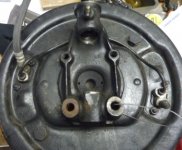
Thanks for the replies. I was hoping to avoid removing the MC, but maybe it will be necessary? It seemed to be working fine before I did the front brake work. One other thing and I'm not sure if it matters...If you look at the attached photo you will see that the new bridge pipe is oriented under the wheel cylinders, which is how the old one was oriented when I bought the car. The manual shows it oriented above the wheel cylinders. Perhaps it was done this way to facilitate bleeding?
 

Attachments

  • brake plumbing2.jpg
    brake plumbing2.jpg
    38.4 KB · Views: 146
I think the bleeder screw should be at the highest point possible. An air bubble can float above the bleeder for quite a while.
 
This brings back memories of what I went through, after replacing the master, hoses, a cylinder, refurbishing the resevoir, calipers, etc.

I too, was experiencing a soft pedal and found out the connection to one line feed to the master was not tight, yet no signs of leaking were visible.

Therefore, make sure all your connections are clean and "tight".
 
Here's a picture of one of my BN6 front brakes just removed a couple of months ago - bridge pipe is on top:

BN6drumCrop.JPG

I found in the past in order to prevent air from entering the system during the bleeding process, it is necessary to open the bleeder screw enough for the fluid to flow, then hold the screw against its socket so extra air isn't admitted. Also my BN6 would gravity-bleed OK. Do in this order: Driver rear, passenger rear, driver front, passenger front. If you haven't bled all 4 positions you'll need to do that.

Don't know why pipe position would make a difference but it's the only thing you've changed therefore is suspect.
 
Last edited:
That brings to mind; the original bleed screws had a tiny steel ball in them (on the seat), sort of like a check valve. Might've been somewhat of a requirement, given the less than optimum equipment placement...
 
1957 BN4 crossover pipes also run up top. Never gave it a second thought and the brakes bled easily with a nice hard pedal. I use a vacuum style air powered bleeder first to get fluid at all the bleed screws, then I use an assistant to do a final pressure bleed the old fashioned way. It seems to work every time with good results. In my experience if the pedal pumps up fine but then slowly travels to the floor on its own with steady pressure, it means the master cylinder is bypassing internally and needs rebuild/replacement.
JIM
 

Attachments

  • 2012-05-09 002.jpg
    2012-05-09 002.jpg
    95.5 KB · Views: 132
Thanks for the additional input and pictures. I'm not going to mess with the pipe for now since that's how it was before I replaced the wheel cylinders and it was't a problem then. Sounds like I may need to remove the MC. I'm not looking forward to crawling into the footwell. I will try more bleeding first.
 
Back
Top