

-
 Hey Guest!
British Car Forum has been supporting enthusiasts for over 25 years by providing a great place to share our love for British cars. You can support our efforts by upgrading your membership for less than the dues of most car clubs. There are some perks with a member upgrade!**Upgrade Now**
(PS: Upgraded members don't see this banner, nor will you see the Google ads that appear on the site.)
You are using an out of date browser. It may not display this or other websites correctly.
You should upgrade or use an alternative browser.
You should upgrade or use an alternative browser.
Picture of an early widescreen frame
- Thread starter CJD
- Start date


TR3driver
Great Pumpkin - R.I.P
Offline
So it does, I missed that. However, I believe the early cars had them parked on the right as seen from the driver's seat. Photos in the first editions of both the workshop manual and the "Instruction Book" (owner's manual) show them on the right as seen from the driver's seat; and i know the later cars had them parked on the left as seen from the driver's seat. (In front of the driver for a LHD car.)"Also, the link for "parked on the right" actually shows them parked on the left. "
Doesn't the VTR link say "as you face the front of the vehicle"?
Tom
So now I think the text is wrong as well as the photo.

Offline
I just looked at my own Instruction manual, and the TR2 workshop manual. All the photos show the wipers parked on the carburettor side. I did notice in Piggott, the photos of the "original" TR2, with the wiper motor on the carburettor side. His photos of later cars show it moved to the distributor side.
Interesting.
Tom
Interesting.
Tom
Lou Metelko
Jedi Trainee
Offline
Randall:
My TS981 has the Model CRT wiper motor with a date stamp of 3 54. To the best of my knowledge the CRTs did not have the parking position feature (parks where ever you push in the switch!). I have always pushed in the switch when the blades are at far left. Piggott states there was a two speed available as an option (Model DR3). Neither TRA or Piggott says if the two speed self parked or not.
When Bill Lynn was writing his TR2 originality guide he insisted on nameing location with the "as you face the vehicle" notation. I have always been taught location is determined with you sitting in the car then the author does not need the clumsy added notation. Bill's early edition of this essay was titled "the terrible 2s" but enough of we TR2 crazies had him change the name to "the trail breaking 2s". Bill's seven plus year search for TR2s worldwide resulted in an over 20% find. I take the 20% with a big grain of salt because I have not heard as to what criteria was used to be inclued in the "found" list. Still anything near 20% is amazing for a car that was basically just a "beater" for all of the 60s and 70s.
Lou
My TS981 has the Model CRT wiper motor with a date stamp of 3 54. To the best of my knowledge the CRTs did not have the parking position feature (parks where ever you push in the switch!). I have always pushed in the switch when the blades are at far left. Piggott states there was a two speed available as an option (Model DR3). Neither TRA or Piggott says if the two speed self parked or not.
When Bill Lynn was writing his TR2 originality guide he insisted on nameing location with the "as you face the vehicle" notation. I have always been taught location is determined with you sitting in the car then the author does not need the clumsy added notation. Bill's early edition of this essay was titled "the terrible 2s" but enough of we TR2 crazies had him change the name to "the trail breaking 2s". Bill's seven plus year search for TR2s worldwide resulted in an over 20% find. I take the 20% with a big grain of salt because I have not heard as to what criteria was used to be inclued in the "found" list. Still anything near 20% is amazing for a car that was basically just a "beater" for all of the 60s and 70s.
Lou

TR3driver
Great Pumpkin - R.I.P
Offline
Oh yes, of course. Totally forgot that part. Unlike the later cars, the standard (single speed) motor only gets power through the wiper switch, so there is no way for it to park itself.To the best of my knowledge the CRTs did not have the parking position feature (parks where ever you push in the switch!).
The information I have seems to indicate that the DR3 2-speed motors were self-parking. For example, the description in the Lucas 400e master catalog reads:
DR2 Rack type; dual arm; single speed with adjustable switch for self
parking. Separate operating switch.
DR3 As DR2, but single or two speed; high powered motor incorporating
thermostatic control.
I have always pushed in the switch when the blades are at far left.
So are the blades angled (relative to the arms) so they match the screen better on the left?
Just for clarity, I mean no disrespect towards Bill Lynn or anyone else. I am really impressed with both the quality of his article and the fact he chose to share it with the public for free. My assumption is that the apparent mistakes (there are another pair of photos later on that don't match the description) are just typographical errors (and perhaps that whoever restored the green TR2 installed the wrong wiper arms). Or perhaps I am the one who is mistaken (which certainly happens more often than I would like!)
I've already written Bill an email, so perhaps he will correct me via that route.
TR3driver
Great Pumpkin - R.I.P
Offline
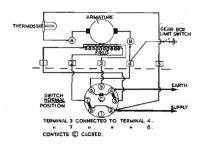
Means, I believe, that there was a cutout inside the motor to shut it down if it overheated. Which might happen if, for example, the wiper mechanism bound up or the blades were locked in place by ice (and the operator didn't clear the ice). Somewhere else there is a comment that the DR2 (single speed motor used on later TR3-4) didn't have a "thermostatic control", because the low power of the motor meant it could survive for a long time with the motor stalled."DR3 As DR2, but single or two speed; high powered motor incorporating
thermostatic control."
thermostatic control on wipers?
Ah, here it is, in the "Overseas Technical Correspondence Course" (click on the fuzzy thing below to see the text)

And in the same document, the diagram for the DR1 showing it's thermostat
TR3driver
Great Pumpkin - R.I.P
Offline
Don't know if anyone is still following this rapidly drifting thread, but JIC:
After some further investigation, mostly in the Lucas 400e Master Parts Catalogue, I believe that the early cars had the wiper arms angled to park on the right (as seen from the driver's seat) only if they also had the driver on the right. LHD drive cars had the arms angled to park on the left. (Although of course as Lou pointed out, the motor itself did not "park", it just stopped wherever it happened to be when the switch was turned off.)
The exception is that early cars with 2-speed wipers had straight arms. They also used a DR1 wiper motor, while the later 2-speed setup used a DR3 motor. Both DR1 and DR3 could apparently be configured to park on either left or right, but at this point I don't have any solid evidence to indicate which one was supplied.
After some further investigation, mostly in the Lucas 400e Master Parts Catalogue, I believe that the early cars had the wiper arms angled to park on the right (as seen from the driver's seat) only if they also had the driver on the right. LHD drive cars had the arms angled to park on the left. (Although of course as Lou pointed out, the motor itself did not "park", it just stopped wherever it happened to be when the switch was turned off.)
The exception is that early cars with 2-speed wipers had straight arms. They also used a DR1 wiper motor, while the later 2-speed setup used a DR3 motor. Both DR1 and DR3 could apparently be configured to park on either left or right, but at this point I don't have any solid evidence to indicate which one was supplied.