• Hey Guest!
    British Car Forum has been supporting enthusiasts for over 25 years by providing a great place to share our love for British cars. You can support our efforts by upgrading your membership for less than the dues of most car clubs. There are some perks with a member upgrade!

    **Upgrade Now**
    (PS: Upgraded members don't see this banner, nor will you see the Google ads that appear on the site.)
Tips
Tips

TR2/3/3A Over drive

TRo8son1

Member
Offline
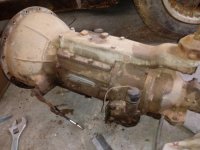
Hi im new to the forum , iv recently purchased a tr3 smallmouth TS20934-LO.matching numbers car in need of full restoration
While reading up on the manual and looking at the gearbox , i noticed there seems to be one or more isolator switches missing / plugged off these plugs seem to have been there long term . a lot of the wiring with the car and to the overdrive is also missing , i take it theise switches are needed . can any one help me with this

Regards
TRo8son1
 

Attachments

  • 20180813_193405.jpg
    20180813_193405.jpg
    53.9 KB · Views: 249
The switches are quite important with the overdrive. Sounds like someone may have switched some components without really understanding what they were doing.

The good news is that you have the plugs, so adding the switches is fairly easy. There is an adjustment procedure though, you may need multiple gaskets under either switch to get proper engagement. See page 26 in the gearbox section of the workshop manual.

The OD wiring is fairly simple, easy to fabricate yourself if you can solder. Should be a relay on the back of the battery box (near the heater). Two wires from it to the OD. One wire to the ammeter, another to the operating switch on the dash. Last wire from operating switch to starter switch.
(Some sources say to pick up power at the fuse block and control box which will also work fine. But what I outlined is what I found on TS39781LO and it appeared to be original.)

I do recommend two modifications to the OD wiring. A diode from the relay output to ground will make the relay live longer, and an in-line fuse in the wire from the ammeter will help protect the solenoid if it gets jammed, in addition to the wiring.
 
Maybe this will help at some point:

s9ppvLd.jpg


I used both the diode and the in-line fuse suggested by Randall. This is the diode I used:

B6Qv3cX.jpg


Several places to add it, I put it right in the harness:

SfvEqPq.jpg


The fuse I put at the connection to the relay:

vt1rvS9.jpg


Relay contacts should point down, I really should fix that someday.
 
Having accomplished the OD wiring installation with the addition of the diode and the fuse holder, I am wondering what an appropriate fuse rating would be? I think in this case I'm trying to protect the solenoid rather than the wire that goes to it?
 
On a Triumph, I’d probably refer to it as “numbers correct”, since there are no numbers that actually match.
 
Thought I had remembered the Diode mod.

What are the specks on the diode or will the Radio shack number correctly identify it also how high a fuse rating?

David
 
The fuse protects both wiring and solenoid, but mostly the solenoid. Possibly less important now, as new solenoids are a lot less expensive than they used to be, but still a good idea, IMO.

I use an MDL 8 fuse, which is an 8 amp "slow blow", mostly because I had a case of them on hand (discarded by a previous employer). But I believe even an ordinary 5 amp fuse (ie AGC 5) would work fine. Or if you want to use a more modern fuse holder, ATO or ATC, etc would work fine too.

The solenoid draws a big burst of current at first (hence the relay and relatively beefy wiring to it), but normally the burst of current only lasts a fraction of a second; not long enough for even a 5 amp fuse to get hot and burn out. The problem is that if something blocks the motion of the solenoid plunger and it doesn't cause the internal contacts to open, the high current will eventually (in a few minutes) cause the solenoid to overheat and burn up. So using a smaller fuse means the fuse blows before the solenoid hurts itself, giving you a chance to correct the problem without needed a new solenoid. (In my case, it was a bit of gravel that had worked it's way inside and jammed the plunger.)

The ratings on the diode are not critical at all; what I used is a 1N4004, which is rated 400 volts and 1 amp. (At the time, Radio Shack sold a bag of 25 of them for a couple of dollars, but they don't do that any more.) Any of the 1N400x series should work fine, and they are readily available at any electronics supplier (Digi-Key, Mouser, Newark, etc) or on eBay. Just for example
https://www.ebay.com/itm/25-x-1N400...095096?hash=item3cb99cbe78:g:ml0AAOxyFiRRzFEx

The one Geo showed above will work just fine too, if RS still has them (and if there is still a RS available to you. AFAIK all the ones near me are gone now.)

If you happen to be near Torrance, California (or passing through), I recommend Torrance Electronics on Carson Ave. All the other stores in the area have closed, but TE was still there last time I drove by.

Note that the diode is polarity sensitive, installation will depend on whether your TR3 is still positive ground or has been converted to negative ground. The diode will usually have a white stripe on one end to indicate polarity, the stripe needs to go towards the positive side. So for positive ground, it would go towards ground; for negative ground it goes towards the relay output pin.

1N4004-500x500.jpg
 
Last edited:
Hello Randall

Thank you for that very informative answer.

We do not have a RS here anymore but we do have a small electronic parts store. Will have to add a second fuse holder.

David
 
I used an in-line holder, hanging off the back of the ammeter. You can see just the end of it, at the top of this photo (taken as I was parting out the wreck).
oOnqwEb.jpg
 
Hi would one of you gent's mind doing a quick sketch of a wiring diagram . from the switch to overdrive to relay including the inline fues and the diode , for us simple foke across the water

Thanks Tony
 
Does this help?
WUo8q9V.jpg
 
Thank you , just the job ,
At the miute i have the gear box drained of oil . will this also drain the ovredrive . ? is there an easy way to test if the overdrve oprates ,as the car is not running at the moment
Regards
Tony
 
You need to remove both plugs to fully drain both gearbox and overdrive. Inside the OD plug is a screen and possibly some magnets that should be cleaned as well.

To test the OD in the car, you'll need the engine running. Put the rear on jack stands, or disconnect the driveshaft. (Disconnecting is probably better.)

Just a fast idle will do, 1000 or 1500 rpm. Select 4th gear and let out the clutch. Without OD, the indicated speed in mph should be close to twice the rpm in hundreds. Eg, 1500 rpm equals 30 mph. Then when you engage OD, the speed should jump up by about 20%. So, for example 1500 rpm should now be about 36 mph.

This is a fairly basic test, it doesn't check things like hydraulic pressure. But it gives at least a first level check of OD operation. If you are worried about it, I suggest getting a gauge and checking the operating pressure. Low pressure can let the OD clutch slip under load, leading to rapid wear and eventually an expensive repair job.

The Buckeye Triumphs site has some good articles on rebuilding an A-type od, which include testing and troubleshooting (and checking pressure).
https://www.buckeyetriumphs.org/gearbox
 
Last edited:
Yep...Photobucket is up to their old tricks again. All the photos are blurred from your end. Last time I had to fork out $100 to get them back. Love you guys, but I don’t plan to fork out that kinda bucks, and re-posting would take months on all my threads.

Oh well...fun while it lasted!
 
Last edited:
Back
Top