• Hi Guest!
    If you appreciate British Car Forum and our 25 years of supporting British car enthusiasts with technical and anicdotal information, collected from our thousands of great members, please support us with a low-cost subscription. You can become a supporting member for less than the dues of most car clubs.

    There are some perks with a member upgrade!
    **Upgrade Now**
    (PS: Subscribers don't see this gawd-aweful banner
Tips
Tips

TR2/3/3A Over drive

Getting the parts together for the OD install.

David
Overdrive fuse holder.jpg
 
With pics

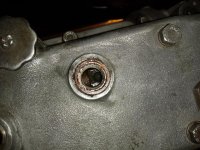
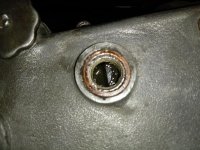
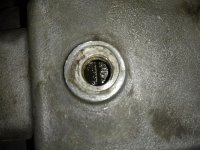
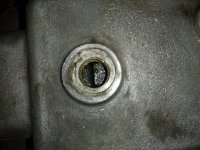
1st ,2nd,3rd , 4th , reverse , first looks a little bit too far Forward ?

My worry is the switches were removed and pluged , i removed the brass plug / only gunk no bits of metal
 

Attachments

  • 20190918_200205_resized.jpg
    20190918_200205_resized.jpg
    92.7 KB · Views: 89
  • 20190918_200230_resized 2nd.jpg
    20190918_200230_resized 2nd.jpg
    67 KB · Views: 83
  • 20190918_200244_resized 3rd.jpg
    20190918_200244_resized 3rd.jpg
    69.1 KB · Views: 84
  • 20190918_200254_resized 4th.jpg
    20190918_200254_resized 4th.jpg
    68.8 KB · Views: 85
  • 20190918_200304_resized reverse.jpg
    20190918_200304_resized reverse.jpg
    92.7 KB · Views: 83
They look good to me. You use the copper washers to set the height of the switches so they engage as the gear is reached.
 
Note that the OD is only enabled in 2nd, 3rd & 4th. The reverse position is used for a reversing light (when fitted, not a common option from what I've seen), and I don't know of anything that is enabled in 1st gear.
 
The wires exit the gearbox tunnel on the left side through a 1"-1.25" hole (with a grommet preferably), staying under the carpet to where the tunnel meets the firewall, and up to the relay and the OD switch.
 
Hello Keith

Thank you.

That is probable the hole I thought was for checking the oil level. I had it run through the fire wall where the main harness passes through.

David
 
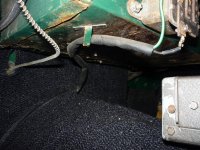
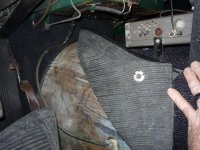
David, I happened to be in the garage - here is how it looks in my 59 TR3A. The first picture is from relay to the firewall, then under the carpet. Under the carpet it goes down & back to a hole in the Xmsm cover. Can't say if its factory though.P1110280.jpgP1110282.jpg
 
FWIW, I didn't like the factory routing, so mine run up the firewall (on the engine side) and through one of the grommets there. (Which I think is what you're saying, but not certain.)
 
Yeah Randall, now that I look at it, that's a lot of wire to have under the carpet if the pull-up winding in the solenoid fails to drop out. 30 years ago such things weren't in my crosscheck. I did add a fuse for it though.
 
I have also added fuses on both the OD coil and OD relay coil. The relay coil seems to be fine with a 5 amp fuse but I had to go to 15 amp for the solenoid coil. 5 and 10 amp fuses blew when I engaged the OD.

I mounted the OD relay on the bracket that supports the heater.

David
 
These photos show how I mounted the relay and where the wires go, when they come out of the tunnel cover they just sit on the floor under the carpet and run up the firewall

Graham
P1010077.jpg
IMG_1628.jpg
P1010208.jpg
 
I ran the OD wire through the engine compartment and through hole where the main harness passes through. Looks like I have missed a rubber plug. The micro switch is my replacement brake light switch. The one contacts on the one from Auto Zone melted the plastic so the brake lights were on all the time.
The relay is mounted above the heater support.

I think my solenoid may not be switching to the lower setting. I am blowing a 15 amp fuse after a few minutes of engagement. Going to get an amp clamp to check the draw. Are the solenoid repairable?

David
OD wire 2.jpg
OD relay.jpg
 
I think my solenoid may not be switching to the lower setting. I am blowing a 15 amp fuse after a few minutes of engagement. Going to get an amp clamp to check the draw. Are the solenoid repairable?
Maybe. Depends a lot on what's wrong, and how creative you are. Normally, there is a plastic pushrod that the plunger hits when it pulls home in the housing. The pushrod opens contacts under the end cap. If your existing pushrod is worn or melted, you may have to fabricate a replacement. AFAIK, no one sells anything but the complete solenoid.

The good news is that they have gotten a lot cheaper. 25 years ago, they were over $100; last time I checked they were only about $30.
Probably not the same quality, though.

BTW, I believe even a regular 5 amp fuse should not blow. I've been running an 8 amp slow blow for many years, just because I had a lot of them on hand, and never blown a fuse.
 
When I check the resistance with a meter I do not always get a change in resistance from un-operated to operated.

I am noticing the solenoid getting warm. I presume the fact that I blow a 15 amp fuse implies no change over.

Will get one on order before I mess with this one.

David
 
I presume the fact that I blow a 15 amp fuse implies no change over.
Very likely. In fact, that's just the reason I added a fuse; my previous solenoid burned up after a bit of gravel got caught and kept the plunger from moving all the way. Using a small fuse means the fuse will blow if the contacts don't open; and perhaps save the solenoid.

But the replacement solenoid was crimped together, and the crimp failed, so the fuse wasn't any help with that :smile:
 
That's what I did David, ordered a new one because it would not pull up on the first high amp circuit . When I took it apart I found a loose connection , resoldered it and it works fine. The relay should be mounted on the battery box, you have used one of the mounting holes for an earth wire?

Graham
 
I have the diode that Randall showed in his drawing that goes between the Relay contacts and the pull in coil. That is the ground point you can see on the battery box in the center of the picture. Do I need a ground for the relay case?

David
 
Back
Top