• Hi Guest!
    If you appreciate British Car Forum and our 25 years of supporting British car enthusiasts with technical and anicdotal information, collected from our thousands of great members, please support us with a low-cost subscription. You can become a supporting member for less than the dues of most car clubs.

    There are some perks with a member upgrade!
    **Upgrade Now**
    (PS: Subscribers don't see this gawd-aweful banner
Tips
Tips

Oil In Radiator - Long

Thanks for the article reference, Ray. Will definitely keep that in mind as we go forward. Sounds like the problems red57 talked about earlier.
 
TomFromStLouis said:
I can't help you with your problem Bob, but I do know that the sports page you ruined will be a valuable Collectible Item when the Cardinals take it all again this year.


Guess not.

Many thanks to Matt Holliday for lighting a fire under Scutaro and the Giants.
 
Thanks Andrea, interesting. I looked for the 'kit' on both Cape International and SC Parts and couldn't find it. Maybe I'll get lucky and it will just be a head gasket problem :whistle:
 
Final post for awhile.
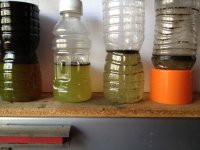
Bottle on left is after return from Springfield, MO (200 miles)
2nd from left is after flushing with water. Oil thickness aboutr 1/4"
3rd from left is the next morning after running another 20 minutes to bring up to temp. Oil thickness about 3/16".
4th is as of now after another 20 minutes of running to bring up to temp. Tried to get the oil and water out showing oil thickness as it is in radiator. Oil thickness is still about 3/16"
 

Attachments

  • 29951.jpg
    29951.jpg
    144.1 KB · Views: 359
Before pulling the head, I would try cleaning the cooling system as well as possible and then test for 'new' oil entering the system - just in case you are only stirring up what is aready in there.

I'm not sure this would be reccomended by anyone but the following is what I did when I was dealing with it (and possibly a waste of time since you already know oil got in there somehow, but hope springs eternal....).

I put about a cup of real stong grease cutting laundry detergent in the cooling system with plain water (no antifreeze). Ran the engine at idle for about a 1/2 hour - fully warmed up so the water was hot and circulating well (heater valve open to flush heater core as well). Shut off and drained, refill with another cup of detergent and plain water and run another 1/2 hour. Shut off and drain and then refill and restarted motor and let it idle with hose in radiator and drain on bottom of radiator open w/hose running at a rate that matched the drain rate so it stayed full and was flushing at the same time to try to get all the detergent out and have just clean water - probably let it run that way another 1/2 hour or so until water draining out didn't feel soapy anymore. Then I shut the drain and filled it up with plain water and drove the car maybe 50 miles and after cooling checked for oil in radiator. If you get oil on top of the water then, you know it's 'new' oil and not just some residue in the system. I'm lazy and would want to be real sure I had a problem before tearing the motor down.

If you need to tear it down, closely examine gaskets and such but if you don't see an obvious problem with the head gasket you may need to pull the motor and take the block & head to a shop. For me this was where I had a problem because my shop was never able to actually find the seepage with pressure testing. It is difficult to set up to pressure test these oil galleries, and it may be diffrent when running hot than when cold - hopefully your shop may have better luck at testing than mine did. Anyway, as I said earlier we tried the oilway repair kit from Moss but it didn't work and I had to find another block to prepare - not certain, but as near as I can tell the problem is most likely in the block rather than the head.

Good luck and please continue to keep us advised of progress.

Dave
 
As we've gotten older and more prosperous (hopefully) and our cars have taken on the role of hobbies, we really try to do repairs the "right" way instead of some of the bodges we used to do to keep them on the road when we were younger. If this is a cylinder head gasket, than replacing it wouldn't be too painful. But if it's block porosity, you're looking at yanking the engine and stripping it down and I suppose taking out the internals in order to do the pipe insert (can't imagine I'd want to bore into the block like that without tanking it afterwards) So just for the sake of argument, what's the chance Bob could get by with flushing his radiator every couple of months until it comes time for a rebuild? Or even using a turkey baster to siphon it off the top of the header tank. If it's a seepage, rather than a giant hole blown through the jacket, I wouldn't think there would be all that much oil going into the cooling system. Thoughts?

Edit - looking at that first bottle again, that sure seems like a lot of oil after 200 miles of driving. Is that what one could expect from a porous block?
 
Rick,

I agree and, as I said in my earlier post, I made it through a whole summer of driving & racing by doing the flushing treatment every 500 miles or so (and I did the turky baster too). My estimate at that time was less than a quart of oil in the water after 500 miles or so. However, the rate of oil seepage may vary from one case to another so it may not be feasable. I do know I never got any water in the oil so all oiling functions were fine - no bearing/piston damage.

One time I let it go for too long and started having higher water temps - I think this was because it had started to become a foamy/oily sludge that wasn't circulating well or transfering heat properly. So I would advise caution, and flushing is a pain in the butt, but I do think it is possible to drive it as is for a while.

Dave
 
Well, look on the bright side! The winter is upon us very soon and this will give you time to sort this nagging problem out one way or another and get her ready for another driving season next spring, I am all for doing things the proper way, But I wonder if bars leak would seal the problem area at least for the short term? But I would check to see if there are any abrasives in that stuff first as not to get that goop mixed in with your oil supply. If it where me, I would just pull the head because that oil should have never found a way into your cooling system in the first place. Also you want peace of mind knowing you are doing things the right way for the long term! Imagin driving your Healey with that issue always on your mind! Not the best thing for resale as well! I think the nagging question remains, That oil is coming from some where! If you have the money and time, Then I would retire the car for this season and approach this with long term resolve. I think it would give you peace of mind. Anyway, that's my two cents worth! Michael, IL.
 
Hi BOB
I have find the Kit
https://www.ahead4healeys.co.uk/BLOCK-OIL-WAY-REPAIR-id2286.html
Cheers
Andrea
PS Just one idea to avoid the rebuild,
flush the cooling system with a product for <span style="font-weight: bold">repair cooling</span> <span style="font-weight: bold">radiators</span> little water leaks-in double quantity than needed for the radiator - i have used one of this product it leave one thin layer on the surfaces and stops little holes and POROSITY-follow the product instructions
Then drain accurately the cooling system and wash it with detergent without lather
then wash again and TESTS
 
60psi oil VS 8psi coolant the radiator stop-leak product will not win...
 
Bob,

Just an off hand thought, have you checked the torque on the head bolts? If its the head gasket leaking, and since the oil supply for the rockers does go through the gasket, there is a strong possibility it is that gasket (as others have pointed out). Also, are the spark plugs all running the same color? any oily or wet/too clean?
 
Time to catch up on some suggestions.
HealeyRick - I'm not sure the far left bottle is representative of what the actual level was. I think I was getting more oil than was actually there. The bottle on the far right is the one that i tried to fill in the same proportion as the tank.

red57 - I think I'm going out early tomorrow morning and put some interstate miles on the engine without getting to far from home. I plan to keep a close eye on both the temp and oil gauges. That will give me a better idea of what is going on. If the level of oil in the radiator increases, then we probably need to park it for the winter.

We have 30,000+ miles on the engine, maybe closer to 50,000. The spark plugs were a consistent 'too rich' black on all plugs.

andrea - thanks for the link. However I think i agree with big6, and TOC earlier, that the oil pressure would win. The person that lent me the oil pan has a block that could be used for a rebuild. That would be much easier that tryng to fix this block. Decisions, decisions.

I'll let you know how tomorrow goes.
 
Took Miss BT out for a 60 mile run around I-270 in St. Louis this morning. Outside temp was a brisk 40 degrees!
Once warmed up the temperature gauge stayed just under 190 degrees and the oil pressure stayed just over 40 lbs at 2500 rpm. I was going about 60 mph based on pass readings on my GPS.
Oil in the radiator tank is still at the 3/16th inch mark.
So, when it warms up a little, I plan on doing the detergent flush and then do "One Lap of St. Louis" once or twice, which is about 100 or 200 miles on I-270 and I-255.
The engine ran very strong with no misses or hiccups at all.

red57 - After doing the flushing, was the oil in the radiator tank still almost black when you ran the engine again? I have fresh oil in the pan and for some reason thought is would be lighter. Might be because I haven't flushed it good yet but there was fresh oil in after I swaped the oil pan out.

Also, my son suggested dishwasher soap, thoughts?
 
Personally with the time and $ spent on driving and cleaning, I would have had the head off and radiator cleaned by this time and probably fixed and ready to run again.
 
@Bob, I don't remeber the oil color much, think it was darker then new oil in the can but don't remember exactly. I do remember it was tough to get all the oil out. As to what to use, I found low sudsing laundry detergent worked best but I expect dishwasher soap might be a good thing to try (we don't have a dishwasher so there was none handy for me to try). Reglaur hand wash type dish soap seemed to make too much suds & I was concerned about froth preventing good circulation (may not be an issue). Whatever cuts grease/oil best I think. I even tried parts washer solvent one time but was afraid of the fire hazard and I don't think it worked all that well anyway. I am not a pro and these were my 'home grown' methods since I didn't know anyone with this kind of problem :smile:

@Larry, I agree - if this is a bad gasket or crack in the head. However, if he pulls the head and doesn't find any problem, does he just put in a new gasket and hope??? Go back and read the various links others have provided - this pourosity is a REAL issue, I didn't invent the idea. Enough have had the problem to inspire the repairs shown in the links. When it first happened to me, I did the quick head removal, new gasket, reassemble as you suggest but it didn't fix the problem which led me to more research and the "oilway Repair Kit"

All I was suggesting by the cleaning & testing was to be as sure as possible what is going on. I think, if it is block pourosity, it may be best to prep another block and transfer your crank, rods, cam etc. rather than the repair tubes - but that is just my experience. I recomend you try to find others/shops that have had this issue & see what their take is.

Dave
 
Back
Top