

• Hi Guest!
    If you appreciate British Car Forum and our 25 years of supporting British car enthusiasts with technical and anicdotal information, collected from our thousands of great members, please support us with a low-cost subscription. You can become a supporting member for less than the dues of most car clubs.

    There are some perks with a member upgrade!
    **Upgrade Now**
    (PS: Subscribers don't see this gawd-aweful banner
Tips
Tips

Oil In Radiator - Long

Bob McElwee

Jedi Knight
Gold
Country flag
Offline
While driving to Eureka Springs for this years Tri-Healey Meet we were driving on a nice twisty MO two lane. As we came around to slight downhill left hand curve I saw something in the road. I couldn’t go right, no shoulder, and made a snap decision to go over – Wrong Move!!

After a very loud clunk/crunching sound my wife looked back and said I think you are leaking something. The engine was still running OK so I started watching the oil pressure gauge. When it headed to zero pressure I turned the engine off and looked for a place to pull off. Found a gravel driveway to a church youth center and coasted in.

A local member had an oil pan so we headed back down Tuesday to swap it out with the one on the car. When we finished swapping pans, I checked the water and brake/clutch reservoir and fired Miss BT up. Ran fine and I headed to the motel where Jean had gotten a room.

We left Springfield about 9:30 Wednesday morning after checking all the fluid levels again. All were OK. While driving on the I-44 I kept my eye on the oil and water gauges. Both were ‘normal’, oil started out at 55 lbs and slowly worked its way down to 40 lbs. Temperature was constant at 190 degrees. I was running at 70 – 73 mph most of the time.

When we got to Rolla I pulled in for gas. Jean parked and came over and said there was a big puddle of something under the car. I looked and checked in the engine bay and couldn’t see any obvious leak. The oil level was still full. I got down on my hands and knees to get a closer look; it was ‘dirty’ oil and was coming out of the radiator overflow pipe. I slowly release the radiator cap pressure and took it off. Oil came out. Because the car had been running ‘normal’ I decided to come on home. Engine was smooth with no misses. Oil and water readings were normal for Miss BT.

I’ve drained some of the new oil out of the pan and there isn’t any water in the pan oil. I did a compression check and cylinders 1 – 5 range for 110 (1), 115 (1) and 120 (3). I can’t get the spark plug out of the number 6 cylinder until I get a different spark plug socket.

Does anyone have any idea how the old oil got in the water? I think when I hit the chunk of ??? an oil tsunami shot up from the oil pan but can’t figure out how it got in the water.

My next step will be to drain the radiator and refill with water and see if it gets contaminated with oil again. If it doesn’t I’ll refill with antifreeze and let her rip.
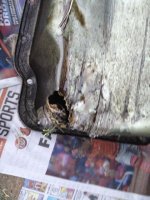
 

Attachments

  • 29887.jpg
    29887.jpg
    63.3 KB · Views: 703
Sure it's old oil and not the mysterious brown crap that sometimes lives in 55 year old water jackets?
 
Not sure where...but oil pressure is higher than water pressure.
Head gasket between oil port and water port. Cracked head between same. Cracked block between same. Water pump bolts separately to block, no spacer plate that is back for timing cover?
Seen it before, not LBC that I can remember, but could not find it (pressure tested heads, okay, just replaced block).
May be heat related.....crack opens under heat. You may never find it with a radiator pressure tester.
Dave
 
Thanks for the replys.
Kellysguy - pretty sure it isn't old sludge, block was boiled out a few years ago.
Dave - if any of the conditions you mentioned are the cause, then the radiator refil will water and a test drive should 'force' more oil into the cooling system again. That may wait till I've put my repaired oil pan back on so I can return the borrowed one.
 
There are tests that will indicate products of combustion in the coolant, that'd be my first step.
 
Except for the pan replacement part of your story, this sounds suspiciously like the 'block pourosity' problem that can strike these engines. May be just coincidence that it happened now or possibly when you hit the whatever there was enough of a jolt to dislodge some rust scale in a water passage somewhere.

I have had the block pourosity problem happen to two blocks. TOC is right, the oil is at much higher pressure than the water, but the water does hold pressure for quite a while after shutting the engine off. One key if it's pourosity is there never seems to be any water getting into the oil like can happen with cracks or blown gaskets and as long as you don't get enough oil in the water to affect cooling you can keep driving it without further damage - several yars ago I made it a whole summer just flushing the cooling system every 500 mles or so.

There is an 'oilway repair kit' available from Moss (originally created by SC Parts, I think), I tried it on one block but it didn't cure the problem & I had to replace the block. The trouble with the kit is you have to strip the block to install & my machine shop was unable to pressure test, so I had to completely reassemble the motor and try it only to find it still was seeping oil into the water - that was not a fun day....

Not what you wanted to hear, I know..
Dave
 
Hi Bob,

If you haven’t already, flush the cooling system and continue to just observe until repeating oil-in-water indications are observed. Since the engine seems to be running good and your compression hasn’t gone to crap, assume all is well until there are further definitives.

When many of us drive, one ear is always listening for strange noises emanating from the car and, immediately, we begin to analyze a response to a potential problem that caused the noise we heard. It is obvious that, from the picture, your engine got a good shot, however, I would suggest you not over analyze because, in the Healey, you will always find something.

Good luck,
Ray (64BK8P1)
 
I can't help you with your problem Bob, but I do know that the sports page you ruined will be a valuable Collectible Item when the Cardinals take it all again this year.
 
Ouch! Bob, sorry to hear you had a problem, but glad you made it home alright. It could be that when you continued on with a hole in the oil pan, and losing oil, the engine severly overheated and created a vacumn in the sump thus "sucking" water into the engine.

What? I said that?
 
Tom - unfortunately the collectible sports page is probably in a Springfield landfill by now.

Johnny - kept my eye on the oil/temp gauge and the temp didn't suddenly go up when the oil pressure started to drop. As soon as it started to move towards 0 lbs I turned the engine off and coasted.

As soon as I put the repaired pan on I'll drain, flush till clear and do some test runs to see what shows up in the radiator. If oil reappears then one of the two Dave's is probably correct. Randy's suggestion of testing then would be the next step prior to pulling head.

Pan gaskets are on the way so hopefully can swap them out next weekend.

Thanks for the thoughts.
 
Bob,

Just a suggestion I haven't seen mentioned:

When changing the pan out, leave it off and put a radiator pressure tester on a cooling system full of water. Leave pressurized overnight with a piece of paper under the block to see if water appears on the paper in the morning.

Also, if possible, don't run antifreeze until this is sorted, it can do major damage to rotating parts if it gets in the oil.

Hope this helps.....
 
Hello Bob,

I agree that putting the cooling system under a pressure test would be a prudent thing to do first.To be very honest, I can't understand how oil could be in your cooling system unless one of your passage ways in your block has rusted through. Or the head gasket gave way. Maybe that jolt exposed the problem and was the last straw breaking through what was left of the inner passage way for the coolent. "IF" there is no oil pushing into your coolant system after the pressure test, I would then use a coolant system cleaner along with the water to break down any oil left in the system and flush the whole mess out in total. Then refill the cooling system with clean water and go for a drive bringing the motor to normal operating temperture. Hopefully after getting the motor block hot and up to temperture then rechecking your cooling and oil systems everything will be back to normal! (wishfull thinking) Did you check inside the oil filter yet? maybe it will reveal something. That motor oil got into your cooling system some how! This should prove interesting! In any case i am really very sorry this sort of thing had to happen to you! Keep us posted Bob. Regards, Michael
 
If you have a casting porosity problem, applying radiator pressure at 7 to 12 PSIG will probably not transfer water / coolant to the oil pan area. By attempting to apply oil pressure at 60 or more PSIG to the cooling system will probably result in radiator damage.
 
I had a similar problem. I was told that the problem was a head gasket but didn't believe it. As it turned out PO had put two different types of non compatible antifreeze in the radiator. The result turned into what looked like oil. I was convinced that it was oil. But is wasn't. It took mulitple flushings, over several days to get rid of it. Kept showing up in small amounts and then finally flushed away. That was 3 years ago. Clear fluid now.
 
I was told the same thing about the antifreeze today at an O'Reilly auto parts store.
I have a sparkplug socket now so I'm planning on checking the #6 cylinder compression first, then drain the oil to confirm no water is in it. The sample I took last weekend still shows no sign of water so I'm reasonably sure that is OK.
Then I plan on doing some sample draining from the radiator and block to see if I'm getting water or the consistent black stuff in the radiator tank. If it is the consistent black stuff I'll drain and flush till clear and then refill with water.
After swaping the borrowed pan with my repaired one I'll run the engine till warm, check the water, if OK drive some and check the water, if OK keep driving and checking till I need to put antifreeze back in, which isn't to far off now.
Thanks for all the comments and suggestions.
 
An Update:
After swapping pans out, i drained the radiator and ran the engine with the radiator drain open and a hose adding water. When i checked the water in the tank it was mostly clear with just a little black stuff on top. Ran it another 15 minutes with the drain closed and got it up to 190 degrees. Let it sit overnight and a significant amount of oily black stuff is in the top of the radiator tank again. Still no water in the oil pan.

Will wait till we kick it around at the Gateway Healey meeting tomorrow but it looks like the head is going to have to come off. Oh, number 6 cylinder was 107 lbs.

It will be awhile before we get to the next step.
 
RAC68 said:
Bob,

If you haven’t already read this, take a look at this article posted at (https://www.healey6.com/Technical/Gallery.pdf) “Austin Healey “C” Series Engine.
Oil traces in Cooling System”. The solid bang your engine received may have stimulated this condition.

Good luck,
Ray (64BJ8P1)
I had the machine shop that did my machining work do a test where they pressureized the block. The only problem I had with the rebuild so far was locating new Oil Gallery plugs and those ended up being made by a local club member with a lathe. The machine shop removed the Plugs to thoroughly clean the engine. I've since found them new and ordered as spares.

Another issue was the 3 Flywheel dowel pins that were "lost" by the machine shop. I had to buy used ones but I took measurements/drawings of them so they can be reproduced on a lathe for the next guy who has this problem.
 
"The only problem I had with the rebuild so far was locating new Oil Gallery plugs and those ended up being made by a local club member with a lathe. The machine shop removed the Plugs to thoroughly clean the engine. I've since found them new and ordered as spares."

One good solution is to tap the ends of the holes with 3/8 pipe taper & use 3/8 pipe plugs with allen sockets so they don't project from the holes. Then, in subsequent rebuilds it is easy to pull the plugs to clean the galleries and re-insert the plugs.
 
Back
Top