• Hey Guest!
    British Car Forum has been supporting enthusiasts for over 25 years by providing a great place to share our love for British cars. You can support our efforts by upgrading your membership for less than the dues of most car clubs. There are some perks with a member upgrade!

    **Upgrade Now**
    (PS: Upgraded members don't see this banner, nor will you see the Google ads that appear on the site.)
Tips
Tips

oil in my cylinder

I should have noticed earlier, but don't rotate the crank until you have locke the liners down. If they move, they will break the seal at the bottom where they interface with the block and will have to be pulled and re-sealed.
 
Got the report back for the head. Pressure check was good and no cracks. The valve guides need to be replaced along with the springs, mine takes the triple spring setup. Of course I have a few questions:

Is it worth it to get the manganese-bronze type valve guide or the stock valve guides?

The machine shop said there were o-ring seals on the valves, is that the same as the part called the "Collar?"
 
doughairfield said:
Is it worth it to get the manganese-bronze type valve guide or the stock valve guides?
IMO, no. In theory they last longer, but in practice they must be reamed oversize because the bronze expands faster with heat than the cast iron head does (causing them to close up when they get hot).
<div class="ubbcode-block"><div class="ubbcode-header">Quote:]The machine shop said there were o-ring seals on the valves, is that the same as the part called the "Collar?" [/QUOTE]No, I don't believe so. Those would be aftermarket seals that someone has added, presumably only on the intake guides (in an attempt to reduce oil burning). The "collars" go on the exhaust valves only, and provide a stepped seat for the inner valve springs (which are shorter than the outside springs).

The added seals can be useful for racing (where longevity is not an issue), or as a band-aid on engines that are already badly worn (BTDT). But in general I feel they are a poor idea, as they keep too much oil away from the stems & guides, which causes them to wear quicker.

The factory setup will easily last 100,000 miles, by which time it will need a ring job, too.
 
Doug...
I'm still concerned that there might be ring damage causing some of that oil in the cylinder; I didn't think that there was enough oil flowing around the intake valve stem area to result in that much getting sucked into the cylinder.
There's enough oil burn't onto the cylinder head to make me ruminate on what condition the oil control ring is in. You indicated you were planning to pull the engine and check the rings, are you still doing that? It would be a heck of a shame to have to strip the head back off to change the rings after boxing it back up again.
 
yes, I"m actually in the process of getting the engine completely taken apart. I agree that with all that oil in there the head may not be the only culprit. I've got the engine on the stand but I'm having a heck of a time getting the screws started on the sealing block in the front and getting the cover off to expose the timing gears. I've got all the bolts out but it's like the cover is glued on.

I'm going to just lift the crank and pistons out through the bottom since I have the block upside down and take the block, crank and pistons to the machine shop this week. I'll let you know how it goes.
 
Doug - don't forget that one nyloc nut that runs right through the center of the cover - I pulled all the peripheral bolts and had the same issue until I realized I hadn't pulled that center nut off.
 
I finally got it off, they used plenty of RTV to secure it in it's previous life.

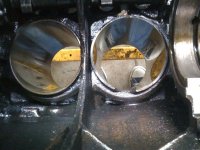
Got the crank and pistons out last night too. I think i'm going to have to replace the cylinder liners. Once I got the crank and pistons out, I was able to see a big chunk of the line for #2 missing where the liner extends past where it's pressed into the block.

This is turning into a total motor rebuild.
 
Unless you found that chunk or pieces of it in the pan, then PO probably installed it that way. Should be ok to continue to use it as long as bore is not tapered or scarred as there is no load on the liner at this point.
Others tell me if I'm wrong.
 
Any pictures Doug?
 
sorry for my tardy reply, had a lot on my plate recently.

I took a pic of the block since I've gotten it all torn down, number 2 cylinder liner is missing a chunk. I assume I"ll have to replace all 4 and new pistons.
 

Attachments

  • 19160.jpg
    19160.jpg
    60.8 KB · Views: 195
Like he said, is the piston skirt worn in that area?
If not, leave it alone.
If it is, and budget does not allow sleeves and slugs, pull that sleeve, rotate 90 degrees (if my foggy old gray cells serve me, the notches on the sides of the sleeves allow 90 degree rotation) and re-seal that sleeve.
The "chip" will then not be in a skirt contact area.
 
also if you use it chamfer the sharp inner edge and smooth it out to avoid any future piston scarring or cracking.
 
Look at it carefully to make sure there is no stress crack rising from the chip. It could come out in two pieces.
 
I'll check both tonight when I get home and send a pic of the piston. Thanks for the insight.
 
Back
Top