• Hey Guest!
    British Car Forum has been supporting enthusiasts for over 25 years by providing a great place to share our love for British cars. You can support our efforts by upgrading your membership for less than the dues of most car clubs. There are some perks with a member upgrade!

    **Upgrade Now**
    (PS: Upgraded members don't see this banner, nor will you see the Google ads that appear on the site.)
Tips
Tips

oil in my cylinder

doughairfield

Jedi Trainee
Offline
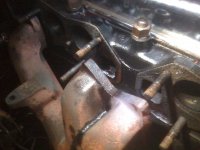
I was driving my TR4 last week, parked it over night, and all of a sudden noticed a loss of power the next morning and the idle dropped down pretty low. Once I got to work I opened up the hood and noticed oil seeping out of the exhaust/intake manifold area. Later I pulled the manifolds off and there is a bunch of oily sludge in the #3 exhaust port. I'm thinking maybe a piston ring came apart and oil is coming up into the cylinder?

Would a compression test be the next logical step to diagnose what the problem is? Any other suggestions would be most appreciated.
 

Attachments

  • 18719.jpg
    18719.jpg
    46.6 KB · Views: 986
Personally, I'd go ahead and pop the head off. The problem will be obvious once you can see inside. Broken piston seems more likely to me.
 
Yeah, I was pretty sure I'd have to pull the head at some point. I'll do it this weekend and see what I can find.
 
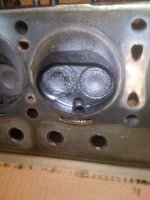
So I pulled the head and found a bunch of oil/carbon in the #3 cylinder. I'm thinking leaking valve guide?
 

Attachments

  • 18849.jpg
    18849.jpg
    48.4 KB · Views: 801
Could be bad rings as well. To test, rotate the engine until the piston is a the bottom of the stroke. Clean the cylinder walls. Crank the engine for 30 seconds and than check for oil on the cylinder walls. If there is oil on the walls you may have a ring problem, if not it is likely that the rings are OK. Before you crank the engine disconnect the low tension wire to the coil to eliminate sparks and cap off the fuel line so you don't pump gas all over.
 
Bad guides won't usually pass that much oil, unless you've added an external oil feed to the head or something.
 
hum, maybe bad head gasket then? I did find some coolant on the head when I removed the valve cover and some oil in the radiator.
 
When you pull the head it always manages to dump some coolant into each cylinder from the cooling jacket passage ways.
Now oil in the radiator would tend to indicate a blown gasket; did you take a look at it when you removed the head?
I think you've got ring/piston problems there; now you've got the head off why don't you just drop the pan (engine in situ) and pop that piston out to make sure, you're more than halfway there already. Let us know how you make out; if you need advice just holler.
 
It had a copper head gasket on there which did not appear to be torn, but there was not any evidence of a sealant or "compound" as they recommend in the repair manual. Should there have been? But that copper gasket very well could have been leaking oil into the cylinder.

My plan at this point is to pull the block out and put it on the stand and totally tear it down. In which case I'll find out if there's a bad ring in there. Then take the block and head to the machine shop to be cleaned up and the cylinder walls checked for to see how far outside tolerance and bored over if needed.

Question, are the studs in the block single use? Should I get new ones when I put the head back on?

Do you recommend using the copper head gasket again or the original one? I've also seen a steel one?
 
Go for Payen gaskets if ya can. Since you've decided to yank the engine and tear it down you'll likely find the offending bits easily.

As for th' studs, you can use the ones you have, but who knows how many times they've been pulled to torque?!? Go with new ones. Summit or TRF are two reliable places to get 'em.
 
Ok, I'll shoot for the Payen, do I need to put some Hylomar or something of the like on the gasket when I put it on? THere wasn't any on there when I took the head off, but the manual says to use some "compound".
 
Permatex has some stuff called High Tack in aerosol. It works. The Payen can be put on dry, tho.

Best to check the data sheet that comes with the gasket. I "film" them (the Payen ones) with oil, actually.... and taken heat for that from some. :shocked:
 
What does the top of the piston look like? The valves in the cylinder next to it are real clean. These have a lot of caking or judging by the exhaust valve, looks like something was bouncing around in the cylinder which could crack the piston. Or a ring came apart.
 
K & W Copper Coat in the spray can. Do not use Hylomar on a head gasket. When I worked at the Fairfax County garage we had to use a 10 foot pipe in the intake ports of a 428 CID police car to break the heads off in chunks after one of the folks used 3M weather strip adhesive on the head gaskets. The 3M caused the head gaskets to leak. 3M weather strip adhesive is wonderful when used as intended on gaskets. It dried too fast and is too strong for head gaskets.
 
Trying to follow this, but, not much chance of a head gasket leak allowing excess oil into the cylinders.

First, even the best oil pressure is lower than the worst compression, so you would blow your oil filter off first......(joke, son, just a joke)

If it was leaking into the combustion chamber when you stopped, well, oil pressure goes away almost as fast as compression when you turn the ignition to "off".

My experience on LBC's in the shops was valve guides and seals usually caused excess oil primarily, followed by pistons and rings.

We'd do 3 or 4 heads to one set of rings for oil-in-cylinder issues.

Just raving a bit.......

Back to your regulary scheduled programming.
 
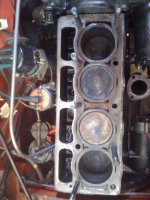
I grabbed a shot of the pistons, the number 3 piston has some pitting in it, not sure if you can see that from the picture. The rest seem to have some carbon build up. I'm going to pull the pistons out this weekend, I guess I'll find out then if rings are bad, but I'm still leaning towards some bad valve guides to leak that oil into the cylinder.
 

Attachments

  • 18921.jpg
    18921.jpg
    59.9 KB · Views: 675
Experience:

Once tha guides/seals start leaking, and when they foul a spark plug, the plug then does not cause combustion and the oil present does not burn off.

Your entire problem could be upper end.
If the rings are broken, you would see some marks on the cylinder wall.
What was the compression again before teardown?
And, what did the leakdown tell you?
 
I am thinking it is mostly upper end. What you described is what I think happened.
Oil was leaking into the cylinder, which became evident by it coming out of the exhaust port.
When I pulled the spark plug out, it was totally covered in oil, there was no way it could have fired.
I have not seen any signs of scuffing on the cylinder walls, but they are pretty smooth so getting them deglazed is probably in order.

I was not able to procure a leak down tester and once I knew I'd have to pull the head because of all the oil in the cylinder and in the radiator, I figured a compression check was somewhat pointless since I knew something in the head was leaking.

I should know something about the head this week, and I'm pulling the motor and gearbox out saturday and getting all that cleaned up. I'll keep you posted.
 
Back
Top