

-
 Hey Guest!
British Car Forum has been supporting enthusiasts for over 25 years by providing a great place to share our love for British cars. You can support our efforts by upgrading your membership for less than the dues of most car clubs. There are some perks with a member upgrade!**Upgrade Now**
(PS: Upgraded members don't see this banner, nor will you see the Google ads that appear on the site.)
You are using an out of date browser. It may not display this or other websites correctly.
You should upgrade or use an alternative browser.
You should upgrade or use an alternative browser.
oil change and starting
- Thread starter sp53
- Start date

TR6oldtimer
Darth Vader
Offline
/bcforum/images/%%GRAEMLIN_URL%%/nonod.gifBrosky said:If it does, it will not last long. The oil will thin very quickly upon warm up and that will end that illusion.
Sorry Paul, but actually a 20w-50 engine oil will increase it's viscosity as it heats up. Over time the additive that causes viscosity to increase with temperature will break down and the oil's viscosity at temperature will begin to decrease.

TR6oldtimer said:/bcforum/images/%%GRAEMLIN_URL%%/nonod.gifBrosky said:If it does, it will not last long. The oil will thin very quickly upon warm up and that will end that illusion.
Sorry Paul, but actually a 20w-50 engine oil will increase it's viscosity as it heats up. Over time the additive that causes viscosity to increase with temperature will break down and the oil's viscosity at temperature will begin to decrease.
Umm not quite. oil viscosity indexes are related to oil temperature. For a single wt oil it is intuitive that the oil will be thinner as it heats up.
For a multi wt oil, at low temperatures, it will approximately as the lower viscosity # but as it heats us it will act like the higher viscosity# however since viscosity of oil is affected by temperature, the actual viscosity of the oil will be lower at the high temperature, it just won't loose quite as much viscosity as a single wt oil would have.
No, but there is a huge snake oil industry which would like you to think so.sp53 said:when the oil is newly changed does the engine have better compression and will the engines actually start better? It just seems to me to be this way, so I thought I would ask the forum. Thanks in advance.
Sp53


Offline
I agree.70herald said:TR6oldtimer said:/bcforum/images/%%GRAEMLIN_URL%%/nonod.gifBrosky said:If it does, it will not last long. The oil will thin very quickly upon warm up and that will end that illusion.
Sorry Paul, but actually a 20w-50 engine oil will increase it's viscosity as it heats up. Over time the additive that causes viscosity to increase with temperature will break down and the oil's viscosity at temperature will begin to decrease.
Umm not quite. oil viscosity indexes are related to oil temperature. For a single wt oil it is intuitive that the oil will be thinner as it heats up.
For a multi wt oil, at low temperatures, it will approximately as the lower viscosity # but as it heats us it will act like the higher viscosity# however since viscosity of oil is affected by temperature, the actual viscosity of the oil will be lower at the high temperature, it just won't loose quite as much viscosity as a single wt oil would have.
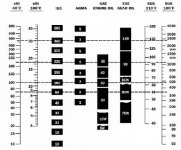
See the attached chart.
An SAE 20 oil at 100F will have a viscosity of about 350 SUS. At 210F it will be around 55 SUS.
A SAE 50 oil at 100F will have a viscosity of about 1050 SUS. At 210F it will be around 92 SUS.
A SAE 20-50 oil at 100F will have a viscosity of about 350 SUS. At 210F it will be around 92 SUS.
Note that gear oils are rated differently. A SAE 90 gear oil is actually quite close in viscosity to a SAE 50 engine oil.
D
Attachments
TR6oldtimer
Darth Vader
Offline
'I are a rock sometimes'.
Of course oils become less viscus when heated. What I really ment to say is that over time motor oils lose their ability to maintain rated viscosity. So in our cars old oil would be less viscous at operating temperature then new. (However, some oils will actually go the other way and increase in viscosity due to sludging.)
As to whether one would notice a change in performance after an oil change I guess would depend on how old the oil was, or more likely it is just the feel good thing of doing it.
Of course oils become less viscus when heated. What I really ment to say is that over time motor oils lose their ability to maintain rated viscosity. So in our cars old oil would be less viscous at operating temperature then new. (However, some oils will actually go the other way and increase in viscosity due to sludging.)
As to whether one would notice a change in performance after an oil change I guess would depend on how old the oil was, or more likely it is just the feel good thing of doing it.

Brosky
Great Pumpkin
Offline
I just wanted to stir up a discussion and it looks like I was successful. Thanks, I did learn somethings about the heat / viscosity factors that I did not know.
Besides, everyone knows that to raise compression over one point you would have to not only wash, but wax the car as well. This after an oil change, of course!
Besides, everyone knows that to raise compression over one point you would have to not only wash, but wax the car as well. This after an oil change, of course!