• Hi Guest!
    If you appreciate British Car Forum and our 25 years of supporting British car enthusiasts with technical and anicdotal information, collected from our thousands of great members, please support us with a low-cost subscription. You can become a supporting member for less than the dues of most car clubs.

    There are some perks with a member upgrade!
    **Upgrade Now**
    (PS: Subscribers don't see this gawd-aweful banner
Tips
Tips

OH, Doc....

tony barnhill

Great Pumpkin - R.I.P
Offline

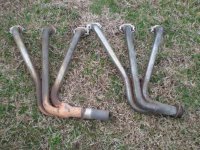
Recognize these?
 

Attachments

  • 10106.jpg
    10106.jpg
    52.1 KB · Views: 445
What have you gone and done now? Lotus stuff?
 
No, they're MGB....but possibly something special...I know the one on the right will end up on my race car!
 
OK - this has always bothered me about MG exhaust: I think I can understand #2 and #3 exhaust ports being joined, but how come the tubing size for their common pipe isn't larger than the other two? What law of physics did I miss while I was snoozing? (OK, so I never even TOOK physics!)
 
Think about which exhaust valves are working when, Mickey...
 
OK - I got that.

But then why aren't ALL exhaust manifolds like that?

And so much attention is made to equal length/diameter tubing for each cylinder. How come?
 
Length is very important to tune the exhaust pipe for max performance when the pipes are open ie got to the sides like in a drag car. Not so important when they go into an exhaust pipe.

Size is important for performance as well. They need to be free flowing but also provide a bit of back pressure.

Now as to what is magic, I would expect only a dyno could say for sure. But the old time test on length is run em long and cut em where they start to turn black from the burning exhaust. ie the flame you see from dragsters.
 
&, Jack, if you look at those 2, they're all 'blued' at the same spot towards the bottom of the runs where they tie into the collector.
 
OK, thanks, guys - I'm gonna do some more research on this.

In the meantime, if you want to know anything about the theology of vicarious atonement... :jester:
 
Aw, Mickey - you're talking to an old altar boy here....

Okay,the theory of atonement showed Jesus as the winner in the struggle with the devil over the rights for the human soul but in early Church theology, the emphasis shifted from the divine side of Jesus to his human side & the need for that side to reconcile man to God after he'd beaten the devil...that theory, called "vicarious atonement" (if I remember those lessons) was: because humans sinned of their own free will, only humans can repay to God the debt they incurred because of their willful disobedience; but only God can make the satisfactory conditions to repay it....so, God had to send the God/man, Jesus the Christ, to satisfy both conditions.

Wouldn't that old priest be happy now? & the nuns whacking their rulers across little palms? They'd probably be shocked I wasn't always sneaking wine after communion but was actually listening!

But, you'd think a priest would understand physics...I mean, the Bible's full of examples!
 
Physics I got...

Four holes and three pipes.........
 
Well, was my answer acceptable?
 
As I remember from our by gone racing days, a good header design will have a savaging effect, whereas the flow from the "hot" pipe will assist pulling gases from the other pipes creating a smoother flow in the system and less back pressure. Theoretically, all pipes should be of equal length also, but that's rarely the case.
 
Hooker had a three bolt collector flange, solidly mounted.

We'll talk, Tony. :laugh:
 
DrEntropy said:
Hooker had a three bolt collector flange, solidly mounted.

We'll talk, Tony. :laugh:
The one of the right that I'm keeping still has that...somebody took it off the one on the left...wouldn't be hard for a muffler shop to reinstall.
 
tony barnhill said:
Well, was my answer acceptable?

Pretty much...

Kinda like the three pipes/four holes hypothesis. :confuse:
 
Tony,

<div class="ubbcode-block"><div class="ubbcode-header">Quote:]Well, was my answer acceptable? [/QUOTE]

ABSOLUTELY....

I know that through the propiciation of my sins by Jesus Christ, I will be forgiven for all of the swearing and evil thoughts that I lavish upon my LBCs... :yesnod:
 
I once had a long talk with David Vizard about MGB headers and exhaust flow. The "factory " headers (special tuning) were Long Center Branch, just like the stock cast iron manifolds. The pipe for cyls 2 and 3 needs to be twice as long as 1 and 4. That pipe has to move twice as much gas, and the way the flow works, with the pulses as the exhaust cycle happens, requires the longer center pipe. This is why 1 and 4 join together fairly soon, and the center pipe did not join until the actual collector. I asked directly about whether or not an LCB header gave a measurable performance gain over the stock LCB cast iron part, and he said except for weight , no. This came from someone that wrote books and dyno tested a lot of A and B series performance parts. FWIW, my 2cents worth.
 
Jesse

The amount may be very insignificant for a stock engine, but I believe on a mod engine it is definately greater depending on Camshaft (valve timing overlap) etc., etc. etc. variables.

Pat
 
jessebogan said:
I once had a long talk with David Vizard about MGB headers and exhaust flow. The "factory " headers (special tuning) were Long Center Branch, just like the stock cast iron manifolds. The pipe for cyls 2 and 3 needs to be twice as long as 1 and 4. That pipe has to move twice as much gas, and the way the flow works, with the pulses as the exhaust cycle happens, requires the longer center pipe.
Hmmm....... :angel:
 
Back
Top
