• Hey Guest!
    British Car Forum has been supporting enthusiasts for over 25 years by providing a great place to share our love for British cars. You can support our efforts by upgrading your membership for less than the dues of most car clubs. There are some perks with a member upgrade!

    **Upgrade Now**
    (PS: Upgraded members don't see this banner, nor will you see the Google ads that appear on the site.)
Tips
Tips

Off my rocker

M

Member 10617

Guest
Guest
Offline
I know how to adjust the valves on my Triumph, but I am learning that there is another aspect to this maintenance that I know nothing about: adjusting the rockers themselves.

Someone mentioned to me that one or more of my rockers may be "too tight." I assume this means that the rockers are binding as they travel up and down. (Sorry for the non-technical description.)

How does one judge if a rocker is "too tight"? And if so, how does one adjust it?

My manuals cover rocker clearance adjustment, but are silent on this other aspect of the problem.
 
These are not, in the classic sense, adjustable. i.e. there's no screw to turn. One has to ream the bushings, that ride on the rocker shaft, to the proper diameter before installing them. Then, they will be neither too tight, nor too loose, on the shaft. It's like fitting your pistons, or rings, or crank bearings. One does it before motor assembly, and hopes for good, long wear.

If, when the motor is hot, you cant easily move a rocker on the shaft, it's too tight.

I suppose it's time to ask, what symptom is making you ask this?
 
And if there is no lash because the valve is open or partially open don't expect to be able to rock the rocker
 
The symptom that the mechanic described to me was: "the valve is making too much noise."

Before he worked on it, I did hear a lot of valve tapping/chatter. After he "fixed" it (whatever he did), that tapping/chatter was significantly reduced.

Another mystery...

Have a GREAT THANKSGIVING. I hope I fit in the cockpit of my car after Thursday's meal!
 
I can recharge your lightening rods...for a small fee!!

John

(IMHO he just went a little tighter on the clearances)
 
Looking back at the statement the mechanic gave me when the work was done, I now see that he listed: "adjusted valve lash."
 
This person who mentioned to you that your rockers were too tight...what did he base that statement on ?
Was it because your valves were no longer "...making too much noise" ?
 
Poolboy,

Actually, what he said was: my valve(s) were "making too much noise." To fix this, he "adjusted valve lash."
 
Yeah, I got that,Ed, but what I was asking about was what you said opening this topic. You said "Someone mentioned to me that one or more of my rockers may be "too tight.".
My question is what did that person base that on. Was it because your valves were just too quiet due to the mechanic reducing the lash ?
I really would hate to think that your mechanic decreased the lash solely because they were perceived as being too noisy.

Give me a noisy valve train with the correct lash over a quiet valve train with inadequate lash any day.

You say you know how to adjust the valves, right ?
You should then.
That way you can not only determine if they are gapped to spec, noise be damned, and at the same time determine if the rocker is fitting properly on the rocker shaft. Put an end to the speculation and find out for youself.
 
Hi, Poolboy,

The mechanic (the "someone" I mentioned above) based his statement that one or more of my rockers may be "too tight" on the judgment that the valves were making a lot of noise. At least that is how I heard him.

This mechanic then "adjusted the valve lash." After that, the valves made less noise. The engine is not quiet, however, as the valve train goes tap, tap, tap... when it is running, just not as loud as before.

As for adjusting the valves, that is just what I am about to do, but first I had to ask about "too tight" valves and how I would know they were "too tight"and if "too tight" then what to do about them. Turns out, if they are "too tigh"t,"there is nothing I can do short of having the engine torn apart, which is not in the plan.

My plan for the winter months is to (1) adjust the valves, (2) adjust the timing, (3) rebuild and properly adjust the carburetors. Right now I am just assembling the information I will need.

I have heard people say that they prefer a "noisy valve train with the correct lash over a quiet valve train with inadequate lash." This is why it peaked my interest when the mechanic said something in the valve train was "too loud.""

In the meanwhile, I'm adding up my annual miles with great drives. My limit -- Virginia law for äntique plated cars -- is 4000 miles. And I am just about there. On the highway, when not at idle, the car runs like a new car.
 
Ed,

If the lash is "too tight", that just means the adjusting screw needs to be backed out a bit. It is a serious problem in that driving that way can lead to burned valves, but the adjustment to correct the problem is trivial.

These engines do make a fair amount of valve noise, they are not perfectly quiet when properly adjusted. The noise will be much less from the driver's seat (and partially obscured by the exhaust noise), but still audible. The noise is typical of solid lifter engines; engines that don't make valve noise generally have some form of hydraulic lifter (which dynamically adjusts the valve lash to nearly zero).

One thing to watch for, some sources say to set the TR exhaust valves to .012". That value is only for early TR2s that still have the cast iron rocker pedestals installed. Your TR3A will have the aluminum rocker pedestals, which means both exhaust and intake valves should be set to .010" (assuming you have the stock camshaft, some aftermarket camshafts take more).
 
I thought you started this whole confusing thread, Ed, by asking about the rockers being "too tight" which is a whole entire matter different from what you say here:
"As for adjusting the valves, that is just what I am about to do, but first I had to ask about "too tight" valves and how I would know they were "too tight"and if "too tight" then what to do about them. Turns out, if they are "too tigh"t,"there is nothing I can do short of having the engine torn apart, which is not in the plan"
:crazy: Now you're talking about valves being too tight... Valves are not rockers and personally I don't follow how they got dragged into this.
When you set the "lash/gap/ clearance" on a particular rocker arm to the valve stem, the rocker arm should be free to rock within the space determined by that lash.
Widen the gap as much as you want to see if the rocker arm is able to rock on the rocker shaft, but when you set the lash use your feeler gauge to get it into the specified "gap/lash/clearance" that Randall's talking about.
Pretty basic stuff we're talking here, Ed.
Maybe you should just bring it into the mechanic and observe the goings on. That might be the best way to learn without endangering your engine. Bring your manual and follow along.
 
Poolboy,

What we have here is failure to communicate...

As for rockers, I have read that when the engine is warm, the rocker should wiggle up and down a bit. If it doesn't, then it is "too tight." When my mechanic mentioned to me that he adjusted the valve lash because the valve was "too tight," and because rockers work with valves, I wondered if perhaps he was also referring to the rocker. At any rate, I have no intention of doing anything to the rockers. My only aim is to get the valve gap (a.k.a. rocker arm clearance) right. Pretty basic stuff, as you say.

We novices depend on you experienced guys to help us maneuver through these mysteries. And, let me say that I am very appreciative of your taking time to straighten me out.

Randall,

It appears that my mechanic may have done just what you suggest: he probably backed out the adjusting screw. The reason he gave for doing this -- not something I had asked him to do -- was that he felt that the valve was "too tight." Perhaps he should have expressed it to me differently.

When the mechanic adjusted the valves about a year ago, he set the intake and exhaust valves at .010. A month or so later, I checked the valves and they were at .010. When I work on the car again this winter, I'll double check the gaps. Thanks for the warning about .012 on the exhaust valves.
 
Confusion more than failure.
Your first post is all about the possibility of "binding" rocker arms and that's the tack I was taking.
 
Poolboy,

Thanks to you guys, I am slowly sorting all this out in my mind (and, indeed, it is confused when it comes to some of these technical matters).
 
Try not to make this stuff too complicated. Valve lash too tight= BAD! Loss of power and possibly burnt valves. Too loose= not as critical. Unless off by a mile,it will increase valve train noise.TR2s with original painted valve covers are usually more noisy than TR3s with chromed covers. Triumph made the chrome covers of heavier gauge metal to reduce valve train noise. Remember these are tractor motors. Big lawn mowers come to mind.
 
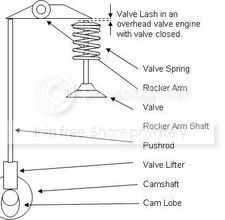
Just to make certain I understand: Can someone give me a quick definition of "valve lash." It's a term used a lot. Is "valve lash" something one sets or corrects by setting the rocker arm/valve stem clearance correctly?
 
Valve Lash or Valve Clearance is the gap between the Rocker Arms and the valve tappet. This clearance must be tightly controlled. If it is too little, the valves may not seat properly. If it is too much, you create valve train noise, and excess load on the valves and valve train components.

As the picture shows below, valve lash basically cuts off the lower portion of the cam profile. This lower section is where the cam profile is designed to gently open and close the valve. If you have too much valve lash, you eliminate the more "gentle" sections and are basically "slamming" the valve open and closed.

No way to load the picture///
 
I'm going to use the terms you used and not introduce the term "valve tappet"
Yes,Ed you have described it as I would. You stick the feeler gauge into this gap that exist between the top of the valve stem and the tip of the rocker arm when the valve is closed. That's how you measure the lash.
If you alter the gap, you have set the lash or adjusted the valves, whichever term you use we'll know what you mean.
_valve-lash-800x800.jpg
 
TR3aguy and Poolboy,

Great information. As you can tell, I'm very curious about how all this stuff works, in addition to how you fix it or improve it. Your explanation and illustrations have cleared up this mystery for me.

Many, many thanks.

Keep on TRing....
 
Back
Top