

-
 Hey Guest!
British Car Forum has been supporting enthusiasts for over 25 years by providing a great place to share our love for British cars. You can support our efforts by upgrading your membership for less than the dues of most car clubs. There are some perks with a member upgrade!**Upgrade Now**
(PS: Upgraded members don't see this banner, nor will you see the Google ads that appear on the site.)
You are using an out of date browser. It may not display this or other websites correctly.
You should upgrade or use an alternative browser.
You should upgrade or use an alternative browser.
new CV half shafts
- Thread starter hondo402000
- Start date
OP

hondo402000
Darth Vader
Offline
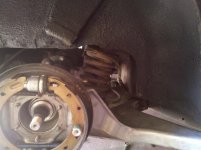
here is a pic during the reinstall process, all finished now, took the 6 out for a spin last night, no more TR6 Twitch, runs nice, quiet, and its faster, well maybe mentally another project comes together thanks Brosky let me know when your package arrives
Hondo
Hondo
Attachments
OP
hondo402000
Darth Vader
Offline
Don I am thinking about that one too, I dont want to do it all at once, my next project around thanksgiving is pulling the engine and having it rebuilt and bring it up to about 160 HP to smoke those rice burners,
Hondo
Hondo
OP
hondo402000
Darth Vader
Offline
I am also waiting on Brosky to do it so I can read his great detailed instructions on How to do it, thats why it only took me by mself, except for my hot girl friend bring me a cold beer, only about 8 hours to do it including smoothing out the trailing arms and soda blasting them
Hondo
Hondo


Offline
I'd like to know how you decide between the new CVs the uprated sliding axles with the heavy duty U-Joints. I note Goodparts offers both.
Also, I don't understand how smoothing out and polishing the trailing arms could really be doing much to strengthen anything?? I'm curious what physics would be at work there.
I'd sure like to see the pics of the CVs installed.
thx
Also, I don't understand how smoothing out and polishing the trailing arms could really be doing much to strengthen anything?? I'm curious what physics would be at work there.
I'd sure like to see the pics of the CVs installed.
thx

BobbyD
Jedi Knight
Offline
I was all set to order the GP uprated hubs/axles when Richard emailed me to tell me about his new CVJs. The price difference was such that the CVJs were a no brainer.
Between the documentation on my site
and
the documentation on Paul's site, no one should be afraid to tackle this job.
But everyone should first do the TA stud repair using Rick Patton's TA Repair Kit. This is a must do repair for everyone that is simple and fool proof to do.
Between the documentation on my site
and
the documentation on Paul's site, no one should be afraid to tackle this job.
But everyone should first do the TA stud repair using Rick Patton's TA Repair Kit. This is a must do repair for everyone that is simple and fool proof to do.
OP
hondo402000
Darth Vader
Offline
by smoothing out the casting flash and blending out nicks and sharp corners, you remove stress risers. a stress riser is a local area in a part that if the part is under stress a crack can form at that area and cause the part to fail. so removing stress risers make the part less likely to fail. If you have Roger williams how to improve book look on page 23, those areas at a minimum need to be smoothed out
BobbyD
Jedi Knight
Offline
KVH said:That really is awesome. Great links.
Where do you get those flexible brake lines I see there?
Spend a hour or two poking through Paul's and my site.........lots of good stuff posted there.
The brake lines are from one of the best kept secrets for Triumph parts... Ted Schumacher of TSI has been a Triumph racer, part supplier and enthusiast for over 30 years and is one of the most knowledgeable guys in the business. His prices are competitive and if you don't see something on his site, call and ask. Besides new parts, he also has a lot of rebuilt stuff. I rebuilt my whole brake system using new (pads, shoes & hoses) and rebuilt (calipers & servo) parts from Ted.
Offline
If I decide to replace the studs using KeenSerts, and if 3/8 is too big, what is the correct size? 5/16?
Also, in re-reading all the posts on this, I note the belief among some that if the studs aren't showing a problem, maybe best not to start one. Along those lines, I could imagine trying to back a few out, and finding them frozen, or perhaps breaking one off, then creating a real problem.
I'm tempted to just replace them, but I do see both sides of that issue.
Also, in re-reading all the posts on this, I note the belief among some that if the studs aren't showing a problem, maybe best not to start one. Along those lines, I could imagine trying to back a few out, and finding them frozen, or perhaps breaking one off, then creating a real problem.
I'm tempted to just replace them, but I do see both sides of that issue.
OP
hondo402000
Darth Vader
Offline
I only had one that had a helicoil in it, all others were in pretty well and not stripped out but the main issue is that Triumph Tapped the holes with a fine thread and what I have read is it should have been a coarse thread in the Aluminum for more holding power, that why the recommendation is to drill out the holes and use the 14 Thread per inch keenserts on the outside and the fine threaded inside so you still use the original studs.
Hondo
Hondo

Brosky
Great Pumpkin
Offline
<div class="ubbcode-block"><div class="ubbcode-header">Quote:]I'm tempted to just replace them, but I do see both sides of that issue.[/QUOTE]
JMHO, but the potential for improvement and avoiding any future issues far outweigh the effort to install them.
These cars are getting older and any opportunity to improve on known potential weaknesses should be taken, if at all possible.
JMHO, but the potential for improvement and avoiding any future issues far outweigh the effort to install them.
These cars are getting older and any opportunity to improve on known potential weaknesses should be taken, if at all possible.

DNK
Great Pumpkin
Offline
Brosky said:...These cars are getting older and any opportunity to improve on know potential known weaknesses should be taken, if at all possible.
My wife said that of me just last week
Offline
Back again.
OKAY, so the original axles were sliding ones which allow considerable play around corners and over bumps in the road.
How much play and give do the CV axles have? Will they be more harsh on the frame and other parts?
I would think the CVs should have the same play and movement, but I'd like to know what others say.
thx
OKAY, so the original axles were sliding ones which allow considerable play around corners and over bumps in the road.
How much play and give do the CV axles have? Will they be more harsh on the frame and other parts?
I would think the CVs should have the same play and movement, but I'd like to know what others say.
thx
OP
hondo402000
Darth Vader
Offline
I am not sure if they have the same amount of play or sliding in and out compared to the originals but there are instruction with the CV axles and you do a couple of checks to make sure you have whats call reserve. basically when the trailing arm is at full extension like when you jack the car up that the joint doesnt slide out of its coupling and full compression like when trailing arm hits the upper rubber bumper the sliding joint doesnt bottom out before full compression on the trailing arm, on the CV axles the in and out action happens in the black housing that mounts to the differential see pauls web site. the outboard joint only swivles for lack of correct terminology. hope this helps
Hondo
Hondo
R
RonMacPherson
Guest
Guest
Offline
Both the rzeppa and the tripost bearing design constant velocity joints are improvements on the old design... Lots better as far as friction transfer, not wasting energy and have full movement... Only concern is the sizing of the joint for the application and maintaing the veracity of the boots, so that road detritus does not get in the joint and contaminate it.